The Agentic Service Bus: A New Architecture for Inter-Agent Communication
As enterprises deploy more AI agents across their operations, a critical infrastructure challenge is emerging: how should these agents communicate with each other? The answer may reshape enterprise architecture as profoundly as the original service bus did two decades ago.
The Chat Trap
Picture this scenario: A Customer Service Agent determines that a customer's refund request is valid. Now it needs to instruct the Logistics Agent to generate a return shipping label. Simple enough, right?
In most current multi-agent implementations, this handoff happens in natural language. The Customer Service Agent essentially writes a message: "Hey, Logic-bot, can you please generate a return label for Order #123 because the customer is unhappy?"
This approach has three serious problems.
Token consumption. Every word costs money. When you multiply casual inter-agent chatter across thousands of daily transactions, the costs become substantial. We are essentially paying for our AI agents to be polite to each other.
Latency. Natural language generation takes time. The receiving agent must then parse and interpret that language, adding more processing cycles. For high-volume operations, these milliseconds compound into real performance degradation.
Ambiguity. What if the Logistics Agent responds with "I'm not sure I understand the tone" or asks for clarification about what "super upset" means for its decision logic? Natural language invites misinterpretation.
Here is the core insight: we don't communicate with APIs in English. When your inventory system queries your ERP, it doesn't send a friendly note asking for stock levels. It sends a structured request with defined parameters and expects a structured response. Why should agent-to-agent communication be any different for high-volume transactions?
The M2M Economy and the Limits of MCP
In December 2025, I wrote about the Model Context Protocol (MCP), which solved an important problem: how do agents connect to data sources like files, databases, and local servers? MCP provided a standardized way for AI agents to retrieve context from their environment.
But MCP addresses context retrieval, not inter-agent transactions. It helps agents read; it doesn't define how agents should act together. As we move toward a Machine-to-Machine (M2M) economy where autonomous agents handle increasingly complex business processes, we need something more: a protocol for doing, not just reading.
Agents need shorthand. They need to execute transactions without re-negotiating the rules of engagement every single time.
Standardized Intents: The Lingua Franca of the Machine Workforce
If we allow agents to chat in natural language, we invite the Tower of Babel problem into our infrastructure. One agent might call it a "refund," another a "credit reversal," and a third a "negative transaction adjustment." This ambiguity is the enemy of reliable automation.
To build a robust Agentic Service Bus (ASB), we must decouple Reasoning from Signaling.
Think in English, Speak in Structs
An agent should use its LLM brain to decide what to do. This internal reasoning can absolutely be in natural language. But when it communicates that decision to another agent or system, it must use a rigid, pre-defined protocol.
We call these signals Standardized Intents.
The Intent Dictionary
Just as microservices rely on API contracts, your agent ecosystem needs what we call an Intent Dictionary. This is a centralized registry that defines every valid action an agent can request.
Why does this matter?
Deterministic handoffs. The receiving agent doesn't need to interpret tone or parse a paragraph. It receives a command it knows exactly how to execute.
Reduced hallucinations. By forcing the sending agent to fit its request into a strict schema, you catch errors before the message ever leaves. If the LLM generates a parameter that doesn't fit the expected format, the request fails locally and can retry, rather than confusing the downstream agent.
Type safety for operations. You can enforce constraints. A refund amount must be numeric and cannot exceed a certain threshold. A shipping tier must be one of a defined set of options.
Visualizing the Difference
Let's return to our Customer Service to Logistics handoff to see this in practice.
The Chat Trap approach: The CS Agent sends something like: "Hey, can you help me out? The customer for order #10249 is super upset about the delay. I promised them a return label. Can you generate one? Also, maybe expedite it?"
The Logistics Agent now faces interpretation challenges. What does "super upset" imply for prioritization? Does "expedite" mean overnight shipping or just priority processing?
The Standardized Intent approach: The CS Agent reasons internally that the customer is upset and decides a return is warranted. It then looks up the appropriate intent schema and constructs a structured message with explicit fields: order ID, reason code (such as DELAY_COMPENSATION), shipping tier (EXPEDITED_OVERNIGHT), and any required authorization tokens.
The Logistics Agent receives this structured payload. It doesn't need to "read." It parses the shipping tier field and executes immediately. No ambiguity, no wasted tokens on pleasantries, no risk of misinterpretation.
The Guard Layer
For IT leaders, implementing this requires what we call a "Guard" layer at the edge of your agents. This layer validates every outgoing message against the Intent Dictionary's schema before it's transmitted. Invalid messages are caught and retried locally, never reaching the downstream agent.
This approach transforms your multi-agent system from a chaotic chat room into a synchronized, type-safe distributed computing environment.
The ESB Reborn: Middleware for the Agent Age
We often discuss Agent-to-Agent (A2A) communication as a behavior, the ability for agents to collaborate. But in the enterprise, A2A needs architecture.
Without a central nervous system, A2A becomes noise. We are witnessing the return of the Enterprise Service Bus concept, not as the heavy, XML-laden monolith of the 2000s, but as a lightweight, high-speed traffic controller designed specifically for the M2M economy.
The A2A Reality Check: Unmanaged vs. Managed
Before we build the bus, we need to understand the traffic.
Unmanaged A2A is what most demonstrations show today: Agent A chatting naturally with Agent B. This "Wild West" approach carries serious risks including infinite token loops, ambiguity, prompt injection propagation (where one compromised agent infects another), and zero auditability. It is shadow IT on steroids.
Managed A2A is where the Agentic Service Bus enters the picture. It treats agent communication not as chat but as routed transactions. It transforms A2A from a feature into a system.
Two Modes of Interaction: Soft vs. Hard A2A
The ASB must handle two distinct types of agent interaction.
Soft A2A (Negotiation) applies when genuine ambiguity exists, such as evaluating whether a claim constitutes fraud. In these cases, the ASB acts as a secure tunnel for LLM-to-LLM reasoning, logging the conversation for compliance purposes.
Hard A2A (Execution) applies when a decision has been made and needs to be acted upon, such as paying an approved claim. Here, the ASB enforces Standardized Intents. It blocks natural language and demands a rigid structured payload, ensuring the downstream Finance Agent receives exactly what it needs to execute.
The Four Pillars of the Agentic Service Bus
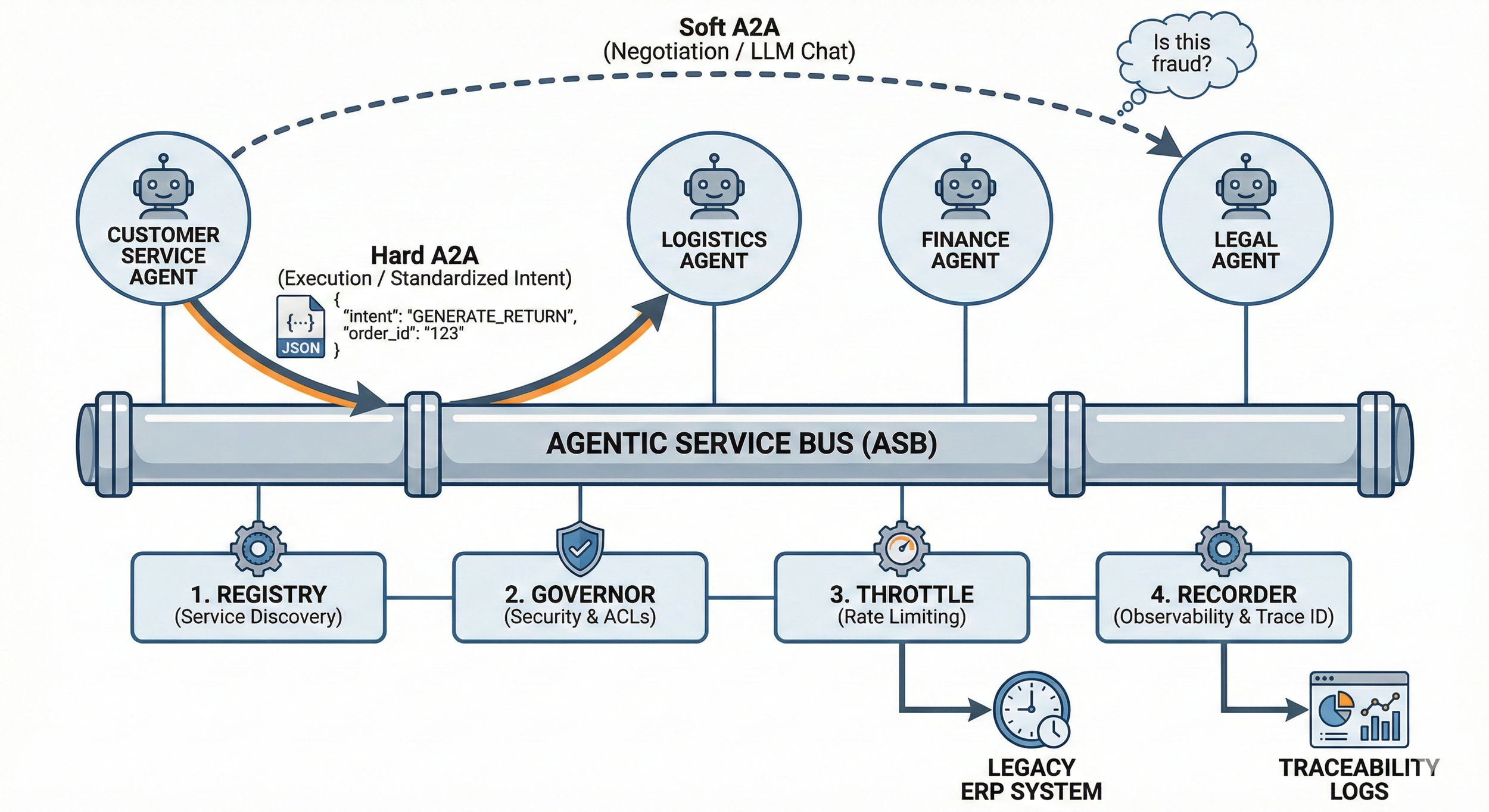
Created with Google Nano Banana Pro
If agents are the "employees," the ASB is the office manager, security guard, and compliance officer rolled into one.
1. The Registry (Service Discovery)
In a fleet of hundreds of agents, a Sales Agent doesn't inherently know the network location of the EMEA Inventory Agent. The ASB maintains a dynamic registry. The Sales Agent broadcasts an intent to check stock, and the ASB routes it to the correct agent based on metadata like region or capability.
2. The Governor (Security and Access Controls)
Agents are eager to help, sometimes too eager. A Social Media Agent might attempt to query the Payroll Agent to answer a user's salary question. The ASB enforces strict Access Control Lists, checking every intent against a permission matrix. Does Agent X have the role required to invoke Intent Y? If not, the bus terminates the request before it ever reaches the target.
3. The Throttle (Rate Limiting and Traffic Control)
Agents operate at silicon speed. A Reconciliation Agent discovering errors could spawn thousands of correction requests in seconds, inadvertently overwhelming your legacy ERP system. The ASB enforces semantic rate limits, perhaps allowing only a certain number of correction requests per minute. It queues the rest, ensuring that legacy systems can keep pace with the faster agents.
4. The Recorder (Observability and Traceability)
When something goes wrong in a chain of five agents, debugging a pile of chat logs is a nightmare. The ASB provides distributed tracing. Every intent is stamped with a unique trace identifier. You can visualize the entire flow from input through each agent to output, knowing exactly which link in the chain failed.
Why Middleware is No Longer a Dirty Word
For the last decade, the industry tried to eliminate middleware in favor of direct API connections. But agents are too dynamic, too unpredictable, and too numerous for point-to-point architecture. To scale A2A, we must embrace the bus.
Building Your Inter-Agent Strategy
This architecture forms the backbone of what we call a true System of Agency. It transforms scattered "toy" agents into a cohesive enterprise workforce.
The roadmap for IT leaders involves three phases.
Identify which agents need to communicate with each other. Map the transaction flows.
Define the Intent Dictionary. Create the API contracts that will govern agent-to-agent communication.
Orchestrate by implementing the ASB layer to manage traffic, security, and observability.
The future isn't just smarter models; it's smarter plumbing. The companies that solve inter-agent communication today will dominate the M2M economy tomorrow.
Key Takeaways
English for humans, protocols for agents. Don't let your bots rack up bills chatting politely with each other.
Structure prevents errors. Standardized intents stop agents from hallucinating during handoffs.
Middleware has returned. You need a traffic controller for your AI workforce.