Orchestrating the Hybrid Workforce, Part 2: The Orchestration Architecture
This is the second article in a 10-part series exploring AI orchestration and the hybrid workforce. Each article examines a critical dimension of how organizations coordinate multi-agent AI systems alongside human teams and includes an "Orchestration Playbook" section with actionable guidance.
Three Layers, One Problem
In Part 1 of this series, we defined orchestration as the discipline of coordinating intelligent systems, both human and artificial, toward business outcomes. We made the case that orchestration has two inseparable dimensions: how agents coordinate with each other and how humans work alongside agent teams.
Now we need to get specific about architecture. When organizations say they need "orchestration," what exactly are they building?
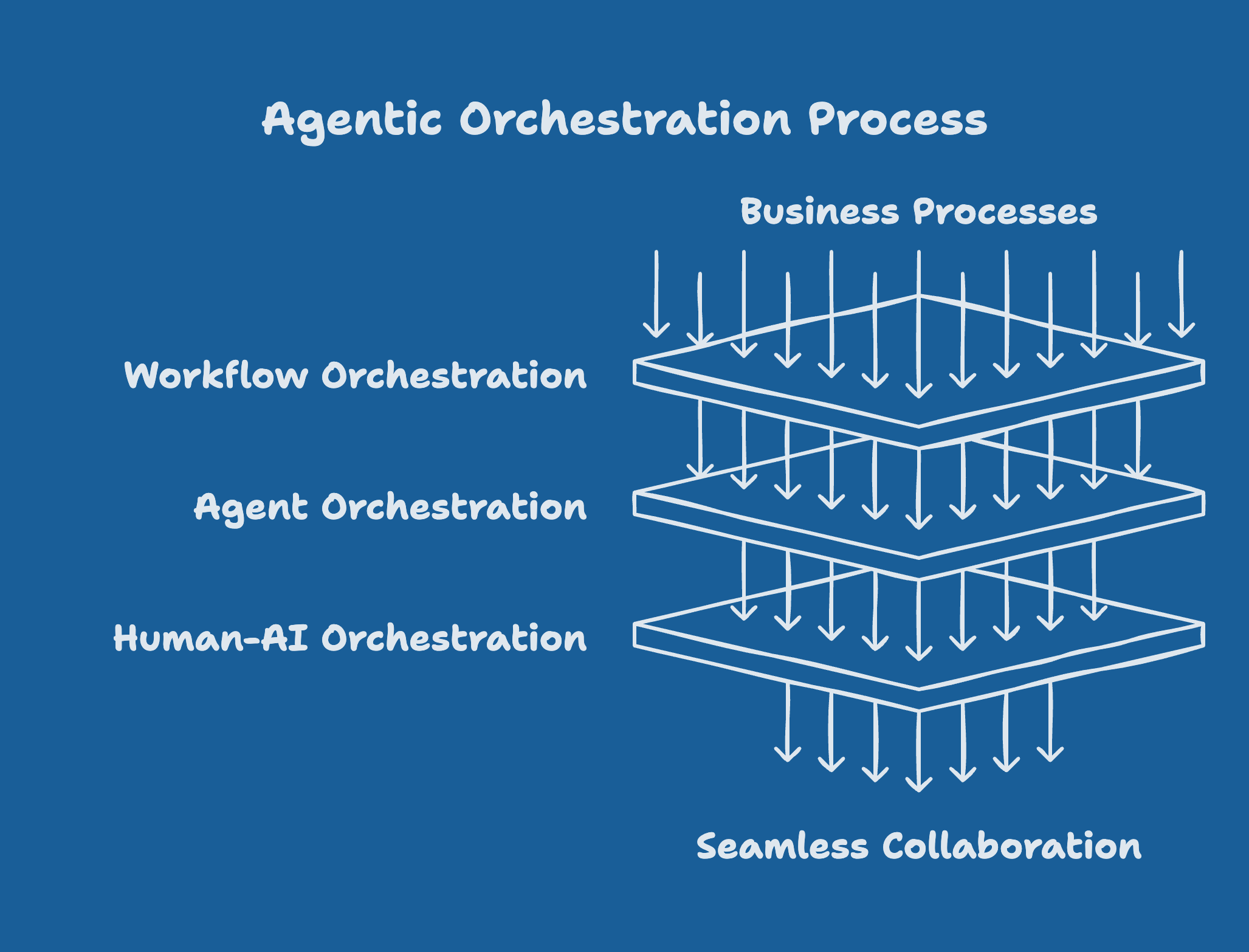
The answer involves three distinct but interconnected layers, each with its own history, vendor ecosystem, and maturity curve. Workflow orchestration coordinates business processes across systems, teams, and handoffs. Agent orchestration manages how multiple AI agents share context, divide tasks, and hand off work. Human-AI orchestration governs how human judgment, oversight, and collaboration integrate with agent workflows.
These layers are not independent. A customer onboarding workflow (layer one) might involve an identity verification agent handing off to a credit assessment agent handing off to a provisioning agent (layer two), with a human compliance officer reviewing flagged cases and a relationship manager personalizing the welcome experience (layer three). The orchestration architecture must coordinate all three layers simultaneously. Organizations that invest in one layer while ignoring the others will find themselves rebuilding.
Understanding these layers, how they interact, and where the market is heading is essential for making sound technology and organizational decisions.
Agentic Orchestration
Layer One: Workflow Orchestration
Workflow orchestration has the longest history of the three layers. Business process management (BPM), robotic process automation (RPA), integration platforms (iPaaS), and intelligent document processing have each addressed different aspects of coordinating work across systems and people. What is changing now is that AI is transforming this layer from static, rules-based routing to dynamic, adaptive process coordination.
The scale of this transformation is visible in market consolidation. Gartner retired its separate Magic Quadrants for BPM, RPA, iPaaS, and related categories and replaced them with a single inaugural Magic Quadrant for Business Orchestration and Automation Technologies (BOAT) in October 2025, evaluating 20 vendors. The message was clear: these are no longer separate markets. They are converging into a unified orchestration platform category. Gartner projects BOAT platform spending will exceed $21 billion by 2029 and predicts that by 2030, 70 percent of enterprises will pivot to a consolidated automation platform, up from 5 percent today.
Forrester reached a parallel conclusion, defining Adaptive Process Orchestration (APO) as an automation platform that uses AI agents and nondeterministic control flows alongside traditional deterministic control flows. Its APO landscape now covers 35 vendors, with a full Wave evaluation expected later in 2026.
The shift from "automation" to "orchestration" in these category names is deliberate. Traditional BPM routes work along predefined paths. Orchestration enables adaptive coordination where AI agents can reason about process state, make routing decisions, and handle exceptions that would have required human intervention. Three architectural generations are emerging: deterministic (rules-based), AI-augmented (traditional backbone with narrowly scoped AI agents), and AI-native (agents use reasoning and planning to dynamically decide execution paths).
The major workflow platforms are racing to add AI-native capabilities. Celonis, which holds roughly 50 percent of the process mining market, launched its Orchestration Engine and became the first process intelligence platform to ship a Model Context Protocol (MCP) server, allowing AI agents from any framework to access real-time process data. Appian, named a Leader in Gartner's BOAT MQ, launched Agent Studio and reported that Q1 2026 AI usage exceeded all of 2025 combined. Pega introduced its Agentic Process Fabric with both MCP and A2A protocol support. Camunda, coming from the open-source BPMN community, added agentic orchestration with AI Agent Connectors and A2A support, positioning BPMN as "the lingua franca for agentic AI."
Process intelligence is becoming a critical enabler. The process mining market grew 30 percent or more in 2024, reaching roughly $3 to $5 billion in 2026, with projections of $19 to $23 billion by 2030. Forrester predicts that process intelligence will rescue 30 percent of failed AI projects in 2026 by giving AI agents the operational context they need to make sound decisions.
This matters because workflow orchestration is the foundation layer. Without it, agent orchestration has no process context, and human-AI orchestration has no workflow structure to integrate with. The organizations seeing results from AI agents are those that first understood their processes, then deployed agents within that context.
Layer Two: Agent Orchestration
Agent orchestration is the newest and fastest-moving layer. It governs how multiple AI agents coordinate tasks, share context, hand off work, and resolve conflicts. A year ago, most production AI deployments were single-agent: one copilot, one chatbot, one automation per use case. Today, the market is pivoting hard toward multi-agent systems, with Gartner reporting a 1,445 percent surge in multi-agent system inquiries from Q1 2024 to Q2 2025. AI agent software spending hit $206.5 billion in 2026, up 139 percent year over year, with $376.3 billion projected for 2027.
The agent orchestration landscape has two dimensions: frameworks that developers use to build and coordinate agents, and protocols that enable agents from different vendors to communicate.
On the framework side, every major platform vendor now offers multi-agent orchestration capabilities. Microsoft merged its AutoGen and Semantic Kernel projects into the Microsoft Agent Framework, reaching 1.0 GA in April 2026 with five orchestration patterns. Google rebranded Vertex AI to the Gemini Enterprise Agent Platform with an Agent Development Kit processing over 6 trillion tokens monthly. AWS launched AgentCore as a framework-agnostic runtime with seven modular services. In the open-source ecosystem, LangGraph reached 1.0 GA with nearly 400 companies deployed during beta, and CrewAI reports 12 million daily agent executions across 60 percent of the Fortune 500.
On the protocol side, two standards are emerging as the connective tissue. Anthropic's Model Context Protocol (MCP), donated to the Linux Foundation's Agentic AI Foundation, has reached 97 million monthly SDK downloads with 41 percent of software organizations running it in production. Google's Agent-to-Agent Protocol (A2A), also at the Linux Foundation with a Technical Steering Committee that includes AWS, IBM, Microsoft, Salesforce, SAP, and ServiceNow, has grown to over 150 supporting organizations.
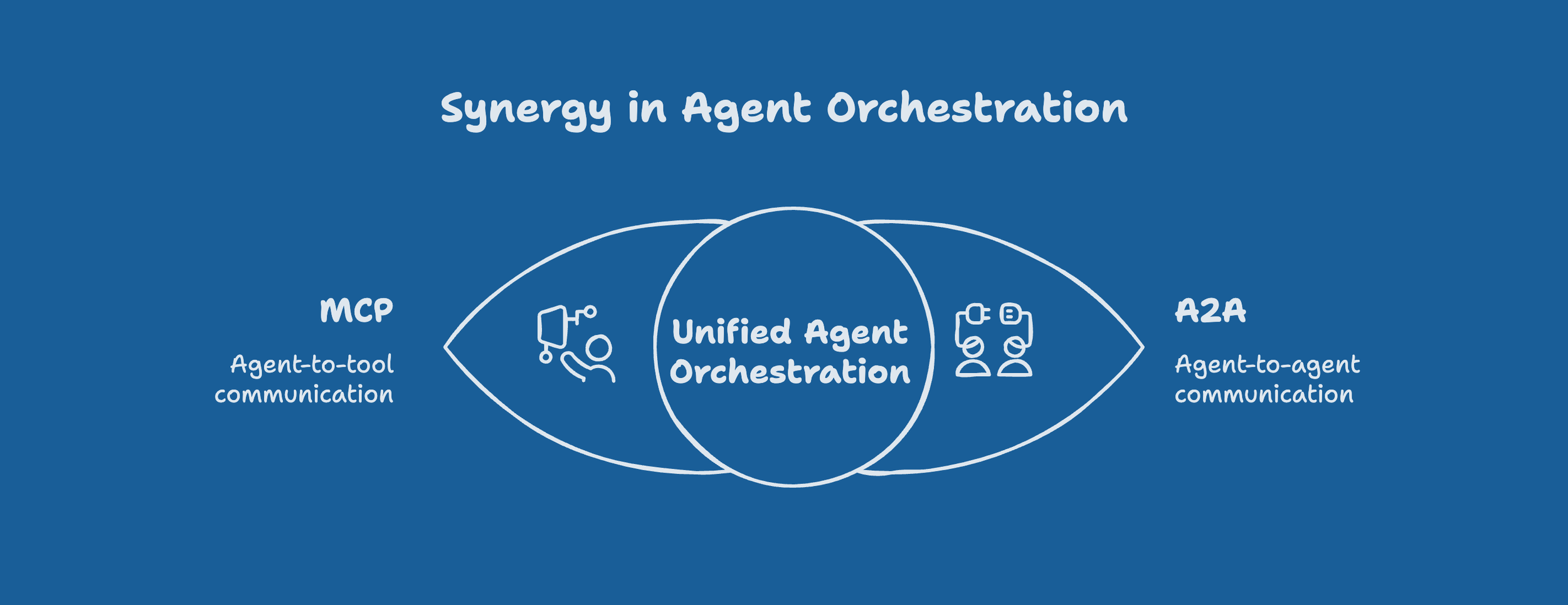
These protocols are complementary, not competing. MCP handles agent-to-tool communication (the vertical axis: how an agent accesses data sources, APIs, and services). A2A handles agent-to-agent communication (the horizontal axis: how agents from different vendors discover each other, negotiate capabilities, and coordinate work). Most production deployments will use both, and native support is generally available in Google Cloud, Azure AI Foundry, and Amazon Bedrock AgentCore.
Agent Orchetration Protocols
The production reality, however, lags the market energy. While 90 percent of enterprises are deploying agents, only 23 percent have successfully scaled them. Only 11 to 14 percent of AI agent pilots reach production at scale, with most failures traced to orchestration and context-transfer issues at handoff points. Only 7 to 8 percent of organizations have integrated cross-agent governance. The technology for multi-agent orchestration is maturing rapidly. The organizational capability to use it effectively is not.
Layer Three: Human-AI Orchestration
Human-AI orchestration is the least mature of the three layers and, as we argued in Part 1, the most important. This layer governs how human judgment, oversight, and collaboration integrate with agent workflows. It is where the "hybrid" in hybrid workforce becomes operational.
The challenge is designing coordination patterns that leverage what each side does best. Agents excel at speed, consistency, pattern recognition, and tireless execution. Humans excel at contextual judgment, ethical reasoning, relationship management, and handling novel situations. Orchestration design must ensure that agents handle the work they are suited for while humans focus on work that requires human capabilities, with clear handoff points, escalation paths, and governance structures connecting them.
Several vendors are building platforms specifically for this layer. ServiceNow unveiled its "Autonomous Workforce" at Knowledge 2026, where AI "specialists" (role-scoped agents) own entire processes end-to-end. The architecture features configurable supervised and unsupervised execution modes per action and an AI Control Tower where human managers oversee agent activity with a real-time "kill switch." ServiceNow's internal deployment resolves IT cases 99 percent faster with 91 percent resolved without reassignment.
Microsoft frames this as "The Frontier Firm," where organizations are "human-led and agent-operated." Its Work Trend Index survey of 31,000 workers found that 28 percent of managers are considering hiring AI workforce managers for hybrid teams. Microsoft's Copilot Cowork, which reached GA in June 2026, provides autonomous agent execution for long-running work with consent gates before consequential actions.
UiPath's Maestro platform takes a different approach, separating the nondeterministic reasoning of AI agents from the deterministic execution of RPA robots. Its three-step coordination pattern works like this: an agent analyzes and recommends, a human approves, and an RPA robot executes. This separation ensures that the unpredictability inherent in AI reasoning does not cascade into the automation that takes action in production systems. Early Maestro adopters report 60 to 80 percent reductions in case handling time.
Research is beginning to formalize the design space. The University of Washington published a five-level autonomy framework ranging from Operator (human does the work, agent assists) through Collaborator (shared execution) to Observer (agent acts autonomously, human monitors). The key insight is that autonomy level should be a deliberate design decision, separate from capability. Just because an agent can act autonomously does not mean it should. The autonomy level should match the risk, regulatory context, and organizational readiness for each specific workflow.
McKinsey estimates that the combined value of effective human-AI coordination, what it calls "Superagency," could reach $3 trillion annually by 2030. Its framework for "The Agentic Organization" suggests that 2 to 5 humans can effectively supervise 50 to 100 specialized agents when the orchestration layer is well-designed.
New platforms are emerging to serve this coordination need. Workday launched an Agent System of Record that manages AI agents the same way businesses manage employees: hire, onboard, assign responsibility, manage outcomes. Salesforce's Agentforce 360 platform, which unifies humans, agents, apps, and data, surpassed $500 million in ARR with 330 percent year-over-year growth. Dust, a startup that raised $40 million from Sequoia, bills itself as "multiplayer AI for human-agent collaboration" and reports 3,000 organizations running 300,000 agents.
The regulatory environment is accelerating demand for this layer. The EU AI Act mandates human oversight for high-risk AI systems, with full enforcement for enterprise agents arriving August 2, 2026. Penalties reach 35 million euros or 7 percent of global turnover.
Gartner's survey of 700-plus CIOs projects that by 2030, zero percent of IT work will be done by humans alone. Seventy-five percent will involve humans augmented with AI, and 25 percent will be handled by AI alone. The question is not whether human-AI coordination will be necessary. It is whether organizations will design it intentionally or let it emerge chaotically.
The Great Convergence
The most significant architectural development of 2025-2026 is the convergence of these three layers into a single platform category. Technologies that were separate markets with separate buyers, separate budgets, and separate vendor landscapes are merging.
Gartner's BOAT MQ consolidated business process automation, low-code platforms, iPaaS, intelligent document processing, RPA, collaborative workflow, and agentic automation into a single evaluation. Eighty-one percent of organizations use six or more different tools for automation, and 72 percent of enterprise application leaders want consolidated platforms. Forrester separately identified the Agent Control Plane as an emerging category for inventorying, governing, and orchestrating heterogeneous AI agents, with 40 percent of vendors reporting active RFPs from customers explicitly requesting one.
Enterprise buying behavior confirms the shift. Spending on platform investments is growing at 40 percent versus 5 percent growth in point solutions. Nearly two-thirds of enterprise buyers now gravitate toward a "mostly platform" model, with the preference for best-of-breed point solutions dropping to 20.7 percent.
For organizations making architecture decisions, this convergence means that the three orchestration layers will increasingly be served by integrated platforms rather than assembled from separate components. The leaders in Gartner's BOAT MQ, ServiceNow, Pegasystems, and Appian, each span workflow orchestration and are rapidly adding agent orchestration and human-AI orchestration capabilities. Meanwhile, the agent-first platforms from the hyperscalers (Microsoft, Google, AWS) are adding workflow orchestration and human-AI coordination features.
This does not mean a single vendor will own the entire orchestration stack. The consensus across analyst firms is that no single vendor should control all the planes for identity, data, model routing, orchestration, and governance. The emerging architecture separates a Control Plane (policy, identity, routing, observability, audit) from an Execution Plane (agents, tools, workflows, APIs). Organizations should expect to use multiple platforms and should prioritize interoperability through standards like MCP and A2A to avoid lock-in.
Build vs. Buy: The Orchestration Platform Decision
The build-versus-buy question for orchestration is tilting decisively toward buy.
Seventy-six percent of enterprise AI use cases are now purchased rather than built internally, up from 53 percent in 2024. Forrester predicts that 75 percent of companies attempting to build their own agentic systems will fail, citing gaps in orchestration, control, and trust. Gartner projects that over 40 percent of agentic AI projects will be canceled by end of 2027 due to cost overruns, unclear ROI, and inadequate risk controls.
The economics reinforce the conclusion. A full multi-agent system costs $250,000 to $400,000 or more to build, with integration engineering consuming 40 to 55 percent of total project cost. Total cost of ownership over three years for custom builds regularly exceeds initial estimates by two to four times. Meanwhile, enterprises manage an average of 897 applications, and only 29 percent are integrated. Organizations with AI agents use 1,103 applications, 45 percent more than those without.
The emerging consensus is "buy the platform, build the differentiation." Purchase foundational orchestration capabilities: governance, observability, state management, security, and standard integration patterns. Build custom logic only where it creates strategic differentiation, where your orchestration patterns encode proprietary business knowledge that competitors cannot replicate.
As we argued in the mid-market series, the buy-first approach is not a concession. It is a strategy that preserves resources for the work that matters most: designing the workflows, decision authority structures, and human-AI coordination patterns that are unique to your organization.
The Integration Reality
No architecture discussion is complete without confronting integration, which remains the biggest barrier to orchestration at scale. Ninety-five percent of IT leaders cite integration as their biggest barrier to AI. Thirty-five percent of AI projects fail specifically due to integration complexity. Only 7 percent of enterprises describe their data as "completely ready" for AI.
BCG's widely cited 10/20/70 framework puts the challenge in perspective: 10 percent of AI success comes from algorithms, 20 percent from technology and data infrastructure, and 70 percent from people and processes. The integration challenge is not primarily technical. It is organizational.
The iPaaS market, which exceeded $9 billion in 2024, is evolving to meet this need. MuleSoft launched Agent Fabric with MCP and A2A support. Workato shipped an MCP Gateway. Gartner predicts that by 2028, 70 percent of organizations building multi-LLM applications will use integration platforms for connectivity, up from less than 5 percent in 2024. For organizations planning their orchestration architecture, integration strategy is the connective tissue that determines whether the three orchestration layers work together or operate in isolation.
Orchestration Playbook
Map your current orchestration landscape. Inventory your existing automation across three categories: workflows that are fully manual, workflows that are partially automated (individual tools or agents operating independently), and workflows that are fully automated end-to-end. For each partially automated workflow, identify the gaps: where do humans manually bridge between automated steps? Where do agents produce outputs that no other system consumes? These gaps are your orchestration opportunities.
Evaluate your existing platforms before adding new ones. Most organizations already own platforms with native orchestration capabilities they have not activated. Forrester notes that less than 15 percent of firms will activate agentic features in their existing automation suites in 2026. Before purchasing a new orchestration platform, audit the capabilities already available in your existing BPM, iPaaS, CRM, and ERP platforms. The fastest path to orchestration often runs through platform features you have already licensed.
Identify three high-value orchestration targets. Use the volume, predictability, and measurability scoring from the mid-market series. The best candidates for early orchestration are workflows with high transaction volume (enough activity to justify the investment), moderate predictability (not so routine that simple automation handles it, not so novel that agents struggle), and clear measurability (defined success metrics that let you prove value). Cross-functional handoffs, where work moves between departments and currently requires manual coordination, are particularly strong candidates.
Apply the architecture decision framework. For each orchestration target, decide between three approaches. Platform-native orchestration uses capabilities built into your existing platforms (Salesforce Agentforce, ServiceNow AI agents, Microsoft Copilot Studio). Choose this when your workflow lives primarily within one platform ecosystem. A dedicated orchestration layer adds a specialized platform (Camunda, Celonis, UiPath Maestro) to coordinate across multiple systems. Choose this when workflows span multiple platforms or require process intelligence your existing tools lack. Custom orchestration builds coordination logic using agent frameworks (LangGraph, CrewAI, Microsoft Agent Framework) and protocols (MCP, A2A). Choose this only when building genuinely differentiated capabilities that no platform provides and you have the engineering resources to maintain them.
For most organizations, the first two options will cover 80 percent or more of orchestration needs. Reserve custom builds for strategic workflows where your orchestration patterns encode proprietary competitive advantage.