Orchestrating the Hybrid Workforce, Part 1: The Orchestration Imperative
This is the first article in a 10-part series exploring AI orchestration and the hybrid workforce. Each article examines a critical dimension of how organizations coordinate multi-agent AI systems alongside human teams and includes an "Orchestration Playbook" section with actionable guidance.
The Convergence Moment
Two forces are colliding in 2026, and most organizations are not prepared for the impact.
The first is the rapid proliferation of AI agents. Worldwide AI spending is forecast to reach $2.59 trillion this year, a 47 percent increase over 2025. The AI agent market alone is projected to grow from $7.84 billion in 2025 to $52.62 billion by 2030, a compound annual growth rate of 46.3 percent. Eighty percent of enterprise applications shipped or updated in Q1 2026 embed at least one AI agent, up from 33 percent in 2024. Gartner projects that by 2028, the average Fortune 500 company will have over 150,000 AI agents in use, up from fewer than 15 in 2025.
The second force is the workforce transformation that AI demands but that almost no one is executing. Eighty-eight percent of organizations now use AI in at least one business function. Yet only 6 percent of leaders say they are making real progress designing how humans and AI should work together. Eighty-four percent of companies have not redesigned jobs around AI capabilities despite widespread automation expectations. Only 9 percent of companies are leading in reinventing work for AI.
These two forces create an urgent strategic question that goes beyond whether to adopt AI. The question is how to orchestrate the growing constellation of AI agents, automated workflows, and human teams into something coherent, productive, and governable.
That is what this series is about. Not AI adoption. Not agent deployment. Orchestration: the discipline of coordinating intelligent systems, both human and artificial, toward business outcomes.
Why Single-Agent Deployments Hit a Ceiling
Most organizations began their AI journey with individual tools: a copilot for document creation, an AI assistant for customer service, a chatbot for internal IT support. These early deployments delivered real value. But the evidence is mounting that standalone AI tools, deployed without coordination, hit a productivity ceiling faster than anyone expected.
Consider the data. Seventy percent of Fortune 500 companies purchased Microsoft Copilot licenses, but only 20 to 30 percent of paid seats show weekly active use. Only 5 percent of organizations moved from pilot to larger-scale deployment. A National Bureau of Economic Research study of roughly 6,000 executives found that 89 percent saw no change in productivity (measured as sales per employee) despite 70 percent actively using AI. Eighty percent of firms reported no measurable productivity gains.
The pattern holds beyond copilots. A RAND Corporation analysis found that 80.3 percent of all enterprise AI projects fail to deliver promised business value: 33.8 percent are abandoned before production, 28.4 percent reach production but fail on value, and 18.1 percent never recoup their costs. Only 12 percent of CEOs say AI has delivered both cost and revenue benefits. McKinsey reports that only 7 percent of organizations have fully scaled AI enterprise-wide, while nearly two-thirds have not begun scaling at all.
The problem is not the technology. The problem is that isolated AI tools, each solving one problem in one department, do not compound. A customer service agent that resolves tickets faster does not connect to a sales intelligence tool that identifies upsell opportunities, which does not connect to a finance workflow that adjusts forecasts based on pipeline changes. Each tool works in its lane. Nothing connects the lanes.
Boston Consulting Group's research quantified this ceiling in human terms. Productivity increases when workers use one to three AI tools, then drops at four or more. Workers whose AI tasks require high oversight expend 14 percent more mental effort, experience 12 percent greater mental fatigue, and report 19 percent greater information overload. BCG calls this phenomenon "AI brain fry." Eighty-eight percent of heavy AI users report increased feelings of burnout, and workers lose an average of 51 minutes weekly to tool fatigue from application switching, amounting to 44 hours lost annually.
The single-agent ceiling is not a technology limitation. It is an orchestration failure.
The Orchestration Gap
Here is the paradox at the center of enterprise AI in 2026: adoption is accelerating while integration is stalling.
Ninety-nine percent of enterprise leaders claim formal AI strategies. Only 27 percent have achieved enterprise-wide deployment. Deloitte's State of AI report puts it directly: "Enterprise AI adoption is broadening faster than enterprise AI integration." Agent proliferation itself, Deloitte warns, "may ultimately constrain its impact" without orchestration.
The fragmentation is worse than most leaders realize. Most CIOs estimate 60 to 70 AI tools in use across their organizations. Actual monitoring reveals 200 to 300 tools, with organizations spending three to five times what they think on AI. Ninety-eight percent of organizations have employees using unsanctioned AI tools. Shadow AI is now the third most common non-malicious insider action in data loss prevention datasets, a fourfold increase from the prior year.
Meanwhile, 50 percent of enterprise agents operate in isolated silos with no shared context or unified governance. Twenty-seven percent of API connections between agents are completely ungoverned. Only 13 percent of organizations feel adequately prepared for agent governance at scale.
The World Economic Forum warns that siloed AI implementation is the number one reason AI tools go unused. BCG's research on what it calls "future-built" companies, those that coordinate AI investments across functions, shows they plan to spend 26 percent more on IT and dedicate up to 64 percent more of their IT budget to AI. More importantly, they expect twice the revenue increase and 40 percent greater cost reductions compared to organizations with fragmented AI approaches.
The gap between AI tool deployment and AI orchestration is where value is being destroyed. Organizations are spending more on AI and getting less because nothing connects the investments into a coherent system.
Defining Orchestration
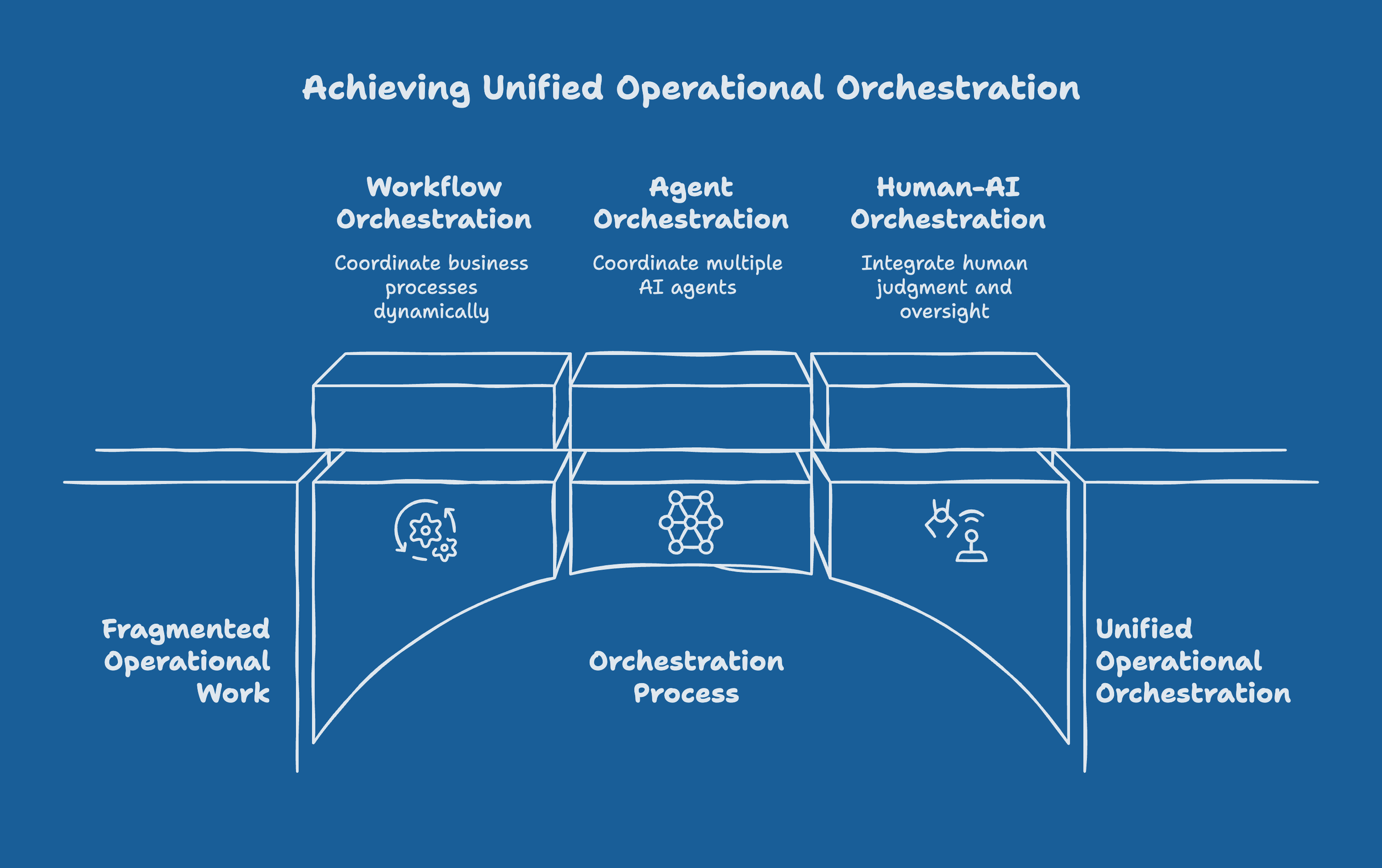
Orchestration is not a new middleware layer or another platform purchase. It is the discipline of coordinating three types of work that are converging into a single operational challenge.
The first is workflow orchestration: coordinating business processes across systems, teams, and handoffs. This has existed in various forms since the early days of business process management, but AI is transforming it from static, rules-based routing to dynamic, adaptive process coordination.
The second is agent orchestration: coordinating multiple AI agents that work on related tasks, share context, and hand off work to each other. This is the technical layer that most vendors focus on, and it is evolving rapidly. Multi-agent systems are growing at a 48.5 percent compound annual growth rate, faster than single-agent deployments. Gartner reports a 1,445 percent surge in multi-agent system inquiries from Q1 2024 to Q2 2025.
The third, and most critical, is human-AI orchestration: designing how human judgment, oversight, and collaboration integrate with agent workflows. This is the least mature of the three layers and the one where most organizations have done the least work. Only 19 percent of AI users are in what Microsoft calls the "Frontier Zone," where individual capability and organizational maturity align. Organizational factors account for 67 percent of AI impact versus 32 percent for individual factors.
These three layers are not separate problems. They are one problem viewed from different angles. You cannot orchestrate agents effectively without understanding the business processes they serve. You cannot design business processes for AI without understanding what agents can and cannot do. And you cannot do either without designing the human role in the orchestrated system.
Unified Operational Orchestration
The major analyst firms are converging on this insight. Gartner published its inaugural Magic Quadrant for Business Orchestration and Automation Technologies (BOAT) in October 2025, evaluating 20 vendors and consolidating business process automation, low-code platforms, iPaaS, intelligent document processing, RPA, and agentic automation into a single platform category. Gartner predicts that by 2030, 70 percent of enterprises will pivot to a consolidated automation platform that orchestrates business processes, AI agents, bots, APIs, and human actions, up from 5 percent today. Forrester defines a parallel category called Adaptive Process Orchestration (APO), covering 35 vendors, and separately recognizes the Agent Control Plane as a distinct market for inventorying, governing, and orchestrating heterogeneous AI agents across vendors and domains.
The market is telling us something. The era of standalone AI tools is ending. The era of orchestrated AI systems, coordinated with human teams, is beginning.
What Orchestration Looks Like in Practice
The organizations that have cracked orchestration are not building theoretical frameworks. They are producing measurable results.
JPMorgan Chase deployed its LLM Suite to over 200,000 employees across 450-plus AI use cases, achieving 83 percent faster research cycles for portfolio managers and automating 360,000 manual hours per year. The key was not deploying 450 separate AI tools. It was orchestrating them within coordinated workflows where agents, data systems, and human analysts work together.
DBS Bank in Singapore generated S$1 billion in economic value from AI in fiscal year 2025, verified through control-group benchmarking, with 2,000 models deployed across 430 use cases. DBS completed the first live agentic payment transaction with Mastercard, where an AI agent autonomously booked a ride and processed payment. That transaction required orchestration across booking systems, payment rails, authentication protocols, and compliance checks, not a single agent acting alone.
EY's Canvas platform processes 1.4 trillion lines of journal entry data annually across 160,000 audit engagements in over 150 countries. In April 2026, EY launched a multi-agent framework on Microsoft Azure for 130,000 assurance professionals, moving from individual AI assistance to coordinated agent teams.
ServiceNow's partnership with Rolls-Royce reduced resolution times by 34 percent and deflected 38,000 tickets in a year. Across its platform, ServiceNow now resolves 34 percent of IT incidents without human intervention, up from 12 percent in 2024.
The pattern across these examples is consistent. Value comes not from deploying agents but from orchestrating them: connecting AI capabilities across functions, coordinating agent and human work, and governing the whole system as a coherent operation.
The Dual Nature of the Challenge
This series treats orchestration as having two inseparable dimensions.
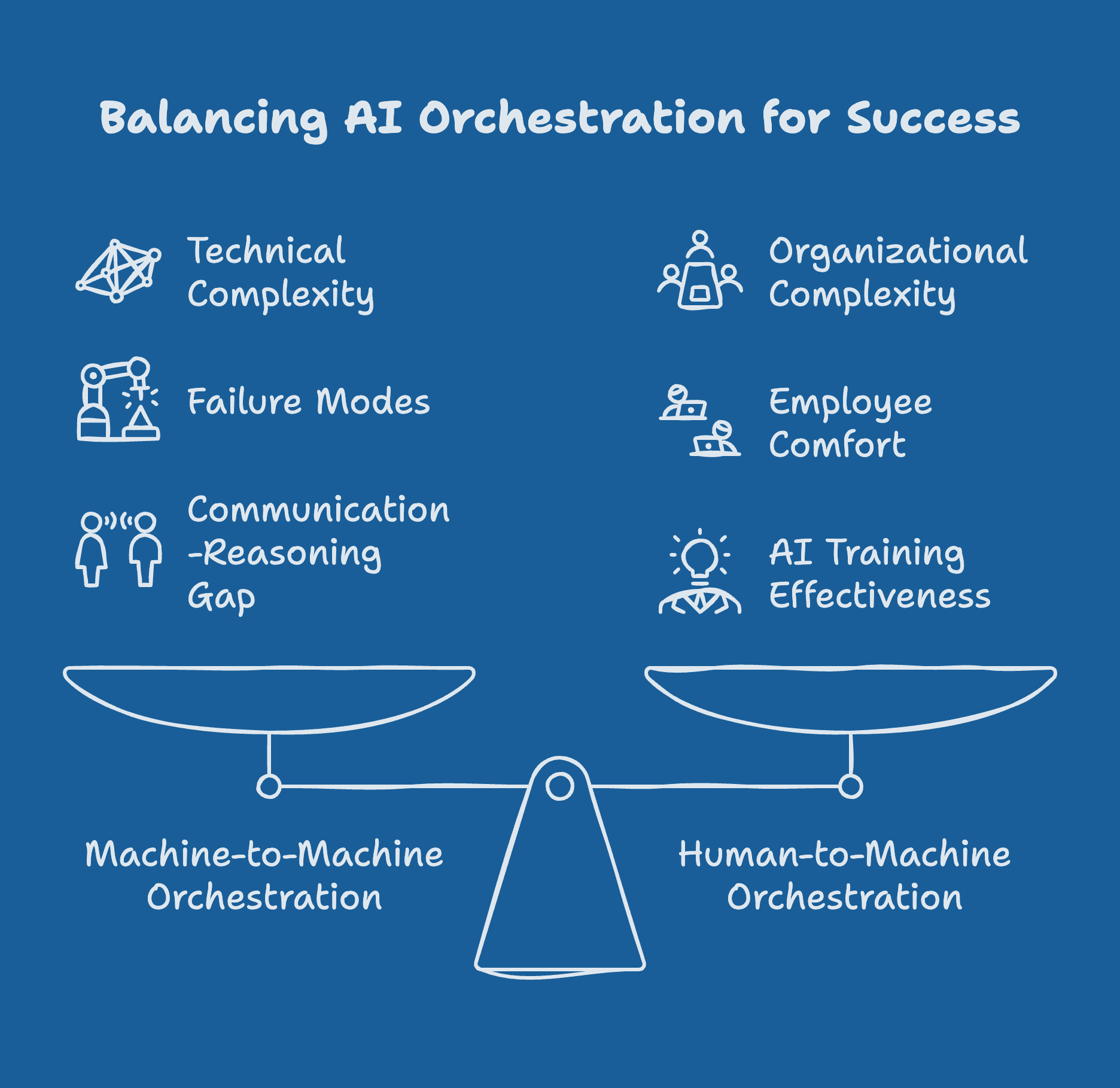
The first is machine-to-machine orchestration: how AI agents coordinate with each other, share context, hand off tasks, and resolve conflicts. This is a technical challenge with real and growing complexity. Research from UC Berkeley analyzing 1,600 execution traces across seven multi-agent frameworks identified 14 distinct failure modes. In many cases, using the same model in a single-agent setup outperformed multi-agent configurations because coordination overhead introduced more errors than specialization eliminated. A separate study testing 54 configurations across 1,620 experiments discovered that agents exchange information actively but systematically fail to synthesize distributed state into correct outputs, a phenomenon the researchers call the "Communication-Reasoning Gap."
The second is human-to-machine orchestration: how humans work alongside, supervise, direct, and govern AI agent teams. This is an organizational challenge that most companies have not even begun to address. Only one in ten employees feels comfortable using AI in their role. Only 12 percent of U.S. employees have integrated AI into daily work. AI training budgets were cut by an average of 18 percent in the second half of 2025 even as AI tool spending increased 23 percent over the same period. Eighty-five percent of workers cannot connect what they learned in AI training to their actual job role.
The organizations that treat these as separate problems, assigning agent orchestration to IT and workforce transformation to HR, will struggle. The organizations that treat them as two halves of the same challenge will build a compounding advantage.
Balancing AI Orchestration
This is the principle we explored in the "Building the Agentic Enterprise" series as human-in-the-lead: not a reactive checkpoint where humans approve agent outputs, but proactive direction where humans set goals, define constraints, supervise execution, and adjust as conditions change. In orchestrated systems with multiple agents working together, the human-in-the-lead role becomes more complex and more important, not less. The Dual Maturity Framework from that series, advancing organizational AI maturity and agentic AI capability maturity together, applies directly to orchestration. You cannot orchestrate effectively if your technology outpaces your organizational readiness, or vice versa.
Why This Matters Now
The competitive window for orchestration advantage is open but narrowing.
IDC projects over one billion AI agents deployed worldwide by 2029, performing 217 billion daily actions. Gartner predicts that agentic AI could drive 30 percent of enterprise application software revenue by 2035, surpassing $450 billion. By 2028, one in four enterprise software purchases will be made by AI agents with no human in the loop. Ninety percent of B2B buying will be AI-agent intermediated by 2028, reshaping $15 trillion or more in commerce.
Organizations that build orchestration capability now, the ability to coordinate agents, processes, and people into coherent systems, will compound their advantage through organizational learning, workflow optimization, and data assets that cannot be quickly replicated. As we argued in the mid-market series, the organizations moving first are not just getting better at AI. They are building the organizational muscle to keep getting better, faster than those who start later.
The organizations still deploying individual AI tools without orchestration will find themselves in the same position as companies that adopted the internet but never integrated it into their business models. The technology is present. The value is absent. And the gap grows wider every quarter.
Orchestration Playbook
Assess your current state. Map every AI tool, agent, and automated workflow in your organization. If you are a typical enterprise, you will find two to four times more than your IT team tracks. Document which are connected to each other, which share data, and which operate in isolation. This inventory is the starting point for orchestration planning.
Identify your single-agent ceiling. Look for these three signals: AI tools that produce outputs no other system uses, departments that have deployed AI independently with no cross-functional coordination, and workflows where human effort is spent translating between AI-generated outputs and other business processes. Each signal indicates orchestration opportunity.
Evaluate your orchestration readiness across three dimensions. First, data integration: can your AI tools access the data they need across systems, or are they limited to siloed datasets? Second, governance foundations: do you have decision authority frameworks, data classification, and acceptable use policies that can extend to multi-agent systems? Third, talent baseline: do your teams have the skills to supervise, direct, and govern AI agents, or are they still struggling with basic AI literacy?
Take one concrete first step. Choose a single cross-functional workflow where two or more AI tools could be connected. Map the handoff points between human and AI work. Design the orchestrated version, defining what each agent does, what humans do, and how they coordinate. Pilot it for 60 days with clear success metrics. This gives you orchestration experience without enterprise-wide risk.
Start the organizational conversation. The biggest barrier to orchestration is not technology. It is the organizational assumption that AI tools are departmental decisions. Orchestration requires cross-functional coordination, shared governance, and leadership commitment. That conversation needs to start now, not after you have 150,000 agents to manage.