Orchestrating the Hybrid Workforce, Part 8: Building the Orchestration-Ready Organization
This is the eighth article in a 10-part series exploring AI orchestration and the hybrid workforce. Each article examines a critical dimension of how organizations coordinate multi-agent AI systems alongside human teams and includes an "Orchestration Playbook" section with actionable guidance.
The Binding Constraint
Every article in this series has examined a dimension of orchestration: architecture, design patterns, human roles, standards, work redesign, governance. Each is necessary. None is sufficient without the organizational capability to execute.
That capability is the binding constraint. Technology is not holding organizations back. Talent, culture, and change management are.
The evidence is consistent across every major research firm. BCG frames it as 30 percent technology and 70 percent people and organization. McKinsey finds that leaders in AI adoption invest twice as much in change management as in building the solution itself. Forrester reports that for every dollar spent on AI agent licensing, organizations spend nearly five dollars on services, most going toward human and organizational change. IBM's 2026 CEO Study found that 83 percent of CEOs say AI success depends more on people's adoption than on the technology. And the Wavestone executive benchmark, now in its tenth year, reports that 93 percent of leaders cite culture and change management as the primary challenge, the highest figure in the survey's history.
The organizations that will succeed with orchestrated multi-agent systems are not those with the best technology. They are those that build three organizational capabilities: orchestration literacy (the knowledge to design and govern human-AI workflows), change management discipline (the practices that sustain adoption beyond the pilot phase), and a culture that makes experimentation safe and collaboration natural.
Orchestration Literacy: Beyond AI Literacy
AI literacy, the ability to use AI tools effectively, is table stakes. Orchestration literacy is the next evolution: the organizational capability to understand, design, manage, and govern orchestrated human-AI workflows where multiple agents coordinate with human teams toward business outcomes.
The distinction matters because orchestration requires skills that individual AI tool use does not. Knowing how to prompt a copilot effectively does not prepare someone to design a workflow where three agents from two vendors coordinate with two human roles across a business process. Orchestration literacy adds systems thinking (understanding how agents, humans, and processes interact), workflow design (decomposing work into human-led, AI-led, and collaborative tasks, as we examined in Part 6), agent supervision (monitoring agent performance, calibrating trust, and intervening effectively, as covered in Part 4), and governance awareness (understanding accountability, compliance, and risk in multi-agent systems, as detailed in Part 7).
IDC published a Human Skills Framework for Agentic AI in May 2026, identifying eight clusters of human capability required for the agentic era. Each cluster breaks into trainable subskills. Critical thinking, for example, decomposes into problem framing, assumption spotting, hallucination detection, trade-off analysis, and metacognition with AI. These are not abstract competencies. They are specific, developable skills that determine whether an orchestrated workflow produces reliable outcomes or generates expensive failures.
Forrester's cognitive operating model takes the concept further, defining a "cognitive skill" as the atomic unit of capability that is executor-agnostic: it can be performed by a person, an AI agent, or a human-agent team. Orchestration literacy means understanding how these skills compose into roles and workflows, and making deliberate decisions about which executor handles which skill. This is precisely the task decomposition framework we outlined in Part 6, elevated from a one-time exercise to an ongoing organizational capability.
Gartner projects that by 2029, at least 50 percent of knowledge workers will develop new skills to work with, govern, or create AI agents on demand. By 2027, 75 percent of hiring processes will include certifications and testing for workplace AI proficiency. The trajectory is clear: orchestration skills are moving from specialized to expected. Organizations that wait to build this capability will find the talent market has priced them out. The AI skills wage premium has already reached 62 percent, up from 25 percent just two years ago.
The Skills Gap at Scale
The gap between skills needed and skills available is the single largest constraint on orchestration maturity. AI talent demand exceeds supply at a 3.2-to-1 ratio globally, with approximately 1.6 million open AI positions against roughly 518,000 qualified candidates. AI job postings grew 78 percent year-over-year while the talent pool grew only 24 percent.
The consequences are visible across the enterprise landscape. Seventy-two percent of employers globally report difficulty filling roles, with AI skills ranking as the hardest capability to find for the first time. Eighty-five percent of tech executives have postponed or slowed important AI projects due to skills shortages. Forty-two percent of companies abandoned most of their AI initiatives in 2025, up from 17 percent the prior year, a 147 percent increase in the abandonment rate.
But the skills gap is not just about hiring. It is about the 93/7 problem: 93 percent of AI-related funding goes to technology, and just 7 percent goes to training. Only 13 percent of workers have received any AI training, even as workplace AI adoption has reached 50 percent. Workera's 2026 AI Skills Benchmark, based on 88,000 assessments, found that only 13 percent of employees are "Accomplished" in agentic AI skills, the lowest of all 14 AI capabilities measured.
The World Economic Forum projects that 59 percent of the global workforce, 1.2 billion workers, will require reskilling or upskilling by 2030. Skills gaps rank as the number one barrier to business transformation, cited by 63 percent of employers. Meanwhile, nearly 40 percent of core job skills will change in that window.
For orchestration specifically, the gap is wider because the required skills are newer and less well-defined. The 20 emerging agentic AI job categories identified by Forbes, McKinsey, and LinkedIn in mid-2026 include orchestration designers, agent supervisors, AI workflow architects, and agent operations specialists. Eightfold AI called the AI Agent Orchestration Specialist "the most important job of 2026." But these roles barely existed 18 months ago, and formal training pipelines are only beginning to emerge.
The Psychology of Agent Teams
Work redesign (Part 6) addressed the structural challenge of the hybrid workforce. The psychological challenge is equally consequential and less well understood.
Working alongside AI agents triggers responses that go beyond standard technology adoption resistance. Researchers describe identity shifts as employees recalibrate their professional self-concept when tasks they considered core to their expertise migrate to agents. A study of 1,923 adults found that 58 percent agreed that AI "did most of the thinking." Among workers, 39 percent overall and 46 percent of Gen Z report that AI reliance has weakened their skill sets, a phenomenon researchers call "cognitive debt." A colonoscopy study documented a concrete example: specialist detection rates dropped from 28.4 percent to 22.4 percent within three months of AI introduction when AI was subsequently removed. Skills atrophy under AI dependence, and the atrophy can be rapid.
Loss of agency compounds the identity challenge. RAND published a formal model in April 2026 identifying three mechanisms of agency erosion: human disenfranchisement (decisions shift to AI), AI enfranchisement (AI gains authority over processes), and AI agenda control (AI shapes what gets worked on). These are not speculative risks. They are measurable dynamics that organizations must design against.
Trust remains bifurcated. A KPMG study of 48,000 people across 47 countries found that only 46 percent are willing to trust AI systems, while 66 percent rely on AI output without evaluating accuracy. More concerning: 57 percent of employees hide AI use and present AI-generated work as their own. Shadow AI use, discussed in Part 7 as a governance challenge, is also a cultural symptom. When employees feel they must conceal AI use, the organization lacks the psychological safety required for effective human-AI collaboration.
Resistance patterns are intensifying even as adoption grows. Twenty-nine percent of employees admit to sabotaging their company's AI strategy, rising to 44 percent among Gen Z. Sixty-four percent of American adults plan to avoid AI "as long as possible." The top drivers are preference for current methods (46 percent), disbelief that AI can help (44 percent), ethical objections (43 percent), and privacy concerns (43 percent). These are not irrational responses. They are signals that organizations have not adequately addressed the human experience of transformation.
Change Management for Orchestration
Change management for orchestrated multi-agent systems is harder than for individual tools because it changes how teams work together, not just how individuals work. When you introduce a copilot, one person adapts. When you deploy an orchestrated workflow with three agents and two human roles, the entire team's coordination patterns change.
The failure data underscores the difficulty. RAND's meta-analysis found that 80 percent of enterprise AI projects fail to deliver business value, roughly twice the failure rate of non-AI IT projects. MIT's Project NANDA found that 95 percent of generative AI pilots yield no measurable P&L return. BCG reports that 70 percent of digital and AI transformation efforts stall before reaching their goals. And 63 percent of AI implementation failures stem from human factors, not technology.
The organizations that succeed share a common pattern: they treat AI transformation as a change management initiative that happens to involve technology, not a technology initiative that includes some change management. McKinsey's research is explicit: transformations are 8x more likely to succeed when activating all elements of the influence model, and 5x more likely when leaders consistently model new behaviors. Leading companies' transformations deliver 20 percent EBITDA uplift with breakeven in one to two years.
Three change management principles apply specifically to orchestration. First, start with workflow redesign, not tool deployment. Deloitte found that organizations leading in intentional human-AI work design are 2.5x more likely to report better financial results. As we argued in Part 6, task decomposition must precede agent deployment. Second, invest in managers before frontline workers. The data from Part 6 bears repeating: organizational factors account for 67 percent of AI's real impact versus 32 percent for individual mindset, and manager behavior is the strongest single lever. Third, make change continuous, not episodic. Orchestration maturity develops over years, not quarters. Organizations encounter a complexity ceiling at around five agents, beyond which coordination breaks down without deliberate capability building. Only 3 percent of organizations are successfully scaling multi-agent systems across multiple departments today.
Training That Works
Most AI training fails because it targets the wrong level. Eighty-two percent of enterprises offer some form of AI training, yet 59 percent still report a skills gap. The problem is that most programs target either absolute beginners or AI engineers, missing the 90 percent of workers who need to use AI confidently in their daily roles.
The approaches that produce measurable results share three characteristics. They are embedded in real work rather than delivered as standalone courses. They are sustained rather than one-time. And they are supported by managers and peers rather than managed by L&D alone.
The AI champions model, which we introduced in the mid-market series, scales effectively. Citi built a network of 4,000 AI Accelerators supported by 25 to 30 AI Champions, reaching 70 percent adoption across 182,000 employees in 84 countries within 12 to 18 months. Champions contributed only 30 to 60 minutes per week. The economics work because champions are practitioners, not trainers. They help colleagues solve real problems with AI tools in the context of real work, which produces faster skill transfer than classroom instruction.
BCG's data confirms: employees who received five or more hours of hands-on training are regular AI users at a rate of 79 percent versus 67 percent with less. But context matters more than instruction. Companies with a clear AI strategy see 25 percentage points more impact than those without, while better tools alone yield only 5 points. BCG also found a 20x higher adoption rate with persona-based learning journeys compared to broad-based training. The implication is that training must be role-specific, workflow-specific, and integrated into how people already work.
The training gap is especially acute for orchestration skills. Workera's assessment data shows agentic AI skills as the weakest across all 14 AI capabilities measured. This gap will not close through generic AI literacy programs. Organizations need training that addresses the specific skills orchestration requires: workflow design, agent supervision, multi-agent coordination, governance awareness, and trust calibration.
Cultural Markers of Orchestration-Ready Organizations
Culture is the substrate on which orchestration capability develops. Four cultural markers distinguish organizations that succeed from those that stall.
Psychological safety is the foundation. Research consistently shows that psychological safety predicts whether employees adopt AI tools, across experience levels, roles, and geographies. MIT found that 83 percent of executives believe psychological safety measurably improves AI initiative success, but only 39 percent rate their organization's safety as "very high." The practical consequence: employees in low psychological safety environments hide AI use at 45 percent versus 17 percent in high-safety environments. Shadow AI is a cultural failure, not just a governance one.
Cross-functional collaboration is the second marker. IBM found that 82 percent of C-suite executives say functional silos block AI value, yet 71 percent report AI applications being created in silos. Orchestrated workflows span departments by definition. An agent workflow that coordinates sales, operations, and finance requires those functions to share data, align on processes, and agree on governance. Organizations that cannot collaborate across functions cannot orchestrate across them.
A measurement orientation is the third marker. Only 31 percent of organizations have metrics tied to KPIs for AI. Without measurement, orchestration investments cannot be justified, optimized, or sustained. Cisco's AI Readiness Index found that only 13 percent of organizations qualify as "Pacesetters" fully prepared for AI, unchanged over three years, and 97 percent of Pacesetters deploy AI at needed scale versus 41 percent globally. What separates Pacesetters is not better technology. It is disciplined measurement.
Leadership modeling is the fourth and most consequential marker. BCG found that employee positivity about AI rises from 15 percent to 55 percent with strong leadership support, nearly a 4x increase. C-level executives deeply engaged with AI are 12x more likely to be among the top 5 percent of companies generating substantial value. At leading companies, 88 percent of managers role-model AI use versus 25 percent at laggards. But leadership overestimates its own effectiveness: 83 percent of executives believe they communicated a clear AI vision, while only 37 percent of frontline employees felt the message got through. The gap is not about intent. It is about execution.
Orchestration Playbook
Assess your orchestration skills across four levels. Level 1 is AI literacy: can your people use AI tools effectively? Level 2 is tool proficiency: can they configure and customize AI agents for specific tasks? Level 3 is orchestration design: can they design multi-agent workflows, define human roles, and manage handoffs? Level 4 is governance capability: can they build accountability maps, implement tiered governance, and ensure compliance? Most organizations have pockets of Level 1 and 2. Orchestration readiness requires critical mass at Levels 3 and 4. Identify your gaps and prioritize training investment where orchestration maturity demands it.
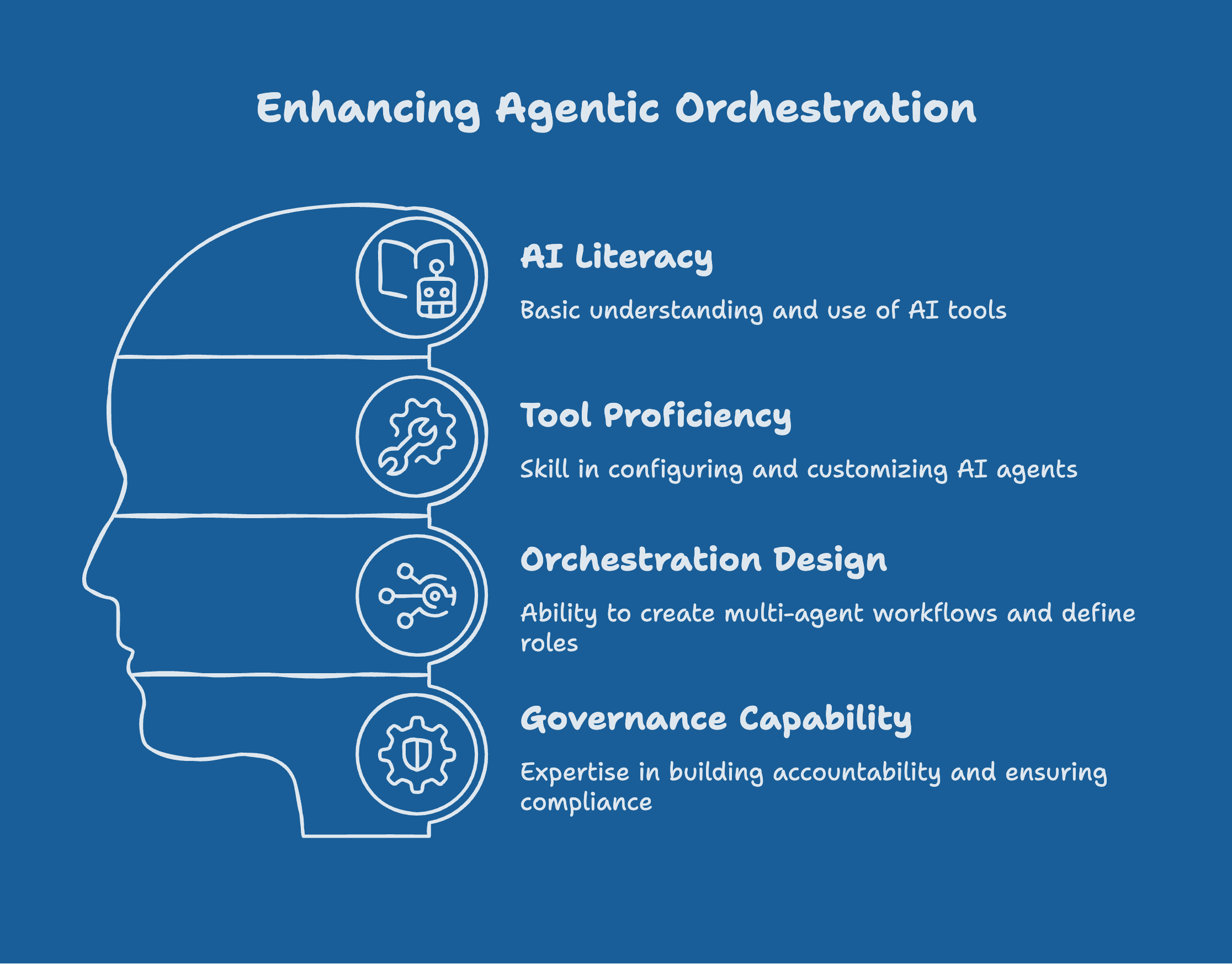
Agentic Orchestration Skill Levels
Launch an orchestration champions program. Identify 25 to 30 practitioners across business units who are already experimenting with multi-agent workflows or show aptitude for systems thinking. Equip them with access to orchestration tools, a community of practice, and 30 to 60 minutes per week of protected time. Their role is not to train others but to solve real problems alongside colleagues, demonstrating orchestration value through practical application. Measure adoption rates, workflow improvements, and champion-influenced deployments. Scale the network as orchestration maturity grows.
Invest in managers before the frontline. Before launching organization-wide orchestration training, equip managers with three things: hands-on experience with the orchestrated workflows their teams will use, a framework for allocating work between humans and agents (the task decomposition approach from Part 6), and explicit permission to experiment. Track whether managers are modeling orchestration behaviors. It is the single strongest predictor of team-level adoption and trust.
Design training around real workflows, not abstractions. Select three orchestrated workflows currently in deployment or planned for the next quarter. Build training around those specific workflows: what the agents do, how work flows between agents and humans, where human judgment is required, how to escalate, how to evaluate agent output. Role-specific, workflow-specific training produces 20x higher adoption than broad-based programs. Update the training as the workflow evolves.
Address resistance directly. The five most common resistance patterns each require a specific response. "AI will replace me" requires transparent communication about role redesign and skill investment, with concrete evidence from your own organization. "I do not trust AI output" requires hands-on experience with real workflows where the employee can verify agent performance. "This is not my job" requires explicit role redefinition that positions orchestration skills as career growth. "I was not asked" requires inclusive design processes that involve affected employees in workflow design. "It does not work" requires rapid iteration on agent performance issues, with visible improvements. Track resistance patterns across the organization and address them systematically, not individually.
Measure cultural readiness quarterly. Track four indicators: psychological safety for AI experimentation (percentage who feel safe trying new AI approaches), cross-functional collaboration health (percentage of orchestrated workflows spanning two or more departments), measurement discipline (percentage of orchestration investments with defined KPIs), and leadership modeling (percentage of managers actively using and demonstrating orchestration tools). Set targets, measure progress, and report to senior leadership alongside the governance review recommended in Part 7.
This is Part 8 of the "Orchestrating the Hybrid Workforce" series. Part 9 will examine orchestration economics and ROI: how the economics of multi-agent orchestrated systems differ from individual AI deployments, why costs are higher but compounding effects are dramatically larger, and how to build the business case for orchestration investment. For the companion frameworks from prior series, including the Dual Maturity Quick Diagnostic and Agentic AI Readiness Assessment, visit arionresearch.com. Follow Arion Research for ongoing analysis at arionresearch.com/blog.