Orchestrating the Hybrid Workforce, Part 6: Redesigning Work for the Hybrid Workforce
This is the sixth article in a 10-part series exploring AI orchestration and the hybrid workforce. Each article examines a critical dimension of how organizations coordinate multi-agent AI systems alongside human teams and includes an "Orchestration Playbook" section with actionable guidance.
The Redesign Gap
The hybrid workforce is not a future state. McKinsey operates approximately 25,000 AI agents alongside its 40,000 human employees, with a goal of reaching agent-human parity within 18 months. Microsoft reports 15x year-over-year growth in active agents across Microsoft 365, with 18x growth in large enterprises. Forty percent of enterprise applications will feature task-specific AI agents by end of 2026, up from less than 5 percent in 2025.
And yet, 84 percent of companies have not redesigned jobs around AI capabilities.
This is the redesign gap: organizations are deploying agents at scale while leaving the work itself unchanged. They bolt AI onto existing job structures, hand employees a copilot, and call it transformation. Deloitte's 2026 Human Capital Trends report found that only 6 percent of leaders say they are making real progress designing human-AI interactions. Only 5 percent say they manage AI in decision-making well. Fifty-six percent of organizations design AI solely for business outcomes, with only 40 percent designing for both business and human outcomes.
The gap is costly. BCG's 2026 "AI at Work" study of nearly 12,000 workers across 14 markets found that having a clear AI strategy and workflow redesign plan lifts measurable business impact by about 25 percentage points, while simply providing better AI tools moves it by approximately 5 points. That is a five-to-one multiplier. Strategy and redesign matter five times more than the technology itself. Organizations that merely bolt on AI without redesigning workflows see minimal gains, and in many cases, the 37 percent productivity tax from rework eats whatever savings the AI generated.
The organizations getting results are those that redesign first and deploy second. Accenture found that companies with fully modernized, AI-led processes achieve 2.5x higher revenue growth, 2.4x greater productivity, and 3.3x greater success scaling AI use cases. But only 16 percent of companies have reached this stage. BCG frames it bluntly: becoming AI-first involves 30 percent technology and 70 percent people and organization.
Task Decomposition: The Starting Point
Work redesign starts not with roles or org charts but with tasks. Every job is a bundle of tasks, and AI changes the composition of that bundle rather than eliminating the job itself.
McKinsey's November 2025 analysis found that current technology could automate about 57 percent of US work hours. This includes digital, rules-based work where AI agents excel: copying data between systems, checking status, drafting standard documents, performing basic analysis, sending routine communications. It also includes roughly 13 percent of work hours from simple machine operations and routine inspections that physical automation handles.
But the 57 percent figure is misleading if read as "57 percent of jobs will disappear." BCG projects that 50 to 55 percent of jobs will be significantly reshaped by AI within two to three years, with only 10 to 15 percent of roles displaced over longer horizons. The reshaping is the harder challenge and the bigger opportunity.
Task decomposition means breaking each role into its component activities and classifying them across three categories. Human-led tasks are those requiring contextual judgment, ethical reasoning, relationship management, creative direction, or handling novel situations. These tasks stay with humans, and in many cases, they become more prominent as routine work shifts to agents. AI-led tasks are those that are predictable, data-intensive, rules-based, or require speed and consistency beyond human capability. These migrate to agents, supervised at appropriate levels. Collaborative tasks are those requiring both human judgment and AI capability working together in real time. These are the most complex to design and the most valuable when executed well.
McKinsey's research on skill durability provides guidance: more than 70 percent of today's skills can be applied in both automatable and non-automatable work. The skills most vulnerable to disruption are highly specialized, automatable ones like routine accounting and standard coding. The skills most durable are those rooted in social and emotional intelligence: interpersonal conflict resolution, design thinking, negotiation, and coaching. A small but critical set of skills remains uniquely human.
The practical implication is that task decomposition should start with your highest-volume, highest-value workflows. Map every task in the workflow. For each task, ask: does this require human judgment, relationship skills, or ethical reasoning? If not, can an agent perform it reliably with appropriate oversight? If some tasks require both, what is the handoff design? The output is a task allocation map that shows where agents add value, where humans are essential, and where the two must collaborate.
New Roles for the Hybrid Workforce
As work is decomposed and reallocated, new roles emerge. LinkedIn data shows AI has already created more than 1.3 million new roles, with AI Engineer ranking as the fastest-growing job title in the US for the second consecutive year. But the most significant shift is not in technical roles. It is in the transformation of existing roles and the creation of hybrid roles that require orchestration skills rather than coding skills.
Forbes, McKinsey, and LinkedIn jointly identified 20 emerging agentic AI job categories in mid-2026, split between technical roles (AI orchestrators, agent supervisors, AI strategists) and AI-augmented frontline roles in sales, service, HR, and operations. The non-technical roles will outnumber the technical ones, and most require no code. McKinsey frames the destination as "the agentic organization" where generalists become orchestrators and new roles emerge to supervise, coach, and govern agents.
KPMG argues that AI agents should be included on the organizational chart with clearly defined roles, responsibilities, and reporting lines, managed using the same processes applied to human talent: onboarding, learning, upskilling, and performance measurement. This is not a metaphor. When McKinsey runs 25,000 agents that saved 1.5 million hours of work, those agents need governance structures that look remarkably like human resource management.
Microsoft's Work Trend Index found that 28 percent of managers are considering hiring AI workforce managers within the next 12 to 18 months, and 32 percent plan to hire AI agent specialists. Within five years, leaders expect teams will be redesigning business processes with AI (38 percent), building multi-agent systems (42 percent), training agents (41 percent), and managing them (36 percent).
Customer service provides a particularly instructive case study. Despite expectations of mass AI layoffs, 85 percent of customer service leaders are expanding human agent responsibilities as AI reduces contact volume. Seventy-five percent are shifting human agents into entirely new roles. Only 31 percent have implemented or planned workforce reductions. The work is being redesigned, not eliminated: AI handles routine inquiries while humans take on advisory, relationship-building, and complex problem-solving work that was previously crowded out by volume. Fifty-four percent of customers still trust human agents more than AI for product or service recommendations.
Team Structures for Human-AI Collaboration
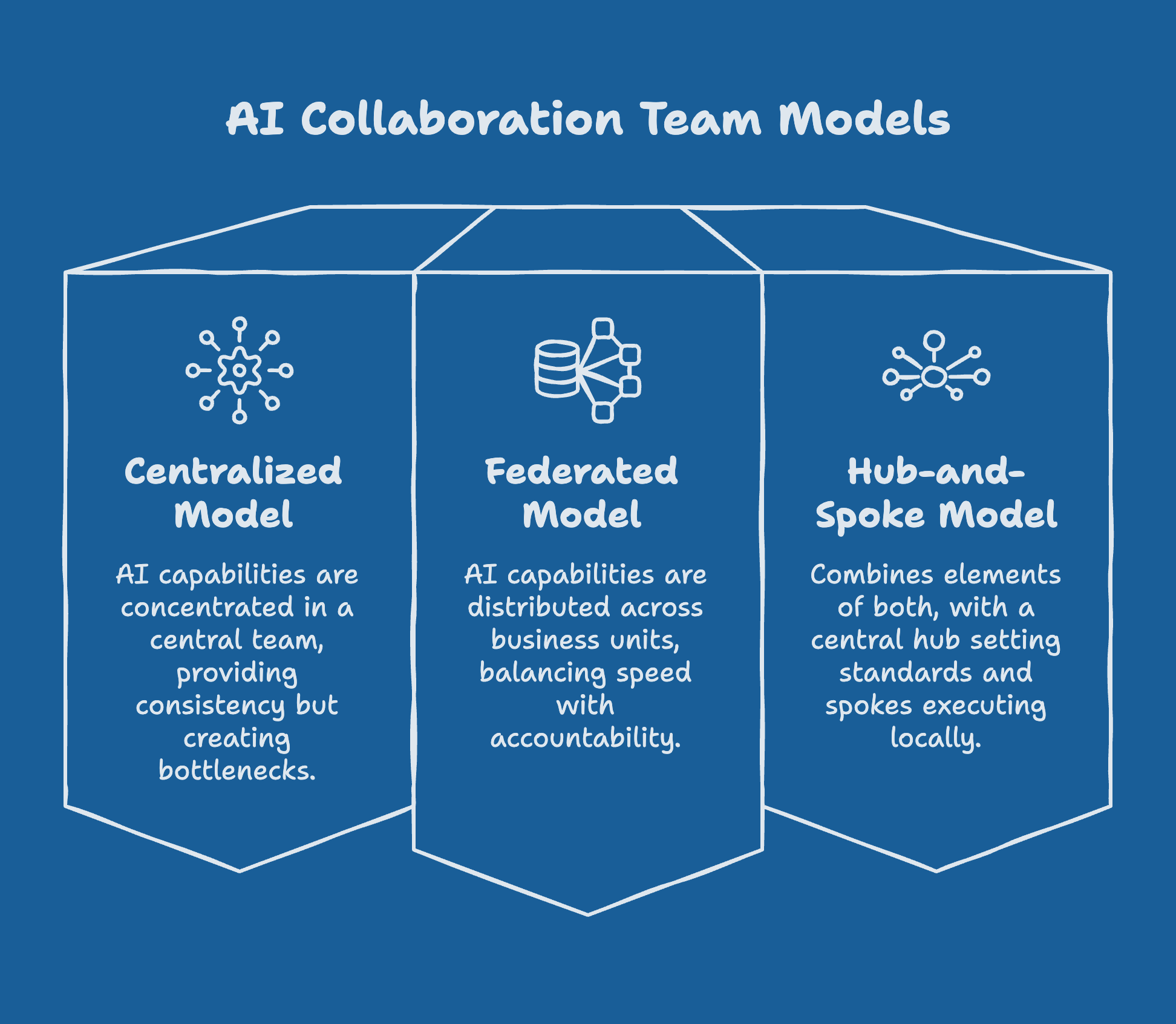
How should organizations structure teams that include both humans and AI agents? Three models are emerging, each suited to different contexts.
The centralized model concentrates AI capabilities in a central team that serves the entire organization. This provides consistency in governance, tooling, and best practices, but creates bottlenecks. Organizations report six-month delays for data access requests under centralized structures, and central teams often lack the domain expertise to govern data and processes they do not understand.
The federated model distributes AI capabilities across business units, each owning its agents and workflows within shared governance guardrails. This model reports 35 percent faster deployment timelines than centralized approaches and 40 percent fewer governance incidents than unstructured deployments. It balances speed with accountability.
The hub-and-spoke model combines elements of both. A central hub sets technology standards, governance policies, security requirements, and best practices. Spokes in each business unit execute locally within those standards, adapting agent workflows to domain-specific needs. Current enterprise adoption splits roughly evenly: 36 percent centralized, 36 percent federated, and 29 percent hybrid hub-and-spoke.
Hybrid Workforce Collaboration
The right model depends on organizational size, regulatory environment, and AI maturity. In the mid-market series, we advocated for a lightweight federated approach with a small central governance function. For enterprises, the hub-and-spoke model offers the best balance of control and agility. In both cases, the key is that the structure must account for agents as team members, not just tools. When a business unit deploys 50 agents, someone needs to supervise their performance, update their instructions, manage their access, and handle their failures. That is a staffing decision, not a technology decision.
The Manager as Orchestrator
Of all the role transformations the hybrid workforce requires, the manager's evolution is the most consequential and the most neglected.
The data is unambiguous. When managers actively model AI use, employees report a 30-point lift in confidence toward agentic AI, a 22-point improvement in critical thinking about AI, and a 17-point increase in perceived AI value. Microsoft found that organizational factors, including culture, manager support, and talent practices, explain more than twice the impact of individual factors: 67 percent versus 32 percent. When managers create psychological safety for experimentation, employees report up to 20 additional points of readiness and are 1.4x more likely to be frequent agent users.
Gallup's findings are even more striking. Employees whose managers actively support AI use are 8.7x as likely to say AI has transformed how work gets done. They are 7.4x as likely to say AI gives them more opportunities to do their best work. Gallup CEO Jon Clifton called the manager "a critical factor that the corporate world has largely ignored when it comes to getting results from AI investments."
The manager's role is shifting from task assigner and performance monitor to orchestrator, coach, and trust builder. In the hybrid workforce, managers must set intent for both human and AI team members, design how work flows between them, evaluate agent outputs alongside human contributions, and build the team's capability to work effectively with agents. Microsoft's 2026 Work Trend Index identifies four modes of working with AI based on engagement and agent usage: delegation, collaboration, asking, and exploration. The most effective users are those who "redefine their value around what only humans can do: setting clear intent and designing how work gets done across humans and AI."
This requires new skills that most managers do not yet have. Only 14 percent of leaders are adept at shaping human-AI interactions. The 63 percent of employees who embrace AI more readily when they understand how it is used and retain override control are depending on their managers to provide that understanding and that assurance.
The "Last Mile" and Work Allocation
Every orchestrated workflow has a last mile: the 10 to 20 percent of work that requires human judgment, empathy, creativity, or accountability. Designing for this efficiently is the difference between AI that augments human capability and AI that creates new bottlenecks.
The challenge is twofold. First, the last mile is where the highest-value work concentrates. When agents handle routine inquiries, data processing, and standard analysis, the remaining human work is harder, more ambiguous, and more consequential. This is the dynamic we described in Part 4 as the supervision paradox: as agents handle more routine work, the work that reaches humans becomes more demanding.
Second, nearly half of workers (47 percent, per BCG) report spending more time managing and directing AI than doing the work itself. Sixty-six percent say they received little guidance on how to redeploy the time AI saves. The result is BCG's "joy paradox": 67 percent of regular AI users say AI has improved their job satisfaction, but 41 percent say their cognitive load has increased. AI makes work better and harder simultaneously.
Effective last-mile design follows a principle: automate the obvious, escalate the ambiguous. Not every exception requires human judgment. Most need a rule; a few need a person. The goal is to minimize the number of decisions that reach humans while ensuring that the decisions that do reach them are the ones that genuinely benefit from human capabilities.
Work allocation between humans and agents should be dynamic, not static. As agents improve, the allocation shifts. As business context changes, the allocation adapts. The orchestration layer (discussed in Part 2) manages this allocation in real time, routing work to the right resource, whether human or AI, based on complexity, risk, urgency, and capability.
The Human Side of Transformation
Work redesign is not a spreadsheet exercise. It is a human experience, and the data on that experience is increasingly complex.
AI usage is climbing. Regular AI use has jumped to 45 percent of workers, up 13 percentage points. BCG reports that 74 percent of frontline white-collar employees are now regular AI users, and 42 percent of regular users say AI saves a full workday per week. Microsoft found that 58 percent of AI users are producing work they could not have a year ago, rising to 80 percent among its "Frontier Professionals."
But confidence is falling. ManpowerGroup's 2026 Global Talent Barometer found that while usage rose 13 percent, confidence in using technology fell 18 percent. Forty-three percent fear automation may replace their job within two years, up 5 points from 2025. AI mentions in employee reviews more than tripled (up 240 percent year-over-year), with sentiment now running 53 percent negative after being 55 percent positive just the prior year. Fifty-six percent have received no recent training. Sixty-three percent report burnout.
Only 14 percent of employees consistently get clear, positive net outcomes from AI. Eighty-two percent of enterprises offer some form of AI training, yet 59 percent still report skills gaps. The problem is that most training targets either absolute beginners or AI engineers rather than the 90 percent of workers who need to use AI confidently in their daily roles. The AI skills wage premium has tripled in two years, from 25 percent in 2024 to 62 percent in 2026, creating a widening gap between AI-capable workers and everyone else.
The WEF projects 170 million new jobs created by 2030 with 92 million displaced, a net gain of 78 million. But 40 percent of job skills will change in that window. Organizations that redesign work deliberately, invest in the right training, and support their managers through the transition will capture disproportionate value. Those that bolt AI onto unchanged structures will join the 40 percent whose agentic AI projects are canceled.
Orchestration Playbook
Decompose three priority workflows this quarter. Select three high-value workflows and break each into its component tasks. Classify every task as human-led, AI-led, or collaborative. For each AI-led task, define the oversight level (Tier 1: agent acts freely, Tier 2: agent recommends and human decides, Tier 3: human only). For each collaborative task, define the handoff points, context requirements, and escalation triggers. The output is a task allocation map that becomes the blueprint for agent deployment and role redesign.
Redesign roles, not just tasks. Task decomposition identifies what changes. Role redesign determines how people experience that change. For each role affected by the task allocation map, define: what tasks move to agents, what new responsibilities emerge (agent supervision, quality review, exception handling), what skills the role now requires, and how performance will be measured. Communicate these changes transparently. The 63 percent of employees who embrace AI when they understand how it is used and retain override control need to see the redesigned role as an upgrade, not a diminishment.
Choose your team structure deliberately. Assess your organization against the three models: centralized (best for early-stage AI with strong governance needs), federated (best for organizations with diverse business units and moderate AI maturity), and hub-and-spoke (best for enterprises balancing scale with domain specificity). Whichever model you choose, explicitly assign accountability for agent performance, governance, and human oversight within the structure. Do not let agents accumulate in business units without someone responsible for managing them.
Invest in managers first. The data shows that manager behavior has 5x more influence on AI adoption outcomes than individual tools or training. Before launching organization-wide AI training, equip managers with three things: hands-on experience with the agents their teams will use, a framework for allocating work between humans and agents, and explicit permission and psychological safety to experiment. Track whether managers are modeling AI use; it is the single strongest predictor of team-level adoption and trust.
Design for the last mile from day one. For every workflow you redesign, define the last-mile work: what decisions require human judgment, what exceptions require human empathy, what outputs require human accountability. Design the workflow so this work arrives in manageable batches with sufficient context, not as a firehose of escalations. Track the ratio of routine to exception work over time. If the exception rate is climbing, the agent needs better instructions. If it is not declining as the agent matures, the task decomposition needs revisiting.
This is Part 6 of the "Orchestrating the Hybrid Workforce" series. Part 7 will examine orchestration governance, trust, and accountability: why governing multi-agent systems is qualitatively different from governing individual AI tools, and why governance must be designed into the orchestration layer itself. For the companion frameworks from prior series, including the Dual Maturity Quick Diagnostic and Agentic AI Readiness Assessment, visit arionresearch.com. Follow Arion Research for ongoing analysis at arionresearch.com/blog.