
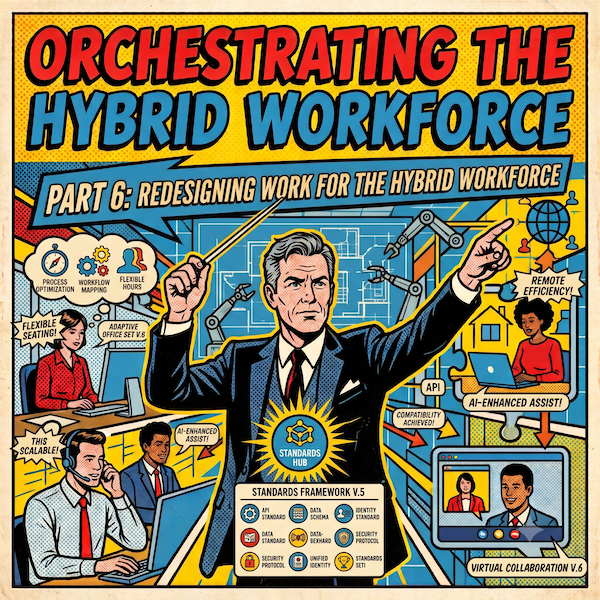
Orchestrating the Hybrid Workforce, Part 6: Redesigning Work for the Hybrid Workforce
Eighty-four percent of companies have not redesigned jobs around AI capabilities, and the cost of that gap is now measurable. BCG's 2026 study of nearly 12,000 workers found that strategy and workflow redesign lift business impact by 25 percentage points while better tools alone move it by only 5, a five-to-one multiplier. In this sixth article of "Orchestrating the Hybrid Workforce," we examine how to decompose jobs into human-led, AI-led, and collaborative tasks, map the new role archetypes where non-technical AI-augmented roles will outnumber technical ones, and compare three team structure models (centralized, federated, hub-and-spoke). The article makes the case that the manager's evolution is the most consequential transformation: Gallup found an 8.7x multiplier when managers actively support AI, and Microsoft measured a 30-point trust lift when managers model AI use. We confront BCG's "joy paradox" (67 percent improved satisfaction, 41 percent increased cognitive load) and the finding that 47 percent of workers spend more time managing AI than doing the work itself. The Orchestration Playbook provides a task decomposition template, role redesign framework, team structure decision guide, and last-mile design principles.
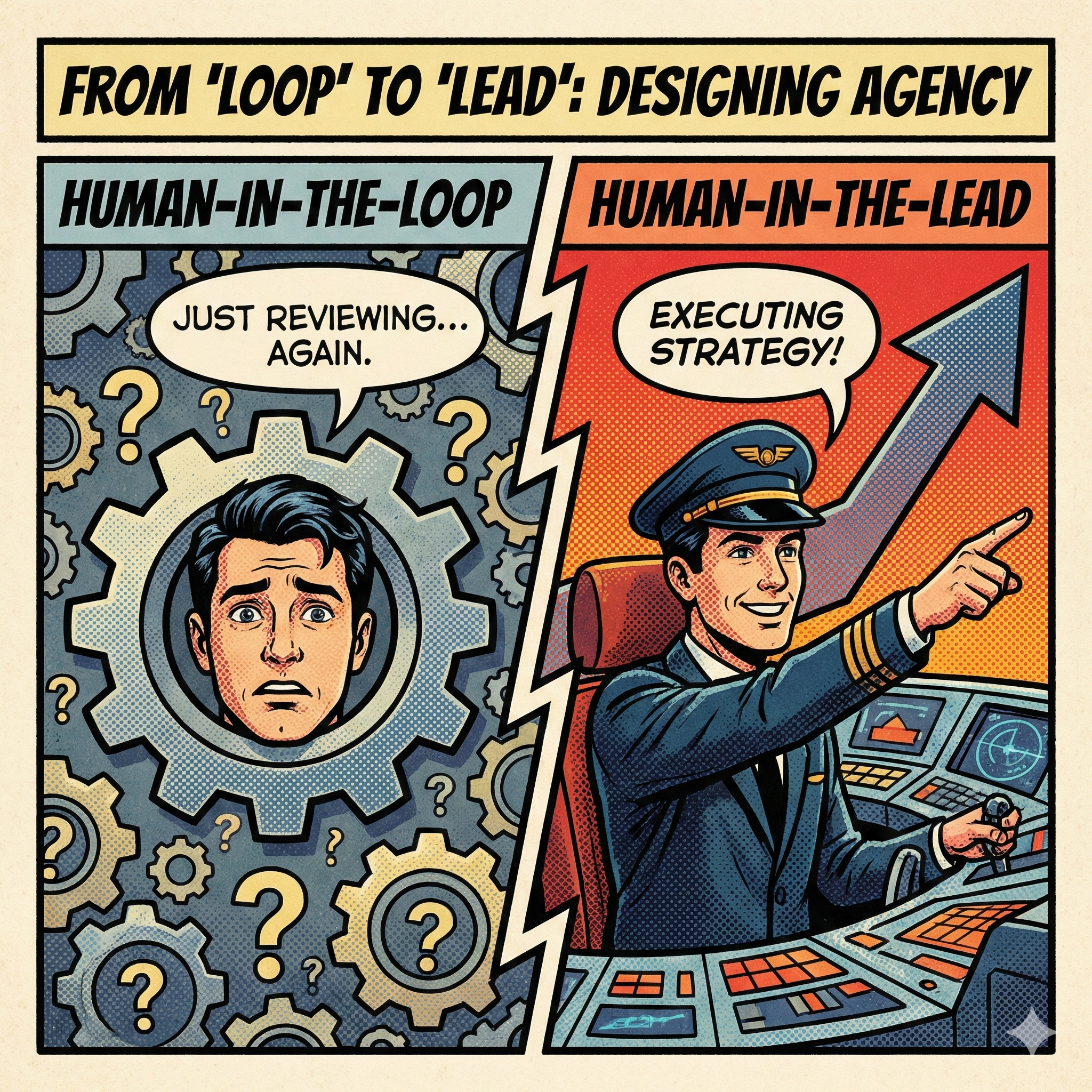
From "Human-in-the-Loop" to "Human-in-the-Lead": Designing Agency for Trust, Not Just Automation
If we want to scale agentic AI, we need a different model. We must stop treating humans as safety nets reacting to AI outputs and start treating them as pilots directing AI capabilities. This is the shift from "Human-in-the-Loop" to "Human-in-the-Lead."