

research Agenda
What we are studying this quarter, what we argue, and what we want to learn from technology providers.
Q4 2026. Updated October 2026. Reviewed quarterly.
Introduction
Arion Research studies how enterprises adopt agentic AI and build a digital workforce. This agenda sets out the nine themes we cover, the questions we are pursuing now, and the position we bring to each.
Enterprise leaders can use it to find research on the decisions in front of them. Technology providers can use it to see where a briefing or a research partnership fits.
The nine themes
1. Agent orchestration and enterprise architecture
The question: How do agents coordinate work across applications, platforms and vendors, and who controls the new layers?
Our position: Orchestrating work matters more than adding applications. Enterprise applications are unbundling into platforms and callable capabilities, and integration is the bottleneck that decides who wins.
This quarter we are asking:
Is the coordination layer a product, a protocol or an open standard, and who owns it?
When does native agent depth beat cross-platform breadth?
Does MCP hold up as the default connection for governed, multi-vendor work?
What happens to the application when vendors expose its capabilities to any agent?
What we want to hear in briefings: How your agents discover, call and coordinate with other vendors' agents. Protocol support, including MCP and A2A. What you expose headlessly. How conflicts between agents are resolved.
Start here: The Future Enterprise report and the Future Enterprise blog series, including the Agent Service Bus analysis.
2. Agent governance and operations
The question: What does it take to trust, control and account for agents in production?
Our position: Governance has to be designed in. Controls belong in the architecture from the start and outside the model, and every agent needs a named owner.
This quarter we are asking:
What does continuous audit require in practice?
Who is the single accountable owner of an agent?
How do enterprises inventory, monitor and stop agents across platforms?
Can certification stand in for continuous oversight?
What we want to hear in briefings: Agent inventory, monitoring and audit trails. Your identity and permission model for agents. Shutdown and incident notification. What is enforced versus only logged.
Start here: Agentic Governance-by-Design and the Accountable Autonomy series in The Digital Workforce.
3. AI strategy, operating model and readiness
The question: How do leaders tie AI to business strategy and know the organization is ready?
Our position: AI strategy is business strategy. Organizational readiness and agentic capability are two different problems, and they have to advance together.
This quarter we are asking:
Why do most enterprises use AI without making it core to operations?
Which readiness dimensions predict success with agents?
How should boards and CEOs measure strategic AI impact?
Where do organizations overshoot or undershoot their maturity?
What we want to hear in briefings: How you assess customer readiness. What separates customers who reach production from those who stall. Time to value.
Start here: The AI Strategy is Business Strategy series on the Arion blog, the Dual Maturity Framework, and The Complete Agentic AI Readiness Assessment.
4. Digital workforce and organization
The question: How do roles, talent, leadership and accountability change when agents join the team?
Our position: Humans lead. Agents and people work together, with people setting direction and holding accountability.
This quarter we are asking:
What new roles does agent oversight create, and who is training people for them?
How does oversight scale without burning out the people doing it?
What changes in the org chart when agents take on defined jobs?
Why does adoption stall on people and not technology?
What we want to hear in briefings: How your product divides work between people and agents. Approval gates. Evidence on adoption and change management.
Start here: Building the Digital Workforce, The Digital Workforce newsletter, and the Disambiguation podcast.
5. Economics of agentic AI
The question: How are agents priced, measured and insured, and who pays when they are wrong?
Our position: Measure outcomes, not activity. Whoever controls metering and attribution shapes the economics of the agentic enterprise.
This quarter we are asking:
What replaces per-seat pricing, and does outcome pricing work?
How do enterprises attribute return to agent work?
How should AI spend be managed as its own category?
Can insurers price agent liability?
What we want to hear in briefings: Your pricing model and how it is metered. Customer ROI evidence. Cost per agent or conversation at scale. Liability and indemnification terms.
Start here: The pricing analysis in the Future Enterprise series, and our ROI and KPI research reports.
6. Market, vendors and models
The question: Who is building what, how agentic is it, and which vendors will last?
Our position: A map needs a method. We classify products against published tests, not vendor labels.
This quarter we are asking:
Which products are native AI versus AI embedded, and why does that matter to buyers?
Where is consolidation heading?
How should buyers assess model provider viability and concentration risk?
Which emerging categories deserve a place in the Atlas?
What we want to hear in briefings: Product architecture and AI dependency. Agentic level, with evidence. Roadmap. Customer proof.
Start here: The Enterprise AI Atlas and The Arion Brief: AI at 10.
7. AI in go-to-market and customer experience
The question: How is AI changing how companies market, sell and serve?
Our position: Evidence over claims. We separate what is new from what is repackaged, and judge by measured revenue and service outcomes.
This quarter we are asking:
Are agent governance and outcome reporting becoming buying criteria in revenue technology?
What happens to the CRM when the interface moves to AI workspaces?
Where do agents deliver measured results in sales, marketing and service?
What we want to hear in briefings: Measured customer outcomes. What agents do autonomously versus with approval. Data and context requirements. Pricing.
Start here: In the Hot Seat, and our customer experience, commerce and sales technology research reports.
8. Operational and vertical AI
The question: Where do agents create value in operations, finance, supply chain and industry-specific work?
Our position: Vertical depth beats horizontal breadth. The value is in specific, well-understood processes with controls built in.
This quarter we are asking:
Which back-office processes are ready for agents today?
How are mid-market ERP vendors bringing agents to market?
What controls do agents need in systems that move money and materials?
Where does vertical depth beat a general platform?
What we want to hear in briefings: Process coverage and pilot results. Approval and audit design. Integration with systems of record. Industry data advantage.
Start here: The use case and industry issues of The Digital Workforce and the vertical AI episodes of Disambiguation.
9. Data foundations and sovereignty
The question: What data quality, governance and control do agents need to work?
Our position: Data quality comes first. An agent reasoning over poor data produces confident wrong actions.
This quarter we are asking:
Which data quality gaps cause agent projects to fail?
How do sovereignty and regional rules change where agents and data can run?
What does governance of agent memory and context require?
What we want to hear in briefings: Data requirements for your agents. Residency and sovereignty options. How context and memory are stored and governed.
Start here: Our AI privacy research reports and the data quality issues of The Digital Workforce.
On our watchlist
Topics we are tracking that are not yet core themes:
Answer engine optimization and AI discovery
Agentic commerce and agent access
Regulation and enforcement
Agent identity
Agent memory and context
AI agent insurance.
Work with us on this agenda
Brief us. If your product bears on one of these themes, tell us what you are building. Briefings are free and carry no obligation.
Sponsor or commission research. We run custom and multi-sponsor studies on the questions above.
License our research. Ask about reprint and distribution rights for published reports.
Our independence
Briefings inform our research but do not buy coverage. Atlas listings and assessments are never paid. Sponsored research is labeled as sponsored, and we keep editorial control of findings.
FAQs
What does Arion Research cover?
1
Nine themes in enterprise agentic AI: agent orchestration and enterprise architecture, agent governance and operations, AI strategy and readiness, the digital workforce, the economics of agentic AI, the vendor and model market, AI in go-to-market and customer experience, operational and vertical AI, and data foundations and sovereignty.
Which technology categories does Arion Research cover?
2
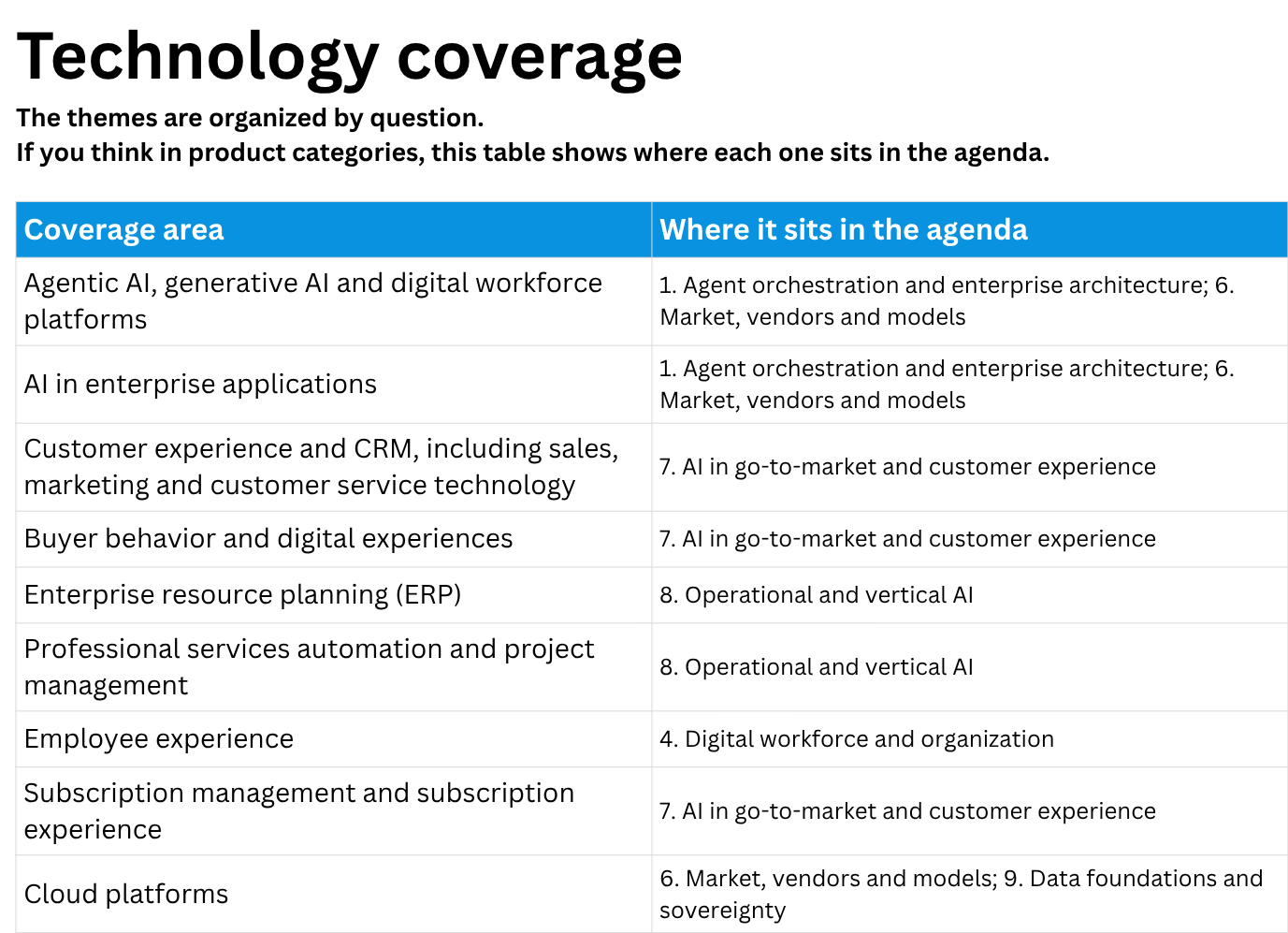
Agentic AI, generative AI and digital workforce platforms, AI in enterprise applications, customer experience and CRM (sales, marketing and customer service technology), ERP, professional services automation and project management, employee experience, subscription management, and cloud platforms.
How often is the research agenda updated?
3
The themes are reviewed and updated every quarter. New research is published weekly across the blog, newsletters and podcast.
How does a technology provider brief Arion Research?
4
Use the briefing request form. Briefings are free and carry no obligation.
No. Assessments follow the same published method for every vendor, client or not.