AI Strategy is Business Strategy, Part 9: Strategic Risk; The Cost of Action and Inaction
This is the ninth article in a 12-part series arguing that AI strategy and business strategy must be the same strategy. Each article examines a critical dimension of strategic AI alignment and includes a "Strategy Playbook" section with actionable guidance.
Risk Is Not Optional
Every AI strategy involves risk. The prior articles in this series addressed strategy alignment, archetypes, CEO leadership, competitive dynamics, business model transformation, data strategy, portfolio management, and talent strategy. Each assumed that the organization has evaluated the risks of its chosen path. Now let’s examine what that evaluation might look like.
The most common risk management failure in AI strategy is treating inaction as risk-neutral. It’s not. "Wait and see" is a high-risk strategy with compounding costs. The competitive divide data from Part 4 showed that the gap between AI leaders and laggards is accelerating, not shrinking, or even staying the same. Every quarter of delay widens the gap in data, organizational capability, and talent. The forgiveness window that let early movers experiment and learn is closing. Inaction is not caution; instead it’s a bet that the competitive dynamics will reverse. Unfortunately the data shows that is a losing bet.
Action without strategy though, is equally dangerous. RAND's analysis documented that over 80% of enterprise AI projects fail to deliver their promised business value. By year-end 2025, over $547 billion of the $684 billion invested globally in AI initiatives had failed to deliver the intended results. The data showed that 33.8% of projects were abandoned before reaching production, 28.4% reached production but failed to deliver the expected value, and 18.1% were running but never recouped the investment. 84% of these failures were attributed to poor leadership: 73% lacked clear metrics, 68% underinvest in building an adequate foundation, and 56% lost C-suite sponsorship.
Strategic AI risk management is built on evaluating three dimensions simultaneously: the risks of moving too fast, the risks of moving too slow, and the risks of moving in the wrong direction. Most organizations evaluate only one dimension, usually the risk of action, and default to caution. You need a framework for evaluating all three.
The Risk of Inaction
The cost of AI inaction compounds across four accelerating dimensions.
Competitive erosion. The learning flywheel from Part 4 means that every quarter an organization delays production deployment is a quarter in which AI leaders are training their systems on real operational data, refining against real edge cases, and building capabilities that late movers cannot quickly replicate. BCG's "future-built" companies achieve 3.6 times total shareholder return compared to laggards. Accenture's AI-mature organizations grow 4.7 times faster year over year. These are not temporary advantages. They are structural gaps that widen with each cycle of the flywheel. The organizations that start now face a competitive catch-up challenge; but those that wait another year face a structural disadvantage that may become permanent.
Talent drain. Part 8 established that AI-capable talent gravitates toward organizations with active AI projects in production. The 62% wage premium and 3.2-to-1 demand-to-supply ratio mean the talent market is a zero-sum competition. Organizations that delay AI deployment do not just miss the competitive advantage of AI systems, but also lose access to the necessary talent. AI engineers want to work where they can build and ship at scale, not where they are constrained to proof-of-concept / endless pilot exercises. Every quarter of inaction makes the talent acquisition challenge more acute and more expensive.
Capability gaps. The institutional knowledge of how to orchestrate AI agents, design human-AI collaboration, and govern multi-agent systems develops through practice, not from case studies, consulting engagements, or vendor partnerships. Organizations that delay building this capability are not preserving their ability to execute a winning strategy. They are accumulating a capability deficit that becomes progressively more expensive to close because the skills themselves grow out of experience.
Regulatory exposure. This may seem counter-intuitive but inaction increases regulatory risk instead of reducing it. Organizations that delay AI deployment also defer developing robust governance. When they eventually deploy at scale, they do it without the governance infrastructure that regulators increasingly require. MAS, RBI, HKMA, and other regulators are embedding AI governance expectations into standard compliance frameworks. Organizations that build governance into their deployment are positioned for more effective compliance. Rushing to deploy without a governance foundation increases enforcement risk as well as opening the organization up to a number of PR / brand, ethical, privacy and other business damaging risks.
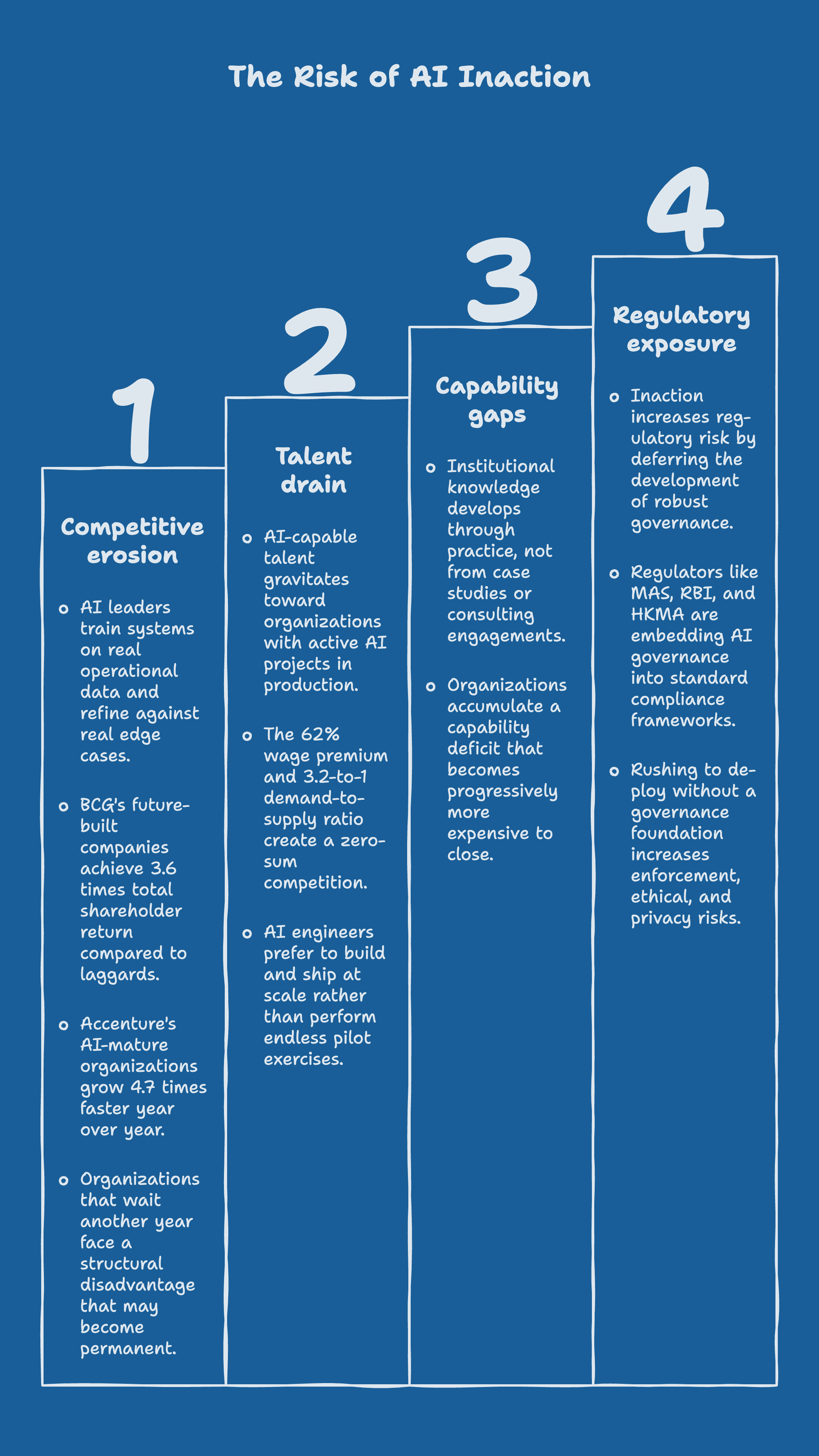
The Risk of AI Inaction
The compounding nature of these costs is the real story. Inaction is not static, it exponentially increases risk. For every quarter of delay competitive erosion becomes steeper, talent harder to attract, capability gaps wider, and eventual governance catch-up more expensive. The "inaction tax" accelerates over time.
The Risk of Action Without Strategy
If inaction is high-risk, taking action without strategy is equally dangerous. The failure data is unambiguous: AI investments disconnected from business outcomes, competitive positioning, and organizational design produce expensive mediocrity.
The failure modes fall into three categories.
Strategic misalignment. The organization deploys AI that does not serve its strategic priorities. This is the strategy gap from Part 1: AI investments chosen for their technical appeal rather than their business impact. The result is a portfolio of AI capabilities that impress in demonstrations but produce no measurable competitive advantage. The 95% of generative AI pilots that produce no P&L return, documented by MIT, trace primarily to this failure mode.
Organizational unreadiness. The organization deploys AI without the workforce readiness, change management, and workflow redesign required for adoption. The 93/7 budget split from Part 1, with 93% allocated to technology and 7% to people, predicts this outcome. BCG's research found that employees at companies pursuing workflow redesign are 24 percentage points more likely to see measurable business impact. Organizations that skip the organizational preparation may achieve technical deployment but fail at business adoption.
Governance deficit. The organization deploys AI without the governance structures required for responsible, compliant, and sustainable operation. This is governance deferral: treating governance as something to address after deployment rather than designing it into the system from the start. Our orchestration series from earlier in 2026 made the case for governance-by-design, embedding governance into AI systems from conception rather than bolting it on after the fact. Organizations that defer governance are accumulating strategic risk that materializes as incidents, compliance failures, and loss of stakeholder trust.
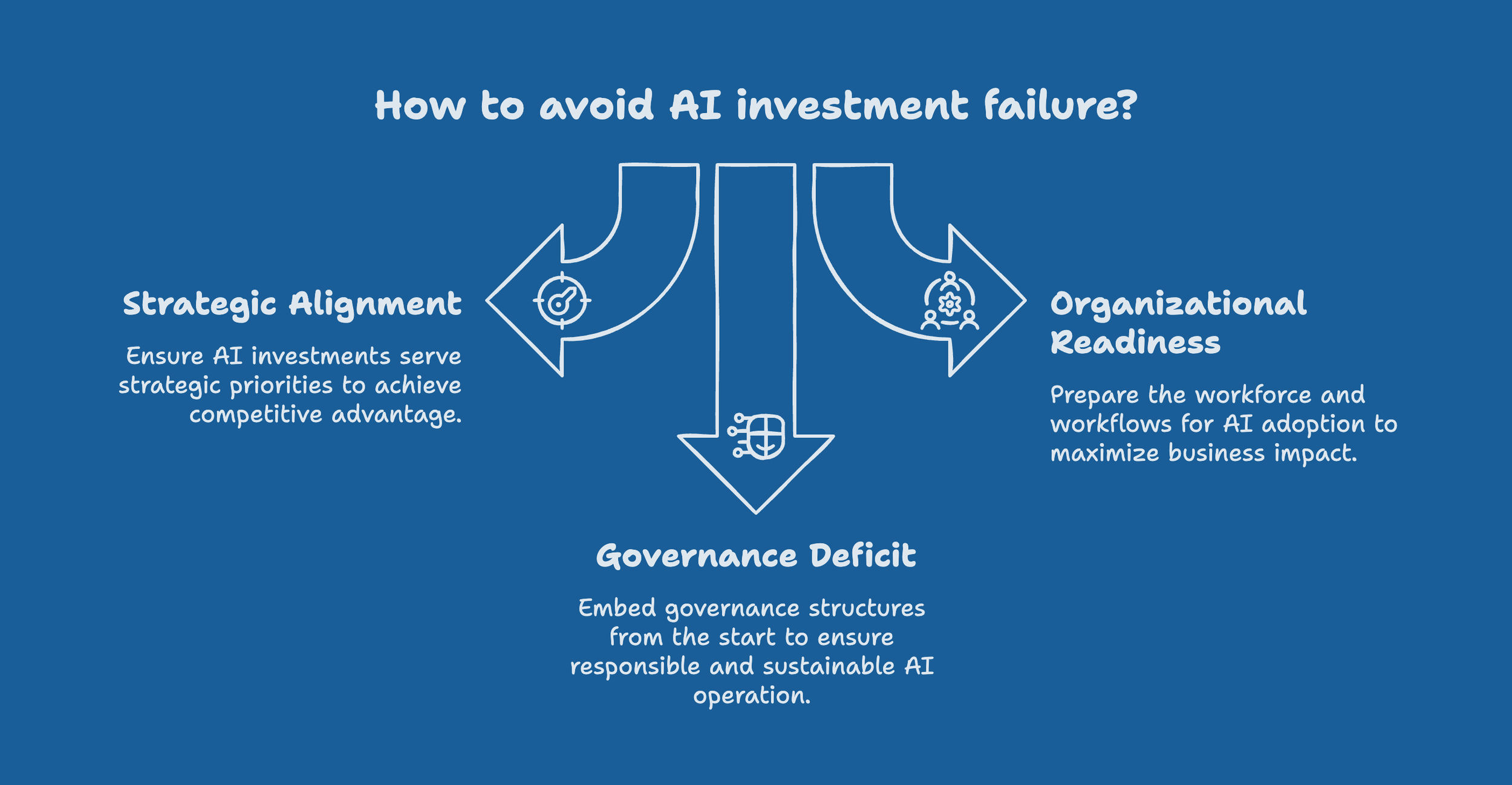
Avoiding AI Investment Failure
The common thread across these failure modes is that they are strategic failures, not technology failures. The technology works. The strategy, organizational preparation, and governance do not. This is why the thesis of this series, that AI strategy must be business strategy, matters for risk management: the primary risks of AI are strategic risks, and they require strategic responses.
The Governance Risk
Governance risk deserves special attention because it’s the most consequential risk that organizations systematically underestimate.
Gartner predicts that by 2030, 50% of AI agent deployment failures will result from insufficient governance platform runtime enforcement. By 2027, 40% of enterprises will demote or decommission autonomous AI agents due to governance gaps identified only after production incidents occur. More than 60% of early agentic orchestration implementations will fail to meet performance or cost expectations because enterprises underestimate the integration, governance, and talent requirements needed to make digital workforces reliable at scale.
The financial exposure is substantial. IDC predicts that by 2030, up to 20% of G1000 organizations will face lawsuits, substantial fines, and CIO dismissals due to inadequate AI agent governance. Through 2027, manual AI compliance processes will expose 75% of regulated organizations to fines exceeding 5% of their global revenue. Gartner projects that AI regulatory violations will result in a 30% increase in legal disputes for technology companies by 2028.
Governance risk is compounding because governance deferral creates what amounts to an unbooked liability. Every AI system deployed without adequate governance structures, monitoring, and accountability is a potential incident, a potential compliance violation, a potential lawsuit. The liability accumulates with each deployment, and the remediation cost grows as the installed base of ungoverned systems expands. Organizations that build governance alongside deployment pay the cost incrementally and manageably. Those that defer governance until forced by an incident or regulatory action pay the cost all at once, often at a premium.
The governance-by-design thesis from the orchestration series is the risk management response: embed governance into AI systems from the start, design accountability structures before deployment, and treat governance capability as a strategic investment rather than a cost. Organizations that adopt this approach convert governance from a risk factor into a competitive advantage, because governed AI systems can be trusted with higher-autonomy applications that ungoverned systems cannot safely perform.
The Regulatory Risk
The regulatory landscape adds a layer of strategic complexity that most organizations have not fully incorporated into their AI planning.
Over 72 countries have launched more than 1,000 AI policy initiatives. The landscape splits into three postures: the EU's binding, risk-tiered AI Act; a US federal approach favoring light-touch rules and preemption of state law; and active US state legislation filling the federal gap. Singapore launched the world's first governance framework for agentic AI in January 2026. South Korea's AI Basic Act became the Asia-Pacific's first binding comprehensive AI law the same month. The EU AI Act's most consequential provisions, including obligations for high-risk AI systems, became enforceable in August 2026.
The strategic challenge is not that regulation exists, but that regulation is fragmented. Every multinational must answer the same question: does your governance architecture work across every geography you serve? The answer for most organizations is no, because their governance was designed for a single regulatory environment, if it was designed at all.
Regulatory fragmentation creates three strategic risks. First, compliance cost escalation: organizations that build separate compliance frameworks for each jurisdiction face escalating costs as regulation proliferates. Gartner projects that by 2030, fragmented AI regulation will extend to 75% of the world's economies. Second, market access constraints: organizations whose AI systems cannot meet local regulatory requirements lose access to markets, an increasingly significant competitive disadvantage as AI becomes integral to products and services. Third, planning uncertainty: the pace of regulatory change makes multi-year AI investment planning more difficult, because the regulatory environment the investment was designed for may change before the investment produces returns.
The governance-by-design approach mitigates regulatory risk because it builds adaptable governance infrastructure rather than jurisdiction-specific compliance “band-aids.” Organizations that embed governance principles, including transparency, accountability, human oversight, and data quality, into their AI architectures can adapt to new regulations by adjusting parameters rather than redesigning systems. This is not abstract: it’s the difference between a governance architecture that needs six months to comply with a new regulation and one that needs six weeks.
Scenario Planning for AI Strategy
Given the uncertainty inherent in AI's trajectory, strategic planning must account for multiple scenarios rather than committing entirely to a single forecast.
Best case scenario. AI capabilities advance rapidly, adoption accelerates, and the organization's AI investments produce returns at the high end of projections. In this scenario, the primary risk is underinvestment: the organization's AI portfolio is too conservative, and competitors who invested more aggressively capture disproportionate advantage. The strategic response is to build escalation triggers into the portfolio plan: predefined conditions under which investment increases automatically, so the organization can accelerate without requiring new approval cycles.
Base case scenario. AI capabilities advance steadily, adoption follows the current trajectory, and the organization's investments produce returns within the projected range. In this scenario, the primary risk is portfolio imbalance: the organization has the right total investment but allocates it suboptimally across efficiency, growth, experience, and platform plays. The strategic response is the quarterly portfolio review process from Part 7, with regular rebalancing based on performance data and competitive dynamics.
Worst case scenario. AI capabilities plateau, adoption slows, or the regulatory environment constrains deployment significantly. In this scenario, the primary risk is overcommitment: the organization has invested heavily in AI capabilities that do not produce the expected returns. The strategic response is to build optionality into AI investments: architecture decisions that preserve flexibility, vendor relationships that avoid lock-in, and staged funding models that allow course correction without stranding prior investments.
The purpose of scenario planning is not to predict which scenario will materialize. It is to ensure the organization's strategy is resilient across scenarios. A strategy that produces catastrophic outcomes in the worst case is fragile, regardless of how well it performs in the best case. A strategy that produces acceptable outcomes across all three scenarios is robust, even if it doesn’t maximize returns in the best case.
Strategic Resilience and Flexibility
Resilience in AI strategy means building the capacity to adapt as conditions change, rather than committing irreversibly to a single path. Three architectural decisions create or destroy strategic flexibility.
Standards-based architecture. The Model Context Protocol (MCP), now implemented on more than 10,000 enterprise servers with over 97 million SDK downloads, and the Agent-to-Agent (A2A) protocol, with over 150 participating organizations and production deployments across major cloud platforms, provide the interoperability standards that enable strategic flexibility. Organizations that build on these open standards can switch vendors, add new agent providers, and adapt their architectures without redesigning their systems. Organizations that build on proprietary protocols face switching costs that escalate with each deployment.
Multi-vendor strategy. By the end of 2026, industry analysts project that 40% of enterprise applications will include task-specific AI agents, while simultaneously identifying ecosystem lock-in as a critical AI blind spot. The five contract provisions that protect strategic flexibility are data portability clauses requiring standard-format exports, 90-day minimum pricing change notices, model continuity commitments providing advance notice before deprecation, exit assistance obligations, and explicit API interoperability certifications confirming MCP and A2A compatibility. Organizations that negotiate these provisions preserve options. Those that accept default vendor terms accumulate dependency.
Staged investment. The self-funding model from Part 7 is an optionality strategy as much as a portfolio strategy. By funding transformation investments with efficiency returns rather than large upfront commitments, organizations preserve the ability to redirect resources if conditions change. Staged funding with clear decision gates, predefined success criteria and go/no-go dates at each stage, prevents both premature scaling and sunk cost attachment. If a stage does not meet its criteria, the organization redirects rather than escalates.
The common principle across these decisions is reversibility. Strategic resilience comes from making decisions that can be adjusted as new information emerges, rather than decisions that lock the organization into a single path. In a technology environment that is changing as rapidly as AI, the ability to adapt is itself a competitive advantage.
The Vendor Risk Dimension
The vendor landscape introduces strategic risks that many organizations underestimate because vendor relationships are managed as procurement decisions rather than strategic ones.
Platform dependency. Organizations that build their AI strategy on a single vendor's platform, models, and tools create a dependency that the vendor can exploit through pricing changes, feature deprecation, or strategic pivots that do not align with the customer's interests. The SaaS market disruption from Part 5 applies to AI vendors as well: the vendor's business model may shift in ways that increase costs, reduce capabilities, or create competitive conflicts for the customer.
Pricing model volatility. The shift from per-seat to outcome-based pricing described in Part 5 creates uncertainty for both vendors and customers. Organizations whose AI budgets are built on current pricing models may face significant cost increases as vendors adjust their economics. The 4,500-fold pricing spread between cheapest and most expensive models, and the 30-fold increase in per-interaction costs for orchestrated workflows versus simple queries, mean that pricing model changes can have outsized budget impact.
Agentic arbitrage exposure. The agentic arbitrage dynamic from Part 5 cuts both ways. Your vendors may be disrupted by AI agents that perform their functions at lower cost. And your organization may be disrupted by AI agents that perform your functions for your customers. Both dimensions require monitoring. If a critical vendor's business model is vulnerable to agentic arbitrage, the organization's AI infrastructure is at risk. If the organization's own value proposition is vulnerable, the AI strategy must include defensive positioning.
The strategic response is vendor portfolio management with the same rigor applied to AI investment portfolio management from Part 7. Diversify across vendors to reduce dependency. Negotiate contractual protections that preserve flexibility. Monitor vendor viability as a strategic risk factor. And design the architecture to enable vendor substitution without operational disruption.
Strategy Playbook
The three-dimensional risk assessment.
Score your organization across three risk dimensions, each on a 1-to-5 scale across five factors.
-Action risk (the risk of moving too fast): governance maturity (1 = comprehensive governance-by-design, 5 = no governance framework), organizational readiness (1 = workforce fully prepared, 5 = no training or change management), investment concentration (1 = diversified portfolio, 5 = all-in on a single bet), vendor dependency (1 = multi-vendor with standards-based architecture, 5 = single-vendor proprietary lock-in), and regulatory exposure (1 = governance meets all applicable requirements, 5 = significant compliance gaps).
-Inaction risk (the risk of moving too slow): competitive position (1 = leading in AI deployment, 5 = no production AI), talent trajectory (1 = attracting AI talent, 5 = losing AI talent to competitors), data asset development (1 = learning flywheel running, 5 = no proprietary operational data), capability gap (1 = strong orchestration and governance skills, 5 = no institutional AI knowledge), and market timing (1 = forgiveness window still open, 5 = competitors have set performance expectations).
-Direction risk (the risk of misalignment): strategy alignment (1 = AI investments directly serve strategic priorities, 5 = AI investments disconnected from strategy), archetype coherence (1 = portfolio matches chosen archetype, 5 = portfolio contradicts archetype), portfolio balance (1 = appropriately diversified, 5 = concentrated in a single category), measurement clarity (1 = clear business outcome targets, 5 = no defined success metrics), and accountability structure (1 = outcome owners with authority, 5 = fragmented accountability).
A total score above 15 in any dimension indicates elevated risk requiring immediate attention. Compare scores across dimensions: most organizations will find that their inaction risk score exceeds their action risk score, suggesting that the greater danger is moving too slowly rather than too quickly.
Scenario planning workshop.
Conduct a half-day session with the executive team to develop three scenarios for your industry's AI trajectory over the next 24 months. For each scenario, answer four questions. First, what does AI adoption look like in your industry under this scenario, and how does your competitive position change? Second, what happens to your current AI portfolio under this scenario: which investments become more valuable, which become less valuable, and which become stranded? Third, what is the financial impact: revenue, cost structure, margin, and competitive positioning? Fourth, what strategic response does this scenario require, and how quickly could your organization execute it? The output is not a prediction. It is a resilience assessment: a clear picture of where the organization is robust, where it is fragile, and where it needs to build flexibility.
The strategic flexibility audit.
For each major AI investment and architectural decision, evaluate flexibility using three questions.
-First, reversibility: if conditions change, how easily can this decision be reversed or redirected? Score 1 (easily reversible) to 5 (irreversible).
-Second, interoperability: does this decision use open standards (MCP, A2A) that enable vendor substitution, or proprietary protocols that create lock-in? Score 1 (fully standards-based) to 5 (fully proprietary).
-Third, staged commitment: is this investment structured with decision gates that allow course correction, or is it a single large commitment? Score 1 (fully staged) to 5 (single commitment). Decisions with high scores across all three dimensions are strategic rigidity points.
Develop mitigation plans for each: negotiate contract protections, introduce standards-based alternatives, or restructure the investment into stages.
Governance risk quantification.
Estimate the financial exposure of governance gaps using four calculations.
-First, regulatory fine exposure: for each jurisdiction where you deploy AI, identify the maximum penalty for AI governance violations (7% of global turnover under the EU AI Act, 5% under various other frameworks) and estimate the probability of enforcement action based on your current governance maturity.
-Second, litigation exposure: estimate the legal costs and potential damages of AI-related lawsuits, using the Gartner projection of a 30% increase in AI-related legal disputes by 2028 as a baseline.
-Third, incident cost: estimate the operational, reputational, and remediation costs of an AI governance incident, using industry benchmarks for data breaches and compliance failures.
-Fourth, remediation cost: estimate the cost of building governance infrastructure retroactively versus proactively, recognizing that retroactive governance is typically three to five times more expensive because it requires retrofitting existing systems rather than designing governance into new ones.
Present the aggregate exposure to the board alongside the cost of governance-by-design investment. The comparison rarely favors deferral.
For the companion frameworks from all prior series, including the Dual Maturity Quick Diagnostic and Agentic AI Readiness Assessment, visit arionresearch.com. The themes of strategic alignment, governance-by-design, and orchestration architecture will be developed further in the forthcoming "Governance-by-Design" book. Follow Arion Research for ongoing analysis at arionresearch.com/blog.