AI Strategy is Business Strategy, Part 8: Talent Strategy as Competitive Strategy
This is the eighth article in a 12-part series arguing that AI strategy and business strategy must be the same strategy. Each article examines a critical dimension of strategic AI alignment and includes a "Strategy Playbook" section with actionable guidance.
The People Problem That Is Not a People Problem
The prior articles in this series addressed strategy gaps, archetypes, CEO leadership, competitive dynamics, business model transformation, data strategy, and portfolio management. Each examined a dimension of AI and business strategic alignment, where organizations make decisions that determine outcomes. Now we’ll examine the dimension that may matter most: talent.
The conventional framing treats talent as a support function. The business decides the AI strategy, and HR finds the people to execute it. This framing is wrong in two ways. First, it assumes that the talent required for any AI strategy either exists internally or is available and acquirable. It is not. AI talent demand exceeds supply 3.2 to 1, with 1.6 million open positions against roughly 518,000 qualified candidates. The 62% wage premium for AI skills, up from 25% in 2024 and 57% in 2025, reflects a market where talent scarcity is structural.
Second, the conventional framing assumes that talent decisions are downstream of strategy decisions. They are not. The talent an organization has, and the talent it can attract and develop, determines which AI strategies it can execute. An organization that selects the Platform-First archetype from Part 2 but lacks the orchestration design and governance capability to execute it does not have a talent gap. It has a strategy gap disguised as a talent gap. The talent strategy must be designed concurrently with the AI strategy, not after it.
The World Economic Forum's Future of Jobs Report projects a net increase of 78 million jobs by 2030, with 170 million new roles created and 92 million displaced. The skills gap is cited by 63% of employers as the single biggest barrier to business transformation. Nearly 40% of job skills are expected to change. This is not a human resources challenge. It is a competitive strategy challenge that determines which organizations can execute their AI ambitions and which cannot.
The 93/7 Problem as Strategic Failure
Part 1 of this series introduced the 93/7 split: Deloitte's finding that 93% of AI-related funding goes to technology and just 7% to training and upskilling the people who use it. Seven articles later, this ratio continues to explain why AI investments underperform.
The math is straightforward. An organization that spends $10 million on AI technology and $750,000 on training has made a strategic decision, whether it recognizes it or not, that the technology will be effective regardless of how prepared the workforce is to use it. IBM's 2026 CEO Study found that 83% of CEOs say AI success depends more on people's adoption than technology. Yet only 25% of workers use AI regularly. Kyndryl's 2026 readiness report found that 57% of organizations have broadly deployed AI in core processes, but only 23% of business leaders rate their workforce as fully prepared, down six percentage points from the prior year. The readiness gap is widening as deployment accelerates.
The 93/7 ratio produces predictable outcomes. IBM projects that 53% of employees will need upskilling to perform their current role effectively between 2026 and 2028, and another 29% will require reskilling for a different role. IDC projects over 90% of enterprises will face critical AI skills shortages, with the gap costing an estimated $5.5 trillion in unrealized productivity. Organizations that invest in structured AI training programs see three to four times higher adoption rates than those that rely on self-directed learning. The evidence is clear: training investment is not a nice-to-have. It is a strategic multiplier that determines whether technology investment produces returns.
The portfolio management framework from Part 7 applies directly. The talent investment should be treated as part of the AI portfolio, not as an overhead line item. BCG's research on AI high performers found they invest three times more in process redesign than in the software itself. The 93/7 ratio inverts this relationship, allocating the overwhelming majority to technology and treating the human dimension as an afterthought. Organizations that rebalance toward 70/30 or even 60/40 will outperform those that maintain the current split, because they are investing in the capability that determines whether the technology produces value.
Strategic Workforce Planning for AI
Workforce planning for AI requires forecasting three categories of change: roles that will be created, roles that will be transformed, and roles that will be eliminated. Most organizations focus on the third category because it drives the headline-grabbing displacement numbers. But the strategic opportunity lies in the first two.
Roles being created fall into categories that did not exist three years ago: AI orchestration designers who architect how agents, humans, and workflows coordinate; prompt engineers and AI interaction specialists who optimize human-AI communication; AI governance officers who design and enforce the guardrails for autonomous systems; data product managers who curate and maintain the data assets that power AI; and AI ethics and compliance specialists who navigate the regulatory and ethical dimensions of AI deployment. These roles require a blend of technical understanding and domain expertise that traditional job descriptions do not capture.
Roles being transformed are the largest category and the most strategically significant. The orchestration series examined how AI changes the nature of work rather than replacing workers. Customer service representatives shift from handling routine inquiries to managing complex escalations and supervising AI agent performance. Financial analysts shift from data gathering and basic modeling to strategic interpretation and scenario design. Marketing managers shift from content production to AI-directed content strategy and performance optimization. In each case, the role is not eliminated but elevated, with AI handling routine tasks and humans focusing on judgment, creativity, and relationship management. HR professionals at organizations with AI deployments report far more upskilling activity (57%) than job displacement (7%).
Roles being eliminated are primarily those consisting of routine, repetitive tasks that AI agents perform at lower cost and higher consistency: data entry, basic document processing, standard reporting, and scripted customer interactions. The strategic response is not to delay the transition but to design pathways that move affected workers into created or transformed roles. Organizations that manage this transition well retain institutional knowledge and build loyalty. Those that manage it poorly lose experienced workers and the domain expertise embedded in their experience.
The workforce planning process should map every major role against these three categories, estimate the timeline for transformation, and design development pathways that move people from where they are to where the strategy needs them to be.
Organizational Design Choices
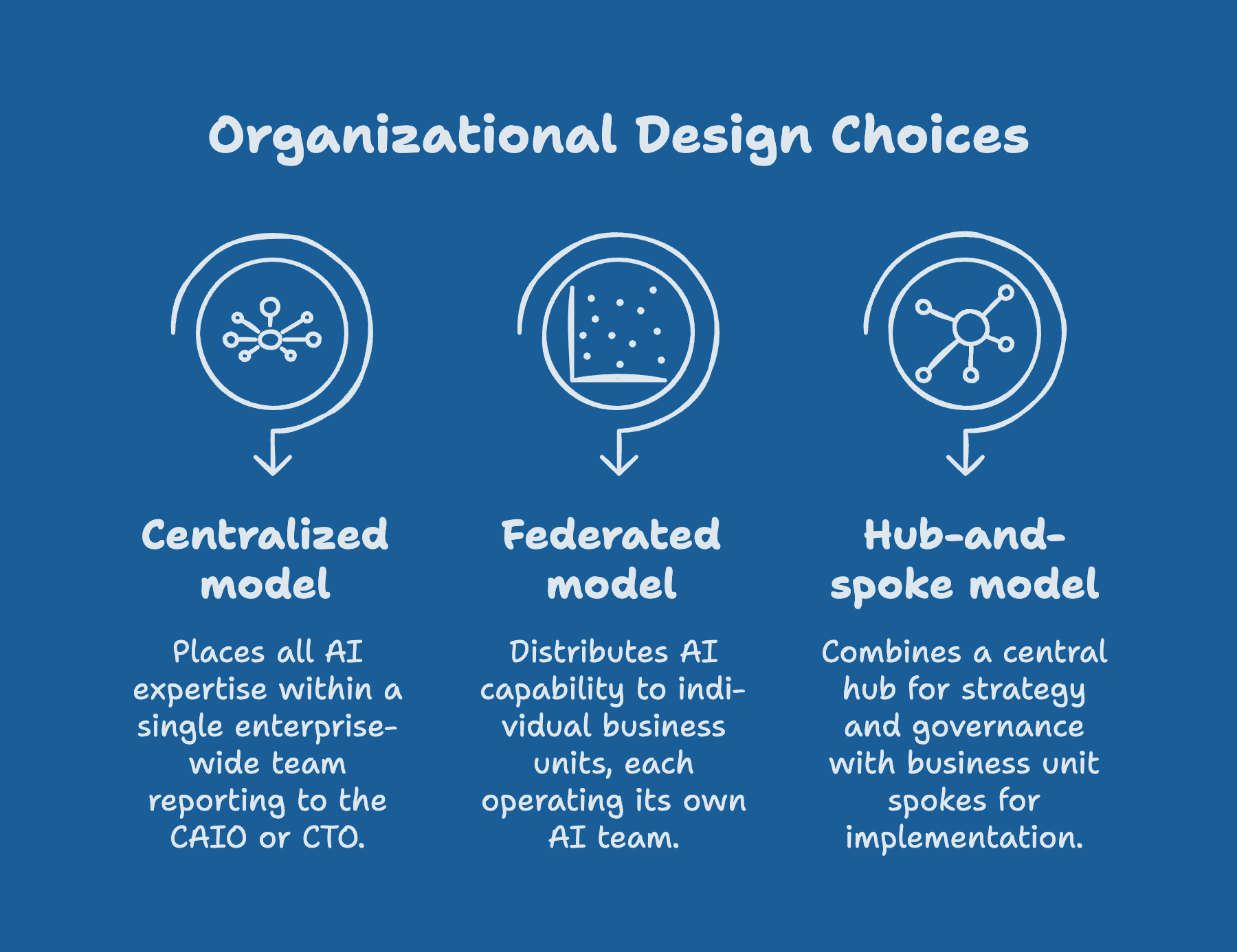
Where AI capability lives in the organization determines how effectively it serves the strategy. Three models dominate, each with different strengths and trade-offs.
The centralized model places all AI expertise within a single enterprise-wide team, typically reporting to the CAIO or CTO. Its strengths are consistency and control: uniform governance, standardized tools and practices, and a critical mass of expertise in one place. Its weakness is distance from business problems. A centralized team may build technically excellent solutions that do not fit the operational context of the business units they serve.
The federated model distributes AI capability to individual business units, each operating its own AI team responsible for its own projects and outcomes. Its strength is speed and domain proximity. Teams that sit within the business understand the data, the workflows, and the customer context deeply. Its weakness is fragmentation: inconsistent governance, duplicated infrastructure, and the absence of portfolio-level coordination that Part 7 identified as essential.
The hub-and-spoke model combines a central hub that owns strategy, governance, and reusable capabilities with business unit spokes that identify, prioritize, and build tailored use cases. The hub provides the coordination and standards. The spokes provide the domain knowledge and implementation velocity. The hub-and-spoke model is the dominant best practice in 2026 because it delivers the governance of centralized with the speed of federated.
Organizational Design Choices
The right model depends on the organization's size, complexity, and strategy archetype. Efficiency-First organizations may function well with a centralized model because the AI applications are standardized and the governance requirements are uniform. Growth-First and Experience-First organizations benefit from the hub-and-spoke model because their AI applications require deep domain integration that centralized teams cannot provide. Platform-First organizations may need a hybrid approach with a strong central platform team and federated application teams.
The CAIO role, discussed in Part 3, is the organizational linchpin. IBM's research found that 76% of organizations had a CAIO in 2026, up from 26% the year before. The CAIO works when it concentrates accountability for connecting AI investment to business outcomes. It fails when it becomes another technology executive without cross-functional authority. In the hub-and-spoke model, the CAIO leads the hub: setting strategy, governing the portfolio, and ensuring that the spokes operate within strategic guardrails while retaining the domain autonomy they need to execute effectively.
Skills Investment as Moat-Building
Part 4 argued that competitive advantage in the AI era comes from capabilities that compound over time and cannot be quickly replicated. Talent is the most durable of these capabilities because the skills that matter most, orchestration design, governance implementation, human-AI collaboration, develop only through operational experience. They cannot be purchased, outsourced, or deployed like software.
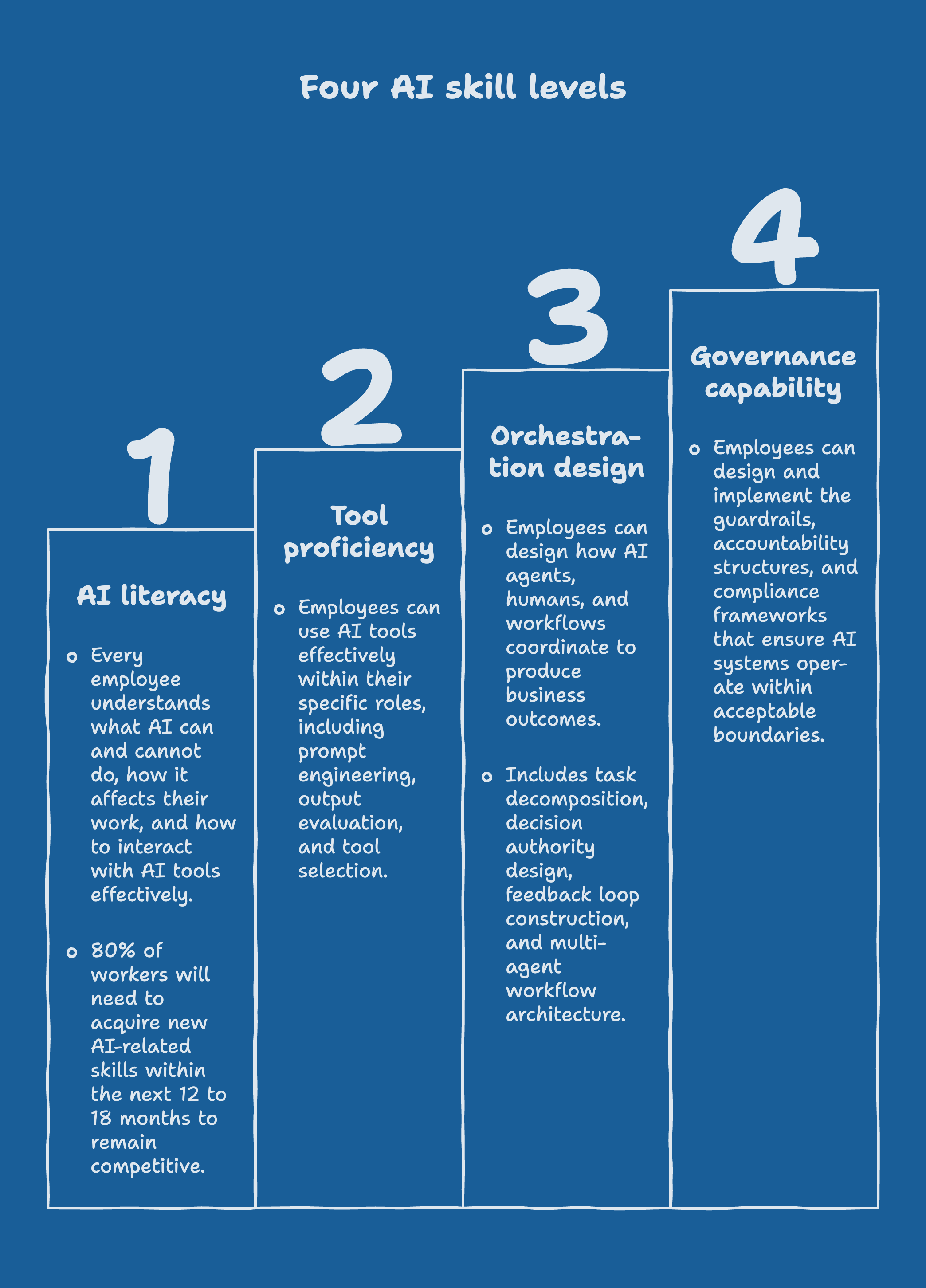
Four skill levels form a progression that organizations should invest in systematically.
AI literacy is the baseline: every employee understands what AI can and cannot do, how it affects their work, and how to interact with AI tools effectively. This is not optional. The organizations where AI adoption succeeds are those where the entire workforce has a working understanding of AI's capabilities and limitations. 80% of workers will need to acquire new AI-related skills within the next 12 to 18 months to remain competitive.
Tool proficiency is the working level: employees can use AI tools effectively within their specific roles, including prompt engineering, output evaluation, and tool selection. This level enables the productivity gains that most organizations are pursuing with their Efficiency-First investments.
Orchestration design is the strategic level: employees can design how AI agents, humans, and workflows coordinate to produce business outcomes. This includes task decomposition, decision authority design, feedback loop construction, and multi-agent workflow architecture. The orchestration series established that this capability is where the learning flywheel spins fastest because it connects AI systems across functions rather than confining them to departmental silos.
Governance capability is the leadership level: employees can design and implement the guardrails, accountability structures, and compliance frameworks that ensure AI systems operate within acceptable boundaries. As AI autonomy increases, governance capability becomes the constraint that determines how much autonomy the organization can safely extend. Without it, AI deployment stalls at low-autonomy applications regardless of technology maturity.
4 Organizational AI Skill Levels
Each skill level builds on the one below it, and each requires different investment approaches. AI literacy can be achieved through broad-based training programs. Tool proficiency develops through hands-on practice with specific applications. Orchestration design requires mentored experience with real workflow design projects. Governance capability develops through exposure to regulatory complexity, ethical decision-making, and cross-functional coordination. The higher levels are institutional capabilities that accumulate over time, which is precisely what makes them competitively defensible.
The Talent Acquisition Strategy
The talent acquisition decision, build versus buy versus partner, is a portfolio allocation problem that should be governed by the same logic as the AI investment portfolio from Part 7.
Build through internal upskilling when the required capability is broadly needed across the organization, when domain expertise is more important than AI specialization, and when the capability is a long-term strategic need that justifies sustained investment. Building is slower but produces more durable capability because upskilled employees bring domain knowledge that external hires lack. Leading companies are moving from a "buy" to a "build" strategy, implementing large-scale internal programs that create baseline AI literacy across the workforce and specialized training for employees in relevant departments. A veteran supply chain manager can be taught to use a predictive AI tool, but teaching an AI engineer the nuances of global supply chain logistics is much harder.
Buy through external hiring when the required capability is highly specialized, when time-to-capability is critical, and when the skill does not exist internally and cannot be developed quickly enough. Buying is faster but more expensive and less durable because external hires may leave, especially in a market with a 62% wage premium that creates continuous poaching pressure.
Partner through contractors, consultants, and fractional leadership when the required capability is needed for a specific phase or project, when the organization cannot justify a full-time position, or when external perspective brings value that internal development cannot replicate. The fractional CAIO model is particularly relevant for mid-market organizations: strategic AI leadership at roughly 10% of the cost of a full-time executive, with time-to-first impact dropping from 6 to 9 months to 30 to 45 days.
Most organizations need all three approaches simultaneously, with the balance shifting over time. Early in the AI journey, buying and partnering provide the expertise to get started. As the organization matures, building through internal development creates the durable capability that sustains competitive advantage. The talent portfolio should be rebalanced quarterly, just like the AI investment portfolio, to reflect changing needs and growing internal capability.
Culture as Talent Strategy
Culture is not a soft factor in AI talent strategy. It is a hard competitive variable that determines whether the organization attracts, develops, and retains the people it needs to execute its AI strategy.
Three cultural elements are decisive.
Psychological safety. Employees need confidence that they can experiment with AI without career penalty. 70% of employees agree that psychological safety is essential to successful AI rollouts. 40% want to be involved in AI decision-making, not just informed after decisions are made. A 2026 executive benchmark survey found that 93.2% of leaders cite cultural resistance, not technology, as the biggest barrier to AI adoption. The organizations that make it safe for people to raise their hands, ask questions, and experiment will accelerate adoption while their cautious competitors stall.
Leadership modeling. The cascade from Part 3 applies directly: CEO engagement drives executive engagement, which drives manager engagement, which drives employee adoption. Gallup's 2026 data reinforces the magnitude of the effect. Employees whose managers actively support AI use are 8.7 times more likely to say their work has been transformed by AI and 7.4 times more likely to agree that AI gives them more opportunities to do what they do best. Yet only 36% of employees in AI-integrating organizations strongly agree that their manager supports their team's use of AI. The manager layer is the bottleneck. Organizations that train and incentivize managers to actively support AI adoption will see dramatically higher adoption and engagement than those that focus only on individual employee training.
Career development alignment. AI-capable workers need to see a career pathway that rewards AI skills development. If the organization's promotion criteria, compensation structures, and role definitions have not been updated to reflect AI capabilities, the implicit message is that AI skills are not valued. Workers who access AI in their workplaces report 86% job engagement and 83% organizational commitment, significantly higher than workers without AI access. AI readiness is no longer just an operational goal. It is a critical employer branding asset. Candidates want structured pathways toward AI literacy, not static roles.
Mid-Market Talent Advantages
Smaller organizations face talent challenges that differ from enterprises, but they also have structural advantages that larger competitors cannot easily replicate.
The mid-market series identified several talent advantages. Shorter distances between strategy and execution mean that AI capability is applied to business problems faster, with less organizational friction. Broader roles give employees exposure to more aspects of AI strategy and implementation, accelerating skill development. More direct impact is visible: in a 200-person company, an individual's contribution to AI outcomes is observable in ways that disappear in a 20,000-person enterprise.
The fractional CAIO model, examined in the mid-market series, is particularly effective for organizations that need strategic AI leadership without the cost of a full-time executive. A fractional AI leader can cost 10-25% of full time costs per year depending on time allocations, providing strategic guidance and governance while maximizing budget. Because fractional leaders work across multiple organizations, they bring pattern recognition that no single in-house hire can match: what works, what fails, and what traps to avoid.
The mid-market talent strategy should leverage these advantages: recruit for breadth and curiosity rather than narrow specialization, develop AI capability through real project experience rather than abstract training, and use fractional leadership to access strategic guidance while building internal capability over time.
Strategy Playbook
Strategic talent gap assessment. Map current AI capabilities against the requirements of your strategy archetype. For each of the four skill levels (AI literacy, tool proficiency, orchestration design, governance capability), assess the current state using three questions. First, what percentage of the relevant population has this skill at the required level? For AI literacy, the relevant population is the entire organization. For tool proficiency, it is every role that interacts with AI tools. For orchestration design, it is the team responsible for designing AI-enabled workflows. For governance capability, it is the leadership team responsible for AI oversight. Second, what level is required to execute the strategy archetype you selected in Part 2? Efficiency-First requires broad tool proficiency with modest orchestration design. Growth-First requires deep orchestration design with strong governance. Platform-First requires excellence across all four levels. Third, what is the gap between current and required capability, and what is the timeline to close it? Gaps that exceed 18 months in critical areas are strategic risks that may require changing the strategy archetype or accelerating talent acquisition.
The talent investment portfolio. Allocate training budget across the four skill levels based on your strategy archetype and current capability gaps. AI literacy should receive the largest share of training investment because it affects the most people and has the highest impact on adoption. Target 100% coverage within 12 months. Tool proficiency should receive focused investment for every role that interacts with AI, with hands-on practice environments and role-specific training paths. Orchestration design investment should target a smaller population: the 5 to 10% of the organization responsible for designing AI-enabled workflows. This investment should include mentored project experience, not just classroom training. Governance capability investment should target senior leaders and the AI governance function with exposure to regulatory frameworks, ethical decision-making, and cross-functional coordination. Track investment at the portfolio level: what percentage of total AI spending goes to each skill level, and does the allocation match the strategic priority?
Organizational design decision framework. Choose between centralized, federated, and hub-and-spoke models using four criteria. First, organizational complexity: organizations with fewer than 500 employees often function well with centralized AI teams. Organizations with multiple business units, geographies, or product lines benefit from hub-and-spoke. Second, domain diversity: if AI applications require deep domain expertise that varies across business units, federated or hub-and-spoke models are preferable. If applications are standardized, centralized works. Third, governance requirements: heavily regulated industries benefit from the control of centralized or the governed flexibility of hub-and-spoke. Lightly regulated industries can tolerate more federated autonomy. Fourth, strategy archetype: Efficiency-First favors centralized. Growth-First and Experience-First favor hub-and-spoke. Platform-First may require hybrid structures.
The talent retention audit. Evaluate whether your culture is retaining or repelling AI-capable talent by examining five indicators. First, voluntary turnover among AI-skilled employees: if it exceeds the organizational average by more than 10 percentage points, culture is repelling talent. Second, manager support: what percentage of managers actively support and model AI use? If below 50%, the manager layer is a retention risk. Third, career pathway clarity: do promotion criteria, compensation structures, and role definitions reward AI capability development? If not, top talent will leave for organizations that do. Fourth, experimentation safety: do employees report that they can try new AI approaches without career risk? If fewer than 60 percent agree, psychological safety is insufficient. Fifth, AI access equity: are AI tools and training available to all relevant employees, or concentrated in a few teams? Unequal access creates engagement gaps that drive attrition.
This article is the eighth in the "AI Strategy is Business Strategy" series. For the companion frameworks from all prior series, including the Dual Maturity Quick Diagnostic and Agentic AI Readiness Assessment, visit arionresearch.com. The themes of strategic alignment, governance-by-design, and orchestration architecture will be developed further in the forthcoming "Governance-by-Design" book. Follow Arion Research for ongoing analysis at arionresearch.com/blog.