AI Strategy is Business Strategy, Part 7: Strategic Portfolio Management for AI
This is the seventh article in a 12-part series arguing that AI strategy and business strategy must be the same strategy. Each article examines a critical dimension of strategic AI alignment and includes a "Strategy Playbook" section with actionable guidance.
Beyond Project Approval
The first six articles in this series established the strategy gap, introduced strategy archetypes, defined the CEO's AI agenda, examined competitive dynamics, explored business model transformation, and linked data strategy to business strategy. Each implicitly assumed that organizations make good decisions about which AI investments to pursue. It’s no surprise that many organizations struggle with that assumption.
Most organizations evaluate AI initiatives one at a time. Shadow AI projects aside (a different discussion completely); a business unit proposes a project, makes the business case showing ROI, receives approval, and proceeds to pilot and / or implementation. The next proposal goes through the same cycle. Each decision is made on its own merits with its own business case.
While this approach seems rational; is it? What’s treated as a routine project approval process is really a portfolio management problem. Organizations that evaluate AI initiatives by project miss the portfolio effects: how initiatives interact, where synergies compound, and where redundancies waste resources. The (some would say irrational) focus on productivity leads to overfunding low-risk efficiency projects that deliver modest returns, and underfunding transformational investments that could impact competitiveness and the bottom line. They allow pilots to proliferate, consuming scarce resources and hurting credibility without producing clarity or results.
The evidence for the portfolio perspective is in the numbers. Enterprise AI budgets are doubling in 2026, with corporations planning to spend 1.7 percent of revenues on AI, up from 0.8 percent in 2025, according to BCG's AI Radar survey of 2,360 executives. Yet only 6 percent of organizations qualify as AI high performers with measurable bottom-line impact, according to McKinsey's survey of nearly 2,000 companies. The AI Spending Efficiency Index dropped from 118.2 in 2025 to 58.2 in 2026, meaning that as the number of heavy AI spenders doubled, the proportion capturing enterprise-level returns was cut nearly in half. Organizations are spending more and getting proportionally less. The problem is not the total investment. It is how the investment is allocated.
The Difference Between Projects and a Portfolio
A list of AI projects is not an AI portfolio. The distinction matters because it determines how decisions are made, how resources are allocated, and whether the organization captures the compounding effects that separate AI leaders from laggards.
A list of projects that are evaluated individually, are funded individually, and measured individually. Each project has its own business case, its own timeline, and its own success criteria. The aggregate result is a set of AI initiatives that may or may not align with strategic priorities, may or may not complement each other, and may or may not produce cumulative value greater than the sum of their parts.
A portfolio is designed, balanced, and governed as a system. Investments are evaluated not just on their individual merits but on how they interact with other projects in the portfolio. The portfolio is balanced across risk levels, time horizons, and strategic value. Resource allocation considers not just which projects deserve funding but how the total investment should be distributed to produce the best aggregate outcome. And the portfolio is governed through a disciplined process that kills underperformers, scales winners, and rebalances as conditions evolve.
The portfolio perspective changes three critical decisions. First, it changes what gets funded. Individual project evaluation favors low-risk, quick-ROI efficiency projects because they are easier to justify. Portfolio evaluation asks whether the balance between efficiency and transformation is appropriate for the organization's competitive position and business strategy. An organization pursuing the Growth-First archetype from Part 2 that allocates 90 percent of its AI budget to efficiency projects has a portfolio imbalance, regardless of how strong each individual project's business case is.
Second, it changes how investments interact. Individual evaluation treats each project as independent. Portfolio evaluation identifies where investments compound each other. A customer data platform investment and a personalization engine investment may each have modest standalone returns, but together they can create a capability neither delivers alone. Conversely, portfolio evaluation identifies redundancies: multiple teams building similar capabilities that a single coordinated investment could deliver more effectively.
Third, it changes how performance is measured. Individual evaluation measures each project against its own. Portfolio evaluation measures whether the aggregate AI investment is producing the strategic outcomes the organization needs. An AI portfolio where every project meets its targets but the aggregate impact on competitive position is negligible has succeeded at the project level and failed at the portfolio level.
The Portfolio Balance Problem
The most common portfolio failure is imbalance: too much investment in one project or project type and too little in others. In most organizations, the imbalance favors efficiency at the expense of transformation.
This bias is structural, not accidental. Efficiency projects are easier to scope, easier to measure, and easier to justify. They have shorter payback periods: customer service automation typically pays back within 12 months, while revenue-generating AI programs average two to four years, according to Deloitte. And they carry lower risk because they optimize existing processes rather than creating new ones. They produce visible cost savings that satisfy the CFO's demand for near-term returns.
The problem is that efficiency gains are table stakes. When every competitor achieves the same 20 percent cost reduction in the same processes, the advantage is zero. The efficiency investments that dominate most AI portfolios are necessary but not sufficient for competitive differentiation. As BCG's 2026 research found, only 6 percent of organizations qualify as AI high performers, and those high performers share three patterns: workflow redesign rather than simple automation, more than 20 percent of digital budgets allocated to AI, and innovation-oriented objectives beyond pure efficiency. High performers invest three times more in process redesign than in the software itself.
The imbalance problem connects directly to the strategy archetypes from Part 2. An Efficiency-First organization should weight its portfolio toward operational improvement, but even Efficiency-First organizations need some transformational investment to avoid the commodity trap. A Growth-First organization that allocates 80 percent of its AI budget to cost reduction is pursuing an efficiency portfolio under a growth label. The strategy archetype should determine the portfolio allocation, not the other way around.
Deloitte's 2026 State of AI report quantifies the gap: twice as many leaders as the year before report transformative impact from AI, but just 34 percent are truly reimagining the business. Thirty percent are redesigning select processes, and 37 percent are using AI only at a surface level. The organizations stuck at the surface level almost certainly have portfolios weighted entirely toward efficiency.
The Six Economic Traps
The orchestration series identified six economic traps that prevent organizations from realizing AI's full value. Reframed as portfolio management failures, they reveal how portfolio decisions determine outcomes.
The pilot trap is a portfolio composition failure. The organization has too many small experiments and not enough production investments. A March 2026 survey found that 78 percent of enterprise technology leaders have at least one AI agent pilot running, but only 14 percent have scaled an agent to organization-wide operational use. A well known CTO captured a common enterprise-AI challenge: “It is so easy with a pilot to let a thousand flowers bloom.” This is “pilot purgatory”: the state in which AI initiatives are neither cancelled nor scaled, consuming resources and credibility while delivering neither transformation nor clarity. The portfolio fix is composition discipline: set a maximum ratio of pilots to production investments and enforce it. Every pilot should have predefined success criteria, a timeline, and a go/no-go decision date.
The undirected savings trap is a portfolio reinvestment failure. The organization captures efficiency gains but does not reinvest them in higher-value AI initiatives. Efficiency savings that flow to the bottom line without reinvestment plans are a one-time benefit, not a compounding advantage. The portfolio fix is explicit reinvestment policy: a defined percentage of AI-generated savings is earmarked for the next stage of AI investment, creating the self-funding model that turns efficiency wins into transformation capital.
The premature scaling trap is a portfolio sequencing failure. The organization scales an AI initiative before its unit economics are proven, consuming resources that could fund multiple smaller experiments or proven investments. The portfolio fix is staged funding with clear gates: initial funding for proof of concept, additional funding contingent on demonstrated unit economics, and full-scale funding only after production validation.
These three traps, along with the infrastructure overinvestment trap, the talent concentration trap, and the governance avoidance trap from the orchestration series, share a common root cause: the absence of portfolio-level governance that evaluates how individual investments serve the aggregate strategy.
Synergy Mapping
The most underutilized dimension of AI portfolio management is synergy: the value created when investments compound each other. Deloitte's research consistently finds that coordinated AI implementation delivers substantially more value than isolated deployments. The organizations achieving the highest levels of success with AI are those that coordinate between IT and line-of-business teams and sequence investments to build on each other.
Synergies in AI portfolios take three forms.
Data synergies occur when one AI initiative generates data that improves the performance of another. A customer service AI that captures interaction patterns creates training data for a sales prediction model. A supply chain optimization system that logs decision outcomes generates data for a demand forecasting agent. These synergies are the operational expression of the learning flywheel from Part 4 and the data strategy from Part 6: the portfolio should be designed so that data flows between investments, creating cumulative intelligence rather than isolated datasets.
Capability synergies occur when investments in shared infrastructure, tools, or skills benefit multiple AI initiatives. A natural language processing capability developed for customer service can be adapted for internal knowledge management. An orchestration layer built for one multi-agent workflow can be extended to coordinate agents across other functions. These synergies reduce the total cost of the portfolio because shared capabilities avoid redundant development.
Workflow synergies occur when AI investments in adjacent process steps create end-to-end automation that neither delivers alone. An AI that automates invoice processing creates partial value. Combined with an AI that automates payment reconciliation and another that handles exception management, the three investments create a fully automated accounts payable workflow whose value exceeds the sum of its parts. The orchestration premium, the additional value created by coordinating multiple AI systems into coherent workflows, is where the portfolio perspective produces its greatest return.
Synergy mapping should be an explicit step in portfolio planning. For every proposed AI investment, the portfolio governance team should ask: which existing investments does this compound? Which planned investments does this enable? And which existing investments could compound this one if coordinated? Investments with high synergy potential should receive priority because they produce portfolio-level returns beyond their standalone value.
Capital Allocation and AI Investments
AI competes for investment against every other strategic priority the organization faces. Capital allocation for AI must apply the same rigor used for any other major investment category, adjusted for AI's unique risk and return characteristics.
Three adjustments are necessary.
Total cost of ownership (TCO) is higher than it appears. AI cost projections routinely underestimate the true investment required. The FinOps Foundation's 2026 State of FinOps report found that 73 percent of enterprises reported AI costs exceeding original projections. Token costs illustrate the problem: a simple customer service AI workflow in 2023 cost $0.04 per interaction, while a more complex orchestrated system in 2026 costs $1.20 per interaction, roughly 30 times higher. With a 4,500-fold pricing spread between cheapest and most expensive models, using premium models for simple tasks burns budgets 10 to 100 times faster than necessary. Engineering time for deployment and monitoring accounts for 20 to 30 percent of true total cost but rarely appears in infrastructure budgets. Total spend over the first three years often lands at two to three times the initial development cost once maintenance, enhancements, compliance, and operational support are included. The orchestration series identified a 5-to-1 services multiplier for agentic AI: for every dollar spent on AI technology, organizations should budget five dollars for integration, customization, training, and change management. Capital allocation that ignores these multipliers produces portfolios that are underfunded from the start.
Payback periods vary dramatically by use case. Customer service automation typically pays back within 12 months. Revenue-generating AI programs average two to four years. Transformational initiatives may take three to five years to produce measurable returns. McKinsey's analysis of 340 enterprise deployments found a median payback period of 16 months with a median ROI of 210 percent over three years. But averages obscure the variance. Only 6 percent of organizations report payback in under a year. Capital allocation must account for these differences by matching funding structures to payback expectations: short-cycle funding for efficiency projects, patient capital for transformation investments, and option-style funding for platform plays where the strategic value may take years to materialize.
AI returns compound rather than deplete. Traditional capital investments depreciate. A machine wears out. A building deteriorates. AI investments, when designed around the learning flywheel, appreciate. The data generated by AI operations improves performance over time. The organizational capabilities developed through AI deployment enable progressively more sophisticated applications. This compounding characteristic means that discount rate frameworks developed for depreciating assets may undervalue AI investments, especially transformational ones whose primary returns emerge in years three through five.
The practical implication is that CFOs should evaluate AI portfolios using a blended framework: standard ROI analysis for efficiency projects with clear, short-term payback, strategic option valuation for transformational investments where the payback is uncertain but the competitive consequences of not investing are severe, and portfolio-level return analysis that captures synergies and compounding effects invisible at the project level.
Portfolio Governance
The quarterly portfolio review is the CEO's primary mechanism for keeping AI investments on track and producing the intended strategic results. As established in Part 3, this is a business review, not a technology review. But the portfolio perspective adds specific governance skillsets and activities that most organizations lack.
Kill decisions. The hardest governance activity is killing AI initiatives that are not producing results. The sunk cost fallacy is especially powerful in AI because the investments in data prep, model training, and organizational change feel like progress even when the business outcomes fall short of expectations. AI projects fail the sunk cost test more often than other categories of technology work because gains arrive late, prompt and model investments feel like progress, and teams resist "killing” projects until the budget is gone. The portfolio governance fix is commitment up front that every AI initiative has predefined success criteria and a decision date. If the project hasn’t met its criteria by the decision date, the default action is termination, not extension. The burden of proof falls on the project team to justify continuing, not on the governance body to justify cancellation.
Scale decisions. The opposite of the kill decision is the scale decision: identifying which investments deserve significantly more resources because they are producing results that compound. Scale decisions require different evidence than approval decisions. Approval requires a plausible business case. Scaling requires demonstrated unit economics, proven adoption, and evidence that additional investment will produce proportional or increasing returns. A premature scaling trap can occur when organizations scale based on enthusiasm instead of evidence.
Rebalance decisions. The portfolio should be reviewed quarterly and adjusted based on a set of criteria including competitive dynamics, strategic shifts, and performance data. If the organization's competitive position has changed, if a new threat has emerged, or if the portfolio has drifted toward one category at the expense of others, rebalancing is necessary. Rebalancing is not a sign of poor planning; it’s a sign that governance is working effectively in a rapidly changing business environment.
Successful portfolio governance requires one structural element that most organizations lack: a single executive with authority over the entire AI portfolio. In most organizations, AI investments are distributed across business units, IT, and innovation groups, each with its own budget and governance process. Without a single point of accountability, portfolio-level decisions, including kill decisions, scale decisions, and rebalance decisions, cannot be made effectively. The CAIO role discussed in Part 3, when properly empowered with cross-functional authority, is the natural owner of portfolio governance.
The Self-Funding Model as Portfolio Strategy
The most effective portfolio strategy for most organizations is the self-funding model: using efficiency gains from early AI investments to fund progressively more transformational initiatives. This approach eliminates the need for large upfront AI budgets that compete with other capital demands and builds organizational confidence by demonstrating returns before requesting additional investment.
The self-funding model works as a portfolio sequencing strategy. Phase one deploys AI for operational efficiency in areas with clear cost savings: customer service automation, document processing, routine analysis, and process optimization. These investments should produce measurable savings within 6 to 12 months. Phase two reinvests a defined percentage of those savings, typically 30 to 50%, in experience and growth investments: personalization engines, revenue optimization, demand prediction, and customer insight platforms. These investments produce returns over 12 to 24 months. Phase three uses the combined returns from phases one and two to fund transformational investments: new business model experiments, platform plays, and strategic capability development.
The self-funding model aligns with the data from Deloitte and Fortune showing that CFOs are shifting their AI expectations from efficiency to transformation. In 2025, the primary goal of AI projects was cost reduction. In 2026, finance and other C-level executives expect AI to shift from experimentation to proven, enterprise-wide impact, with AI seen as a catalyst to reinvent the business rather than a cost-reduction tool. The self-funding model provides the bridge: it starts with efficiency to build credibility and capital, then redirects toward transformation as the portfolio matures.
The risk of the self-funding model is that organizations get stuck in phase one. The efficiency returns are visible, measurable, and politically safe. Reinvesting them in riskier transformational initiatives requires the CEO leadership behaviors described in Part 3: visible strategic ownership, explicit reinvestment mandates, and willingness to redirect resources from proven performers to unproven but strategically important bets. Without that leadership, the self-funding model becomes a permanent efficiency program, and the organization misses the transformational opportunity that the efficiency phase was designed to enable.
Strategy Playbook
AI portfolio mapping. Create a comprehensive map of every AI investment, active and planned, across the organization. For each investment, document five attributes. First, archetype alignment: which strategy archetype does this investment serve (Efficiency-First, Growth-First, Experience-First, or Platform-First)? Second, risk level: is this a low-risk optimization of an existing process, a medium-risk improvement to an existing capability, or a high-risk bet on a new capability or business model? Third, time horizon: when is this investment expected to produce measurable business results (under 6 months, 6 to 18 months, or 18 months and beyond)? Fourth, strategic alignment: how directly does this investment connect to one of the organization's top three strategic priorities? Score 1 (tangential) to 5 (directly enables a priority outcome). Fifth, synergy potential: which other investments in the portfolio does this one compound or depend on? The map produces a visual representation of the portfolio's composition, balance, and interconnections.
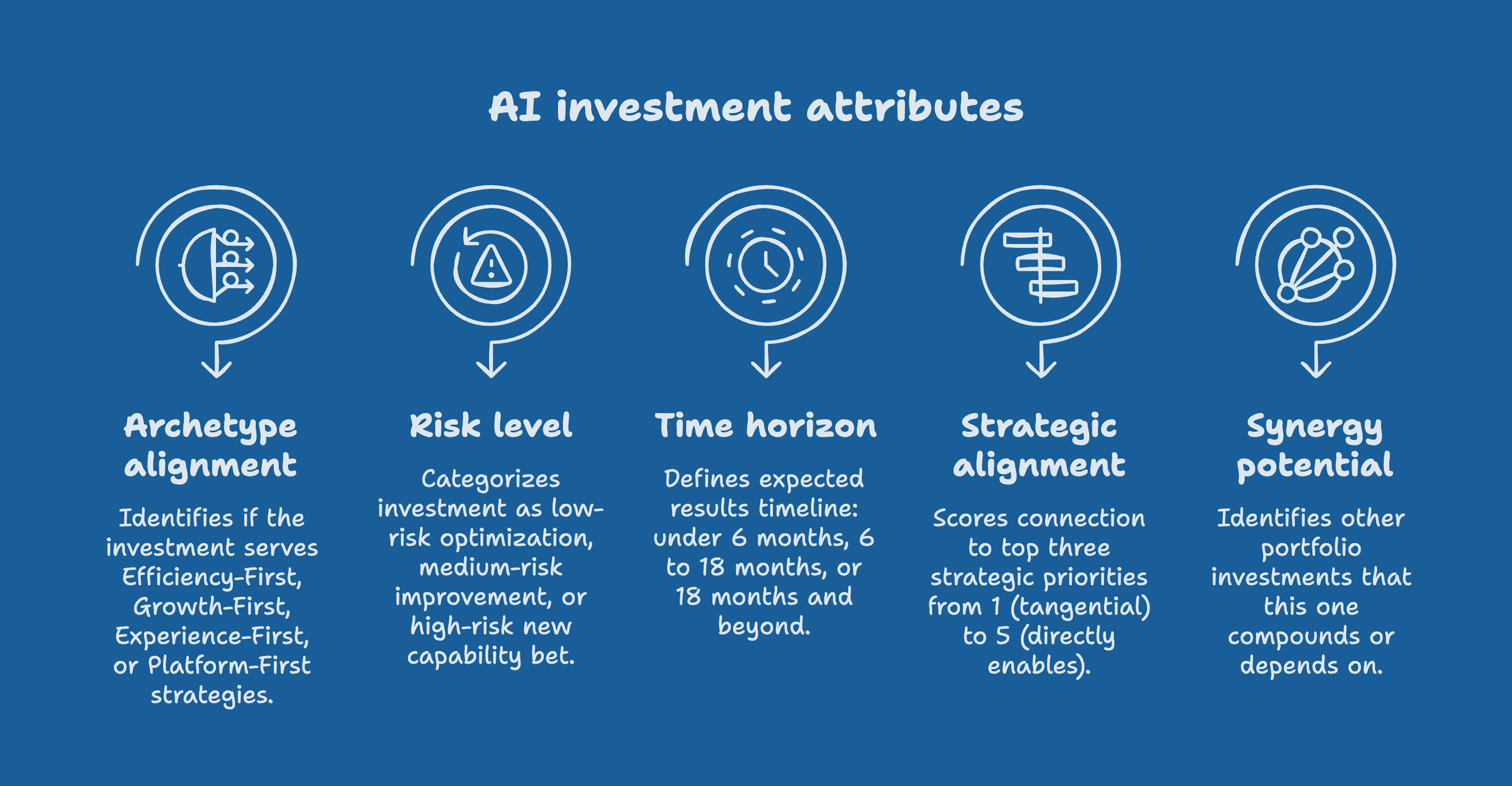
AI Portfolio Mapping
Portfolio balance scorecard. Evaluate whether your AI portfolio is appropriately diversified using four balance tests. First, archetype balance: what percentage of the portfolio is allocated to each strategy archetype? Compare the actual allocation to the target allocation implied by your strategy archetype selection. If you are pursuing Growth-First and 85% of your AI budget is in efficiency projects, the portfolio is misaligned. Second, risk balance: what is the ratio of low-risk, medium-risk, and high-risk investments? A portfolio with no high-risk investments is underweighting transformation. A portfolio with more than 40% high-risk investments is overexposed. Third, time horizon balance: what percentage of the portfolio is expected to produce results within 6 months, 6 to 18 months, and beyond 18 months? Portfolios weighted entirely toward short-term returns lack transformational investment. Portfolios weighted entirely toward long-term returns lack the near-term wins needed to sustain organizational commitment. Fourth, synergy density: what percentage of investments have identified synergies with at least one other investment in the portfolio? Low synergy density suggests a collection of projects rather than an integrated portfolio. Target above 60%.
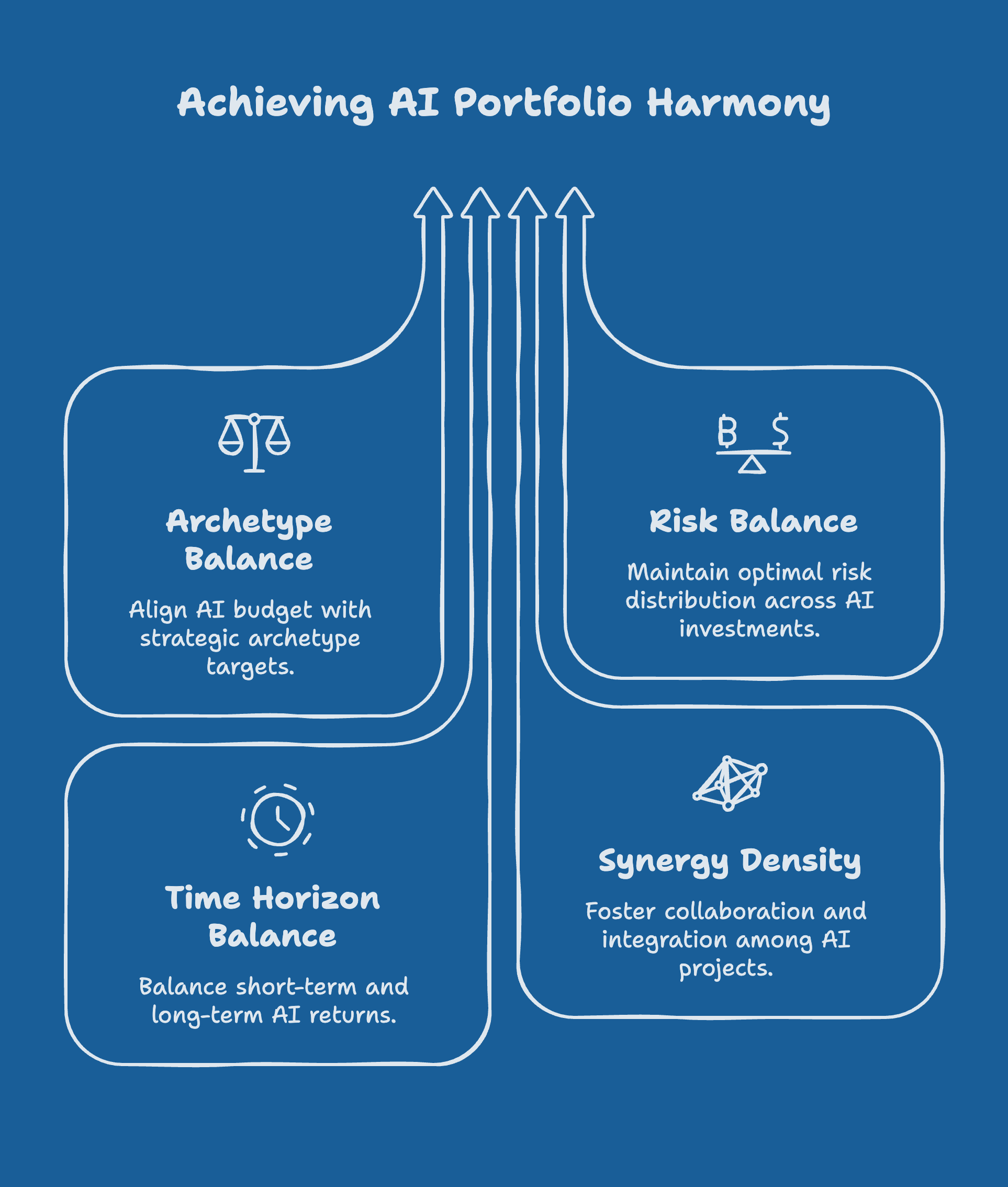
AI Portfolio Balance Scorecard
The quarterly portfolio review process. Structure the quarterly review around five decisions. First, kill: which investments have missed their predefined success criteria and should be terminated? Present the evidence, make the decision, and reallocate the resources. Second, scale: which investments have demonstrated results that justify significantly increased investment? Present the evidence of unit economics, adoption, and scalability. Third, continue: which investments are on track and should continue with current resources? This should be the default for investments meeting milestones. Fourth, rebalance: has the portfolio drifted from its target allocation? Should resources shift between archetypes, risk levels, or time horizons? Fifth, add: what new investments should enter the portfolio based on emerging opportunities, competitive threats, or strategic shifts? Every addition should specify which archetype it serves, what synergies it creates, and how it affects portfolio balance.
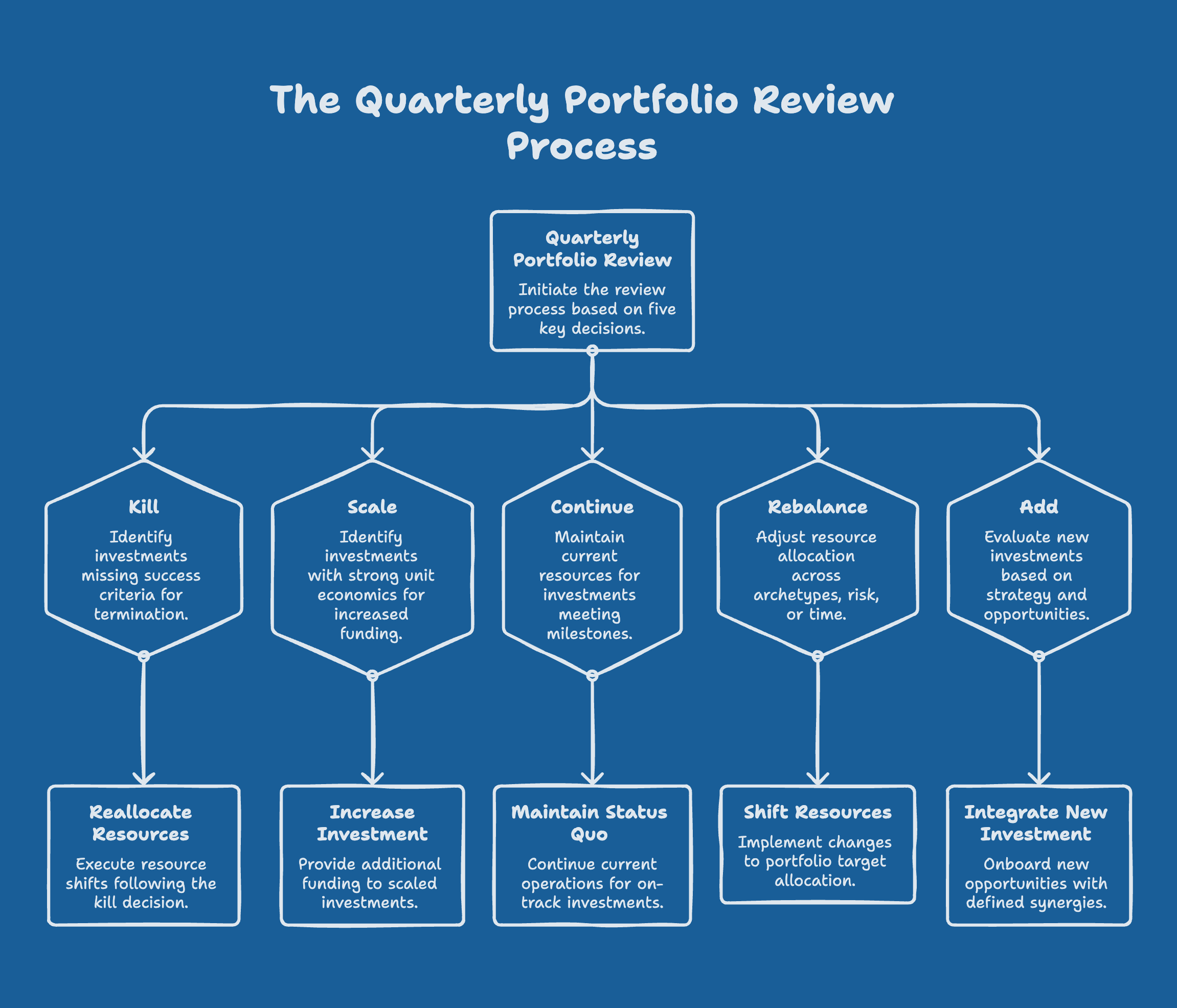
AI Portfolio Quarterly Review
Synergy identification workshop. Conduct a half-day session with AI initiative owners, the CAIO or equivalent, and business unit leaders to map synergies across the portfolio. Step one: list every active AI initiative on a shared board. Step two: for each pair of initiatives, ask three questions. Does initiative A generate data that could improve initiative B? Do initiatives A and B share infrastructure, tools, or skills that could be developed once and used twice? Do initiatives A and B operate on adjacent workflow steps that could be connected for end-to-end value? Step three: map the identified synergies visually, connecting initiatives with labeled links that describe the synergy type (data, capability, or workflow). Step four: identify the highest-value synergies that are not currently being exploited and develop action plans to capture them. Step five: identify initiatives with no synergies, and question whether they belong in the portfolio or should be reconsidered as standalone investments with limited portfolio value.
This article is the seventh in the "AI Strategy is Business Strategy" series. For the companion frameworks from all prior series, including the Dual Maturity Quick Diagnostic and Agentic AI Readiness Assessment, visit arionresearch.com. The themes of strategic alignment, governance-by-design, and orchestration architecture will be developed further in the forthcoming "Governance-by-Design" book. Follow Arion Research for ongoing analysis at arionresearch.com/blog.