
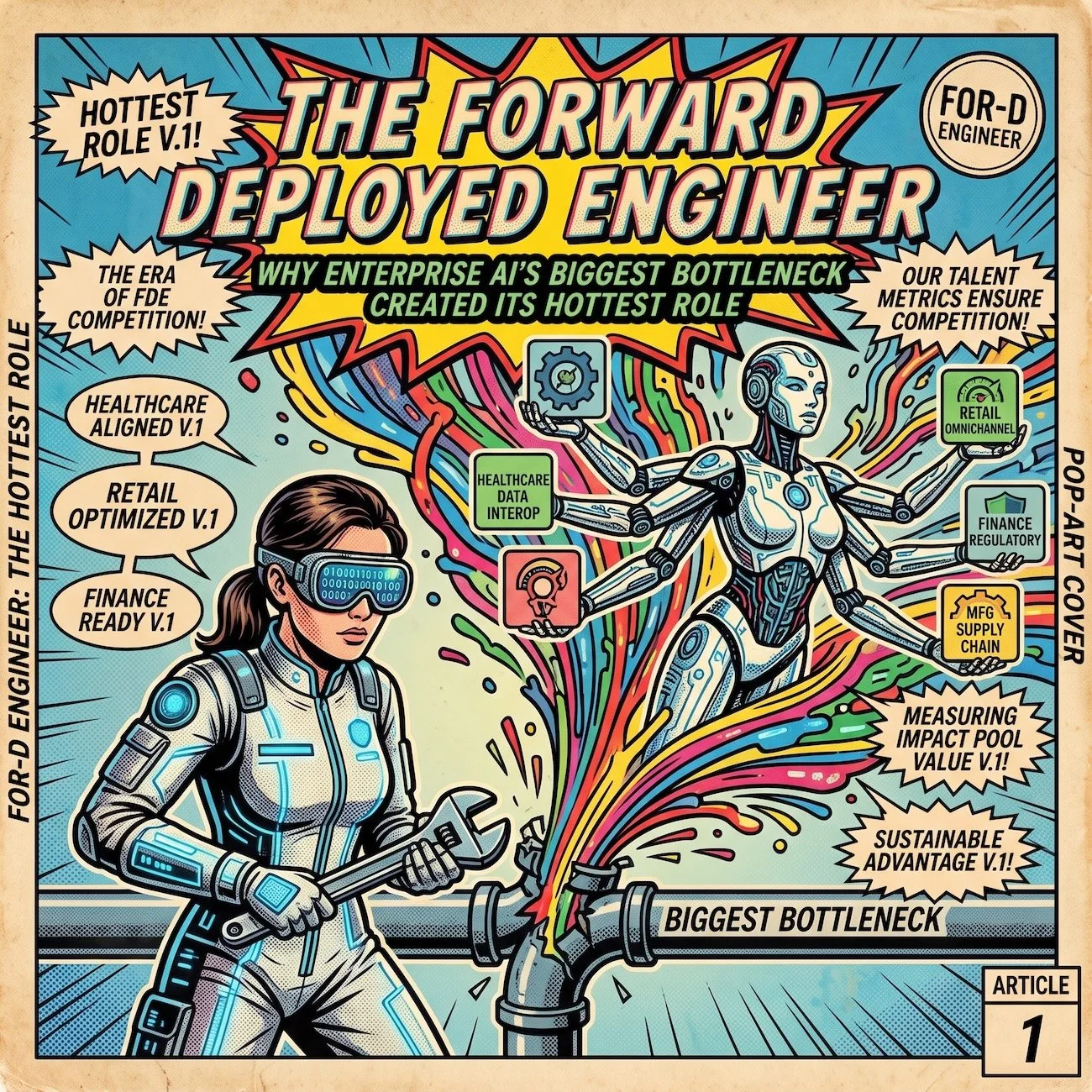
The Forward Deployed Engineer: Why Enterprise AI's Biggest Bottleneck Created Its Hottest Role
The forward deployed engineer has gone from a Palantir curiosity to the most in-demand role in enterprise AI in less than two years, with job postings up 729 percent year over year and salaries clearing $300,000. OpenAI, Anthropic, Google, AWS, and Accenture are all betting billions on the same thesis: AI models work, but enterprise deployment does not, and the solution is embedding engineers directly inside customer environments. This article examines what the FDE explosion reveals about where enterprise AI stands, why the deployment bottleneck has become the industry's central problem, how Accenture has emerged as the cross-platform FDE flywheel, and what the model's structural limitations mean for enterprise AI strategy. It includes a Strategy Playbook for evaluating deployment readiness, structuring FDE engagements, and building the internal capability to operate AI systems independently.

AI Strategy is Business Strategy, Part 12: Building the AI-Aligned Organization
AI strategy alignment is not a one-time exercise. It is an ongoing organizational capability that must be embedded in how the organization plans, invests, executes, measures, and learns. Only 1% of organizations consider their AI strategies mature enough to capture real value, and the window for strategic alignment is measured in quarters, not years. This capstone article synthesizes the full 12-part series into an integrated strategic alignment framework spanning 11 dimensions and a consolidated readiness assessment across 24 criteria. It maps the maturity progression from strategy gap through strategy alignment to strategy integration, contrasts the three-year horizon for organizations that align now versus those that delay, and provides a detailed month-by-month 12-month roadmap covering strategy gap assessment, archetype selection, portfolio restructuring, talent strategy, measurement deployment, governance integration, and Year 2 planning.
AI Strategy is Business Strategy, Part 11: Industry Playbooks; Strategy Alignment Across Verticals
Generic AI strategies fail because they ignore the vertical differences that determine what works. The same AI capability has radically different strategic implications, governance requirements, and deployment timelines across industries. Financial services turns regulatory compliance into a competitive moat. Healthcare operates under patient safety constraints that shape every deployment decision. Manufacturing must bridge the OT/IT convergence gap to unlock digital twin and supply chain orchestration opportunities. Retail wages the competitive battle on customer experience, with agentic commerce reshaping how consumers buy. Professional services confronts the billable hour disruption as AI accelerates knowledge work while threatening the pricing model. This article provides industry-specific strategy frameworks, archetype recommendations, regulatory readiness checklists, peer benchmarking approaches, and tailored 90-day starters for each vertical, applying the universal strategic principles from this series to the distinct competitive realities of each sector.
AI Strategy is Business Strategy, Part 10: Measuring Strategic AI Impact
Most organizations cannot prove their AI investments are working. Only 29% of executives measure AI ROI confidently, only 25% of S&P 500 companies can cite a quantifiable AI benefit, and 56% of CEOs report zero revenue or cost impact from AI. The problem is not the technology. It is measurement infrastructure that tracks tokens and deployments instead of competitive advantage and organizational capability. This article presents a four-tier strategic measurement framework spanning operational, financial, competitive, and capability metrics, alongside practical guidance on leading versus lagging indicators, attribution methodology for connecting AI to business outcomes, and executive reporting tailored to CEO, CFO, and board decision contexts. It also addresses the measurement theater, vanity metrics and cherry-picked case studies, that prevents organizations from recognizing strategic AI failures before they reach the P&L.
AI Strategy is Business Strategy, Part 9: Strategic Risk; The Cost of Action and Inaction
Every AI strategy involves risk, but "wait and see" is not risk-neutral. It is a high-risk strategy with compounding costs. RAND documents that 80.3 percent of enterprise AI projects fail to deliver business value, with 84 percent of failures driven by leadership, not technology. Yet inaction carries equally severe consequences: BCG's future-built companies achieve 3.6x total shareholder return while laggards fall further behind each quarter. Gartner predicts 50 percent of AI agent deployment failures will trace to insufficient governance, and up to 20 percent of G1000 organizations face lawsuits or CIO dismissals from governance gaps. This article provides a framework for evaluating three risk dimensions simultaneously: moving too fast, moving too slow, and moving in the wrong direction, alongside scenario planning, strategic optionality, and governance risk quantification.
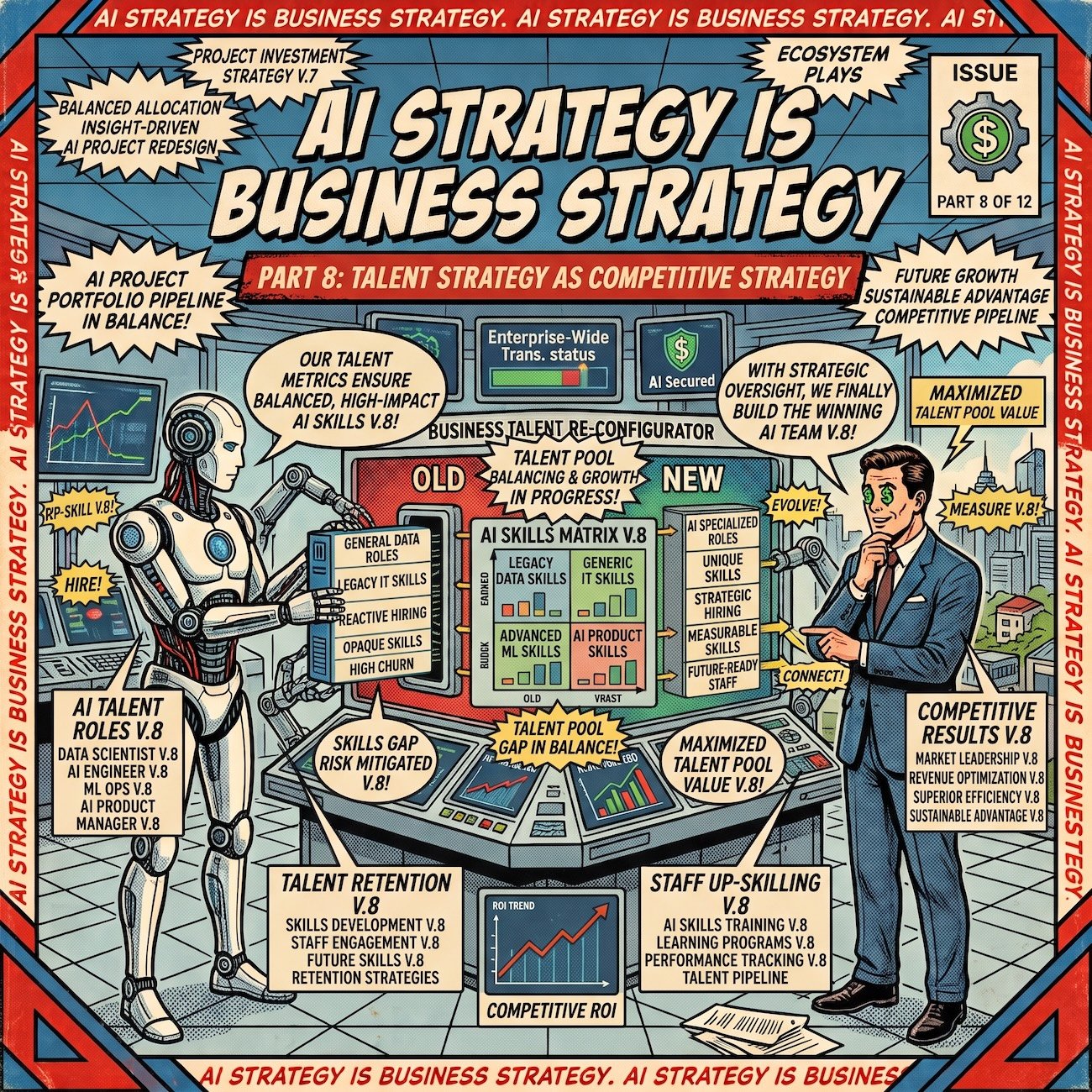
AI Strategy is Business Strategy, Part 8: Talent Strategy as Competitive Strategy
Workforce planning, skills investment, and organizational design are strategic choices that determine AI outcomes, not HR programs that support them. AI talent demand exceeds supply 3.2 to 1, with a 62% wage premium that has risen from 25% in just two years. Yet the 93/7 budget split persists: 93% of AI funding goes to technology while 7% goes to training the people who use it. IBM projects 53% of employees will need upskilling by 2028, and IDC estimates the skills gap costs $5.5 trillion in unrealized productivity. This article examines why talent strategy is competitive strategy, how the four skill levels from AI literacy to governance capability build durable advantage, organizational design choices for AI capability, and why culture is a hard competitive variable.
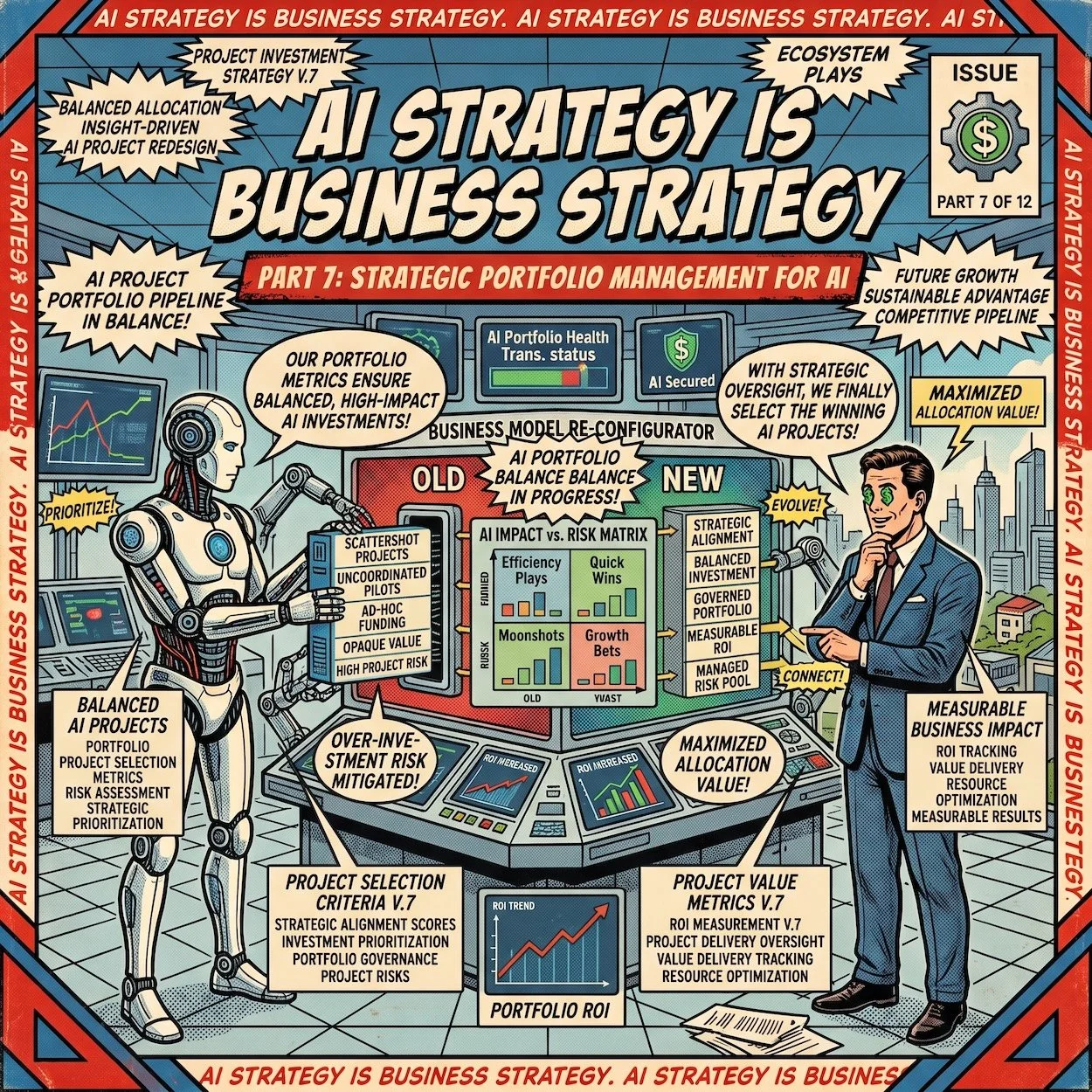
AI Strategy is Business Strategy, Part 7: Strategic Portfolio Management for AI
AI investment is a portfolio management problem, not a project approval problem. Enterprise AI budgets doubled in 2026 to 1.7 percent of revenues, yet only 6% of organizations qualify as AI high performers with measurable bottom-line impact. The AI Spending Efficiency Index dropped from 118.2 to 58.2, meaning that as heavy spenders doubled, the proportion capturing returns was cut nearly in half. Organizations evaluating AI projects individually miss the portfolio effects that separate leaders from laggards: synergies that compound returns, balance across risk levels and time horizons, and governance disciplines that kill underperformers and scale winners. This article reframes the six economic traps as portfolio failures, examines how synergy mapping and capital allocation frameworks improve aggregate returns, and provides a self-funding model that uses efficiency wins to finance transformation.
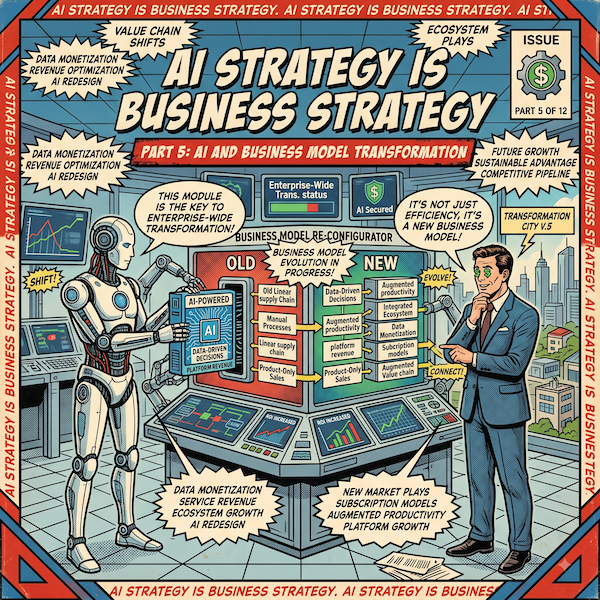
AI Strategy is Business Strategy, Part 5: AI and Business Model Transformation
AI is not just optimizing existing business models. It is enabling entirely new ones while threatening established ones. The February 2026 market correction erased $285 billion from SaaS valuations in 48 hours as markets concluded AI agents could replace entire categories of per-seat software. Gartner estimates $234 billion of enterprise SaaS spending is exposed to agentic arbitrage by 2030. Pure per-seat pricing fell from 21% to 15% of SaaS companies in a single year, with 97% of SaaS CEOs planning to retire seat-based models within two years. This article examines four patterns of AI-driven business model innovation, the emergence of platform economics through agent ecosystems, how value chains are being restructured, and the incumbent's dilemma of managed self-disruption versus disruption by others.
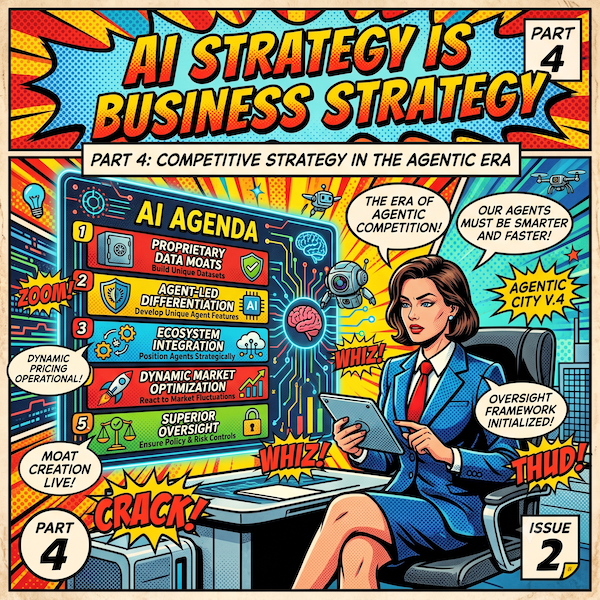
AI Strategy is Business Strategy, Part 4: Competitive Strategy in the Agentic Era
Agentic AI is reshaping competitive dynamics in ways that traditional strategy frameworks did not anticipate. The sources of competitive advantage are shifting from scale and access to learning velocity and orchestration capability, and the gap between leaders and laggards is accelerating rather than narrowing. BCG's "future-built" companies achieve 3.6x total shareholder return while Accenture's AI-mature organizations grow 4.7x faster year over year. Gartner predicts 90 percent of B2B buying will be agent-intermediated by 2028, routing $15 trillion through machine-to-machine exchanges. This article examines the learning flywheel as the new competitive moat, four first-mover advantages unique to the agentic era, where market restructuring is most disruptive, what is being commoditized versus what remains defensible, and why the fast-follower strategy that worked in prior technology waves no longer applies.
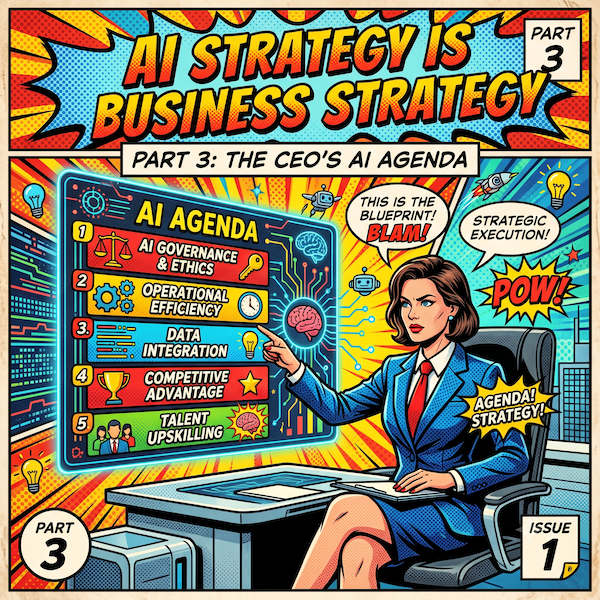
AI Strategy is Business Strategy, Part 3: The CEO's AI Agenda
AI strategy alignment begins at the top, not because CEOs need to understand model architectures, but because the decisions that determine whether AI produces business results are CEO-level decisions. IBM's 2026 CEO Study found that 83 percent of CEOs say AI success depends more on people's adoption than technology, yet only 25 percent of workers use AI regularly. BCG's research shows employee positivity toward AI rises from 15 percent to 55 percent with strong leadership support. This article defines the four strategic decisions only the CEO can make, examines board-level AI governance and the CAIO role's effectiveness, identifies the three CEO behaviors that predict AI success, and provides a 90-day agenda for embedding AI into strategic planning, capital allocation, and performance measurement. The organizations where the CEO owns the AI agenda outperform on every dimension.
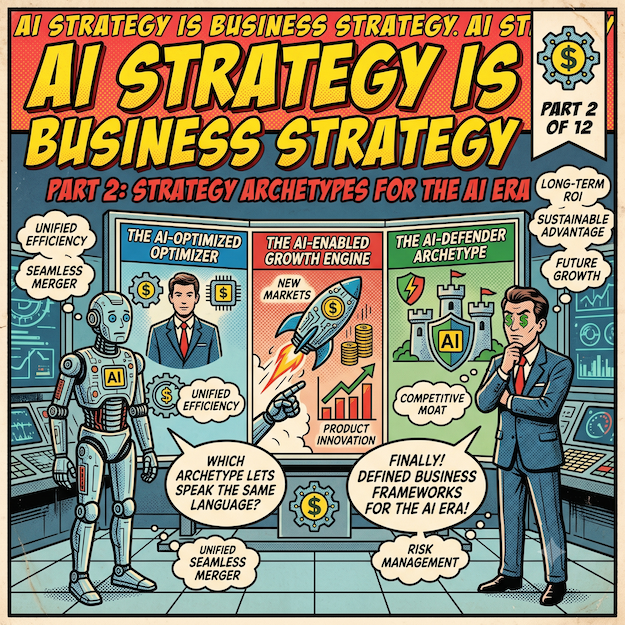
AI Strategy is Business Strategy, Part 2: Strategy Archetypes for the AI Era
Most organizations default to efficiency as their primary AI strategy, not because it is the right fit for their business, but because it is the easiest to measure, fund, and approve. Deloitte's State of AI 2026 found that 66 percent achieve efficiency gains while only 20 percent report revenue growth from AI, even as 74 percent aspire to it. This article introduces four strategy archetypes for AI investment: Efficiency-First, Growth-First, Experience-First, and Platform-First. Each reflects a different theory of value creation based on business model, competitive position, and organizational maturity. The article provides an archetype selection matrix, alignment test, and sequencing framework for progressing across archetypes, arguing that choosing the wrong archetype wastes the compounding window while choosing the right one creates advantages that accelerate with each quarter.
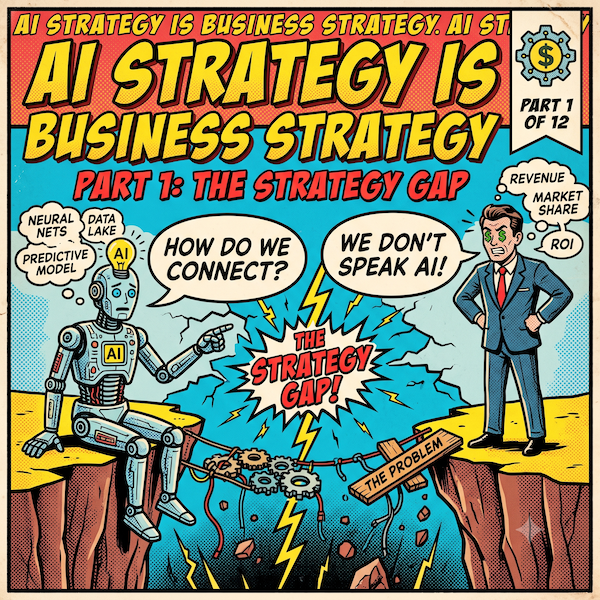
AI Strategy is Business Strategy, Part 1: The Strategy Gap
Organizations will spend $2.59 trillion on AI in 2026, yet 95 percent of generative AI pilots produce no measurable P&L impact, only 25 percent of initiatives deliver expected ROI, and 40 percent of agentic AI projects face cancellation. The root cause is not technology failure. It is strategic misalignment: most "AI strategies" are technology deployment plans disconnected from business outcomes. BCG's research shows that strategic clarity lifts measurable AI impact by 25 percentage points, while better tools alone move it only five. The 5 percent of companies that are "future-built" for AI achieve 1.7x revenue growth and 3.6x total shareholder return. This article examines why the strategy gap exists, what alignment looks like in practice, and introduces a 12-part series framework for making AI strategy and business strategy the same strategy.
Introducing disambiguation.ai; and Our First Training Program for Mid-Market Leaders
disambiguation.ai is live: a new home for practical AI guidance built specifically for mid-market leaders. Our first training program, AI for Leaders, walks you through five hands-on modules covering understanding AI, finding real use cases, governance, and workforce readiness, ending with a one-page roadmap you can bring straight into your next leadership meeting.
The AI-Powered Mid-Market, Part 7: Agentic AI for the Mid-Market
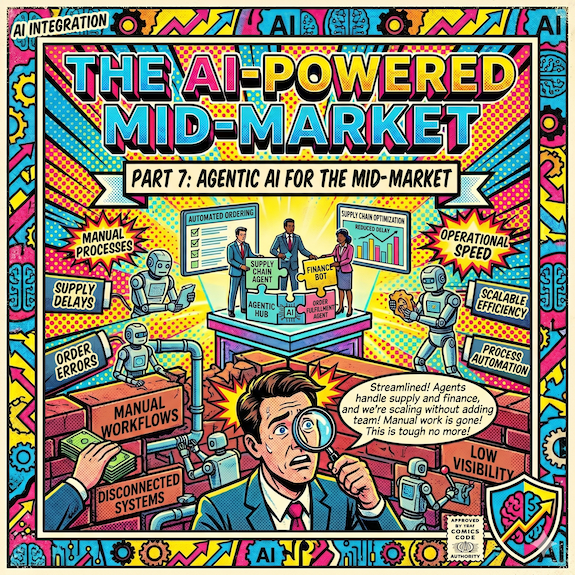
Agentic AI has moved from research concept to production reality, with 57 percent of organizations now running AI agents and the market projected to reach $10.8 billion in 2026. Mid-market organizations might assume this capability requires enterprise-scale infrastructure and budgets, but that assumption is no longer valid. The platforms you already use, from Salesforce Agentforce to Microsoft Copilot agents to ServiceNow Now Assist, are embedding agent capabilities directly into their products. This article identifies the five highest-value agent use cases at mid-market scale, maps the autonomy progression from copilot mode through managed autonomy, and provides a practical monitoring approach that works without a dedicated AI operations team. The Mid-Market Playbook includes a 60-day pilot framework and guidance for connecting your governance framework from Part 6 to agent operations.
The AI-Powered Mid-Market, Part 1: The Mid-Market AI Advantage
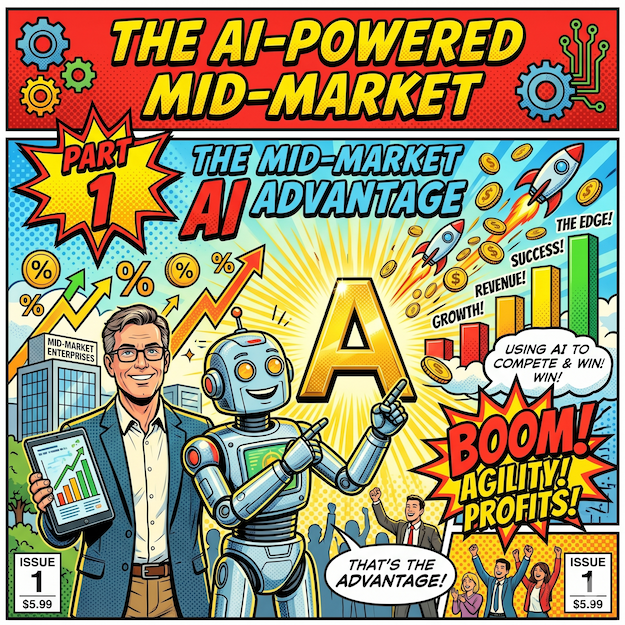
Most AI strategy content is written for Fortune 500 organizations with dedicated AI teams and eight-figure budgets. Mid-market leaders read that advice and conclude they are not ready. This article challenges that assumption. The first in an 8-part series on AI strategy for mid-market organizations, it makes the case that mid-market firms have structural advantages that enterprises envy: faster decision-making, less legacy technical debt, shorter distances between strategy and execution, and the cultural adaptability to shift faster. It backs the argument with 2026 data showing mid-market AI adoption nearly doubling in two years, 91 percent of AI-using SMBs reporting revenue increases, and inference costs dropping more than 99 percent. The article also addresses the real constraints (budget, talent, scale, risk tolerance) and why none of them are disqualifying, and argues that the 88 to 95 percent enterprise pilot failure rate creates a window that mid-market firms can exploit right now.