
Introducing disambiguation.ai; and Our First Training Program for Mid-Market Leaders
disambiguation.ai is live: a new home for practical AI guidance built specifically for mid-market leaders. Our first training program, AI for Leaders, walks you through five hands-on modules covering understanding AI, finding real use cases, governance, and workforce readiness, ending with a one-page roadmap you can bring straight into your next leadership meeting.
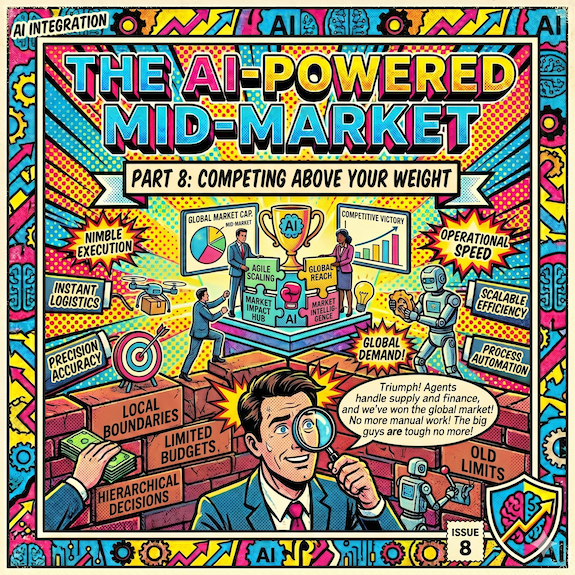
The AI-Powered Mid-Market, Part 8: Competing Above Your Weight
The competitive window for mid-market AI advantage is open but narrowing. With worldwide AI spending forecast to reach $2.59 trillion in 2026 and SMB AI adoption nearly doubling since 2024, the organizations moving now are compounding their gains while those still deliberating fall further behind. In this final installment of "The AI-Powered Mid-Market" series, we examine the data confirming the mid-market AI advantage (91% of SMBs using AI report revenue increases, 5.8x average ROI within 14 months), identify the four patterns that distinguish organizations winning with AI from those still experimenting, and address how to sustain momentum, avoid the shiny object trap, and build adaptive capacity for a fast-evolving landscape. The article closes with a consolidated playbook checklist synthesizing actionable guidance from all eight parts of the series into a single reference for mid-market leaders ready to act.
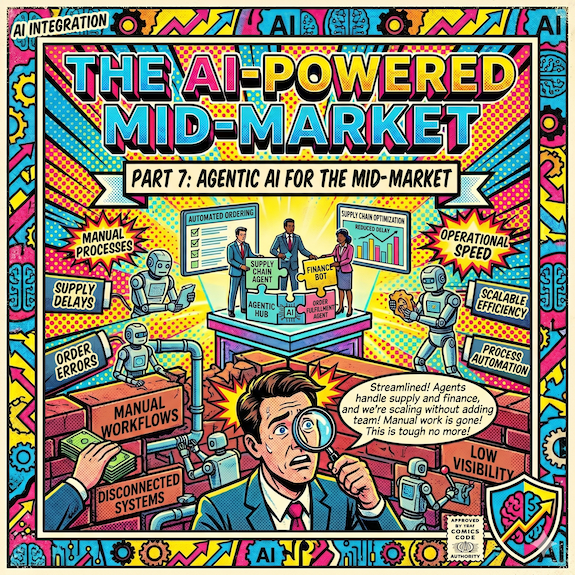
The AI-Powered Mid-Market, Part 7: Agentic AI for the Mid-Market
Agentic AI has moved from research concept to production reality, with 57 percent of organizations now running AI agents and the market projected to reach $10.8 billion in 2026. Mid-market organizations might assume this capability requires enterprise-scale infrastructure and budgets, but that assumption is no longer valid. The platforms you already use, from Salesforce Agentforce to Microsoft Copilot agents to ServiceNow Now Assist, are embedding agent capabilities directly into their products. This article identifies the five highest-value agent use cases at mid-market scale, maps the autonomy progression from copilot mode through managed autonomy, and provides a practical monitoring approach that works without a dedicated AI operations team. The Mid-Market Playbook includes a 60-day pilot framework and guidance for connecting your governance framework from Part 6 to agent operations.
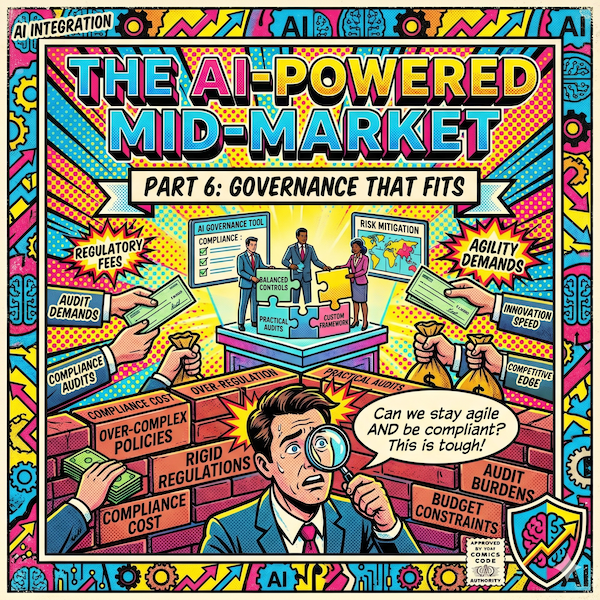
The AI-Powered Mid-Market, Part 6: Governance That Fits
67 percent of employees are already using AI at work, but only 18 percent of organizations have formal AI policies in place. That gap between adoption and governance is costing real money: shadow AI breaches average $4.2 million each. Part 6 of "The AI-Powered Mid-Market" series makes the case that mid-market organizations need governance that fits on a page, not governance that fills a binder. The article introduces a minimum viable governance framework covering four areas: approved tools, data handling rules, decision authority tiers, and incident response. It provides a practical three-tier model for decision authority (where AI acts freely, where it recommends and a human decides, and where humans lead with AI providing information), a simple data classification system, and guidance on vendor governance, regulatory readiness for the EU AI Act and state-level AI laws, and building policies your people will follow. The Mid-Market Playbook closes with four actions: draft a one-page acceptable use policy, define decision authority for current AI use cases, map regulatory exposure, and establish a quarterly governance review cadence.
The AI-Powered Mid-Market, Part 5: AI Talent in a Tight Market
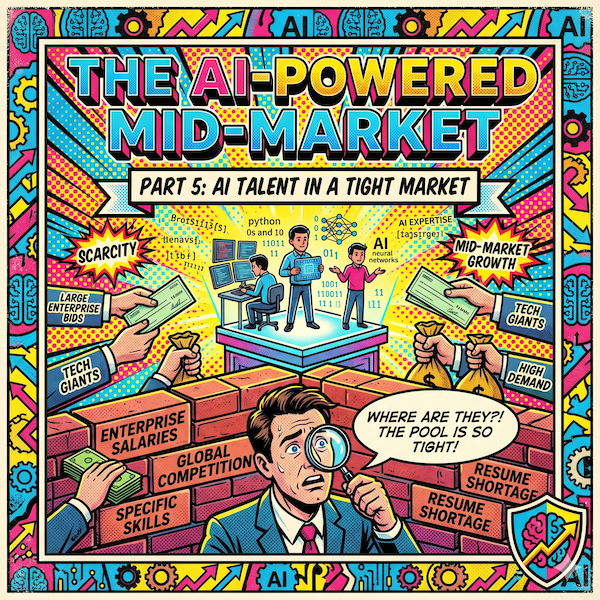
Every AI strategy eventually becomes a talent question, and the AI talent market in 2026 is the most competitive in tech. This fifth article in "The AI-Powered Mid-Market" series argues that mid-market organizations should stop trying to hire their way to AI capability and start building it from within. With AI talent demand exceeding supply by more than 3:1 and base salaries for AI engineers starting at $140,000, competing for specialists against enterprises and well-funded startups is a losing proposition. The article makes the case for distributed AI literacy over concentrated expertise, showing that organizations with structured upskilling programs are twice as likely to report strong AI ROI. It covers a practical three-tier skills framework (AI fluency for everyone, applied skills for regular users, technical skills for a small number of tool managers), the AI champion model for building internal advocates across business functions, why fractional AI leadership may be the fastest way to get executive-level guidance without a $300,000+ full-time hire, how to leverage vendor and partner expertise without creating dependency, and the new roles emerging organically at mid-market scale. The core message: the people who know your business best are the people best positioned to make AI work for you.
The AI-Powered Mid-Market, Part 4: The Buy-First Playbook
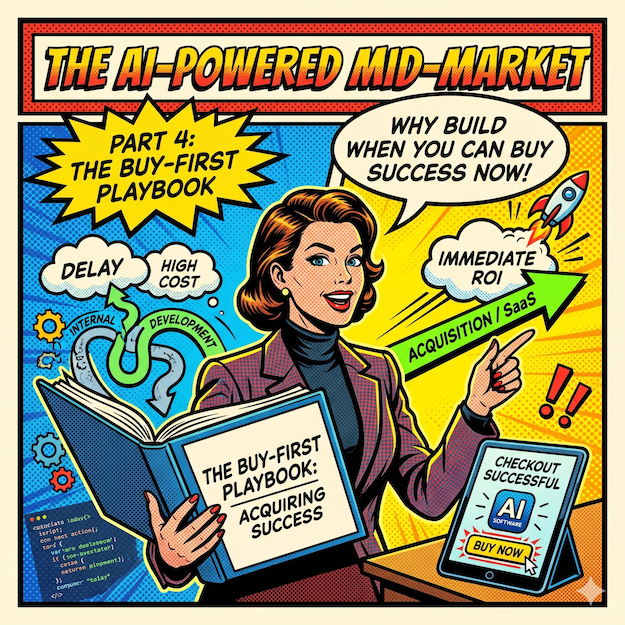
Enterprise organizations spend months debating whether to build, buy, assemble, or extend their AI capabilities. For most mid-market firms, the answer is simpler: buy first. This fourth article in "The AI-Powered Mid-Market" series explains why buying is a strategic choice that plays to mid-market strengths, not a concession to limited resources. It starts with the embedded AI opportunity, where over 60 percent of SaaS products now have AI features that many organizations are paying for but have never activated. The article provides five prioritized vendor evaluation criteria designed for organizations without procurement teams or technical evaluation committees, four contract provisions that protect mid-market buyers (exit rights, data portability, price protection, and usage caps), and a practical explanation of why open interoperability standards like MCP and A2A matter for mid-market buyers facing a 16x switching-cost premium if they do not plan for it. It closes with the scenarios where custom development does make sense at mid-market scale, and why the hybrid approach of validating with SaaS before building custom is increasingly the right path.
The AI-Powered Mid-Market, Part 2: Strategy Without the Enterprise Budget
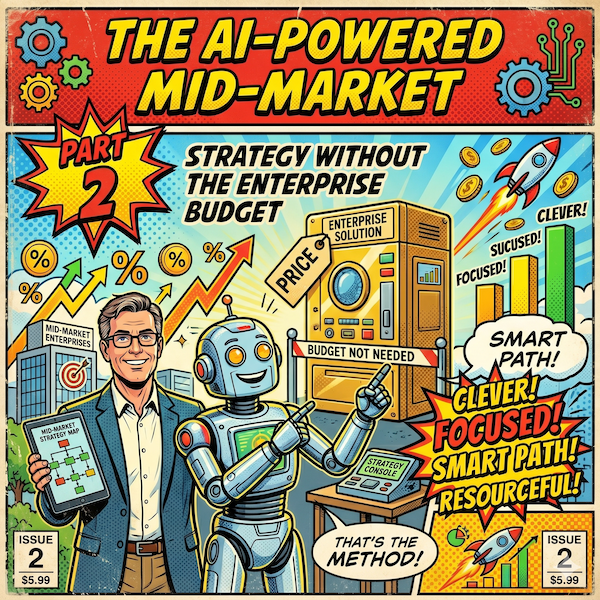
Enterprise AI strategies assume dedicated budgets and multi-year investment horizons. Mid-market organizations need a different approach: one where AI investments pay for themselves as they go. This second article in "The AI-Powered Mid-Market" series lays out a practical investment strategy built around three concepts. The portfolio approach organizes AI investments into quick wins (30 to 90 day payback), strategic bets (6 to 12 months), and infrastructure investments, sequenced so that each phase funds the next. The self-funding strategy shows how early cost savings build the credibility and budget justification for subsequent investments. And the article tackles pilot purgatory, the mid-market version of which is perpetual evaluation rather than enterprise-scale stalling, with a prescription for designing pilots for production from day one. It also breaks down the 2026 AI pricing landscape, covering the shift from per-seat to hybrid and outcome-based models, and provides a simple decision framework for when free tools are enough and when managed platforms are worth the investment.