Workflow Architecture for the AI-Native Enterprise: From Task Augmentation to Process Reimagination
Part 2 of the series "The AI Operating Model Gap"
The Workflow Is the Bottleneck
The first article in this series established the operating model gap: 73% of large enterprises use AI regularly, but only 10% say it is core to how they operate. The gap traces to six organizational dimensions that most enterprises have not redesigned. Of those six, workflow architecture is the most concrete, the most measurable, and the one where the evidence for transformation is strongest.
Workflow architecture is how an organization sequences decisions, tasks, handoffs, and approvals to produce an outcome. It is the plumbing of the operating model, invisible when it works and constraining when it doesn’t. In most enterprises, the workflows that AI touches were designed years or decades before AI existed. Customer onboarding processes, financial close cycles, procurement approvals, compliance reviews, marketing campaign execution, software development pipelines: all of them were designed for humans working with pre-AI tools.
Layering AI on top of these workflows delivers gains. Individually, those gains can be significant. But the workflow itself becomes the ceiling. BCG's research on why AI pilots fail to deliver business value identifies the pattern directly: companies think they’re transforming but in reality achieve marginal gains by doing the same work slightly faster. The problem is not the AI, it’s the workflow.
The organizations seeing 3-4x higher ROI from AI are the ones that redesign the workflow, not just the task. This article examines what that redesign looks like, where enterprises stand today, and how to move from augmenting individual steps to reimagining the entire process.
Three Levels of Workflow Integration
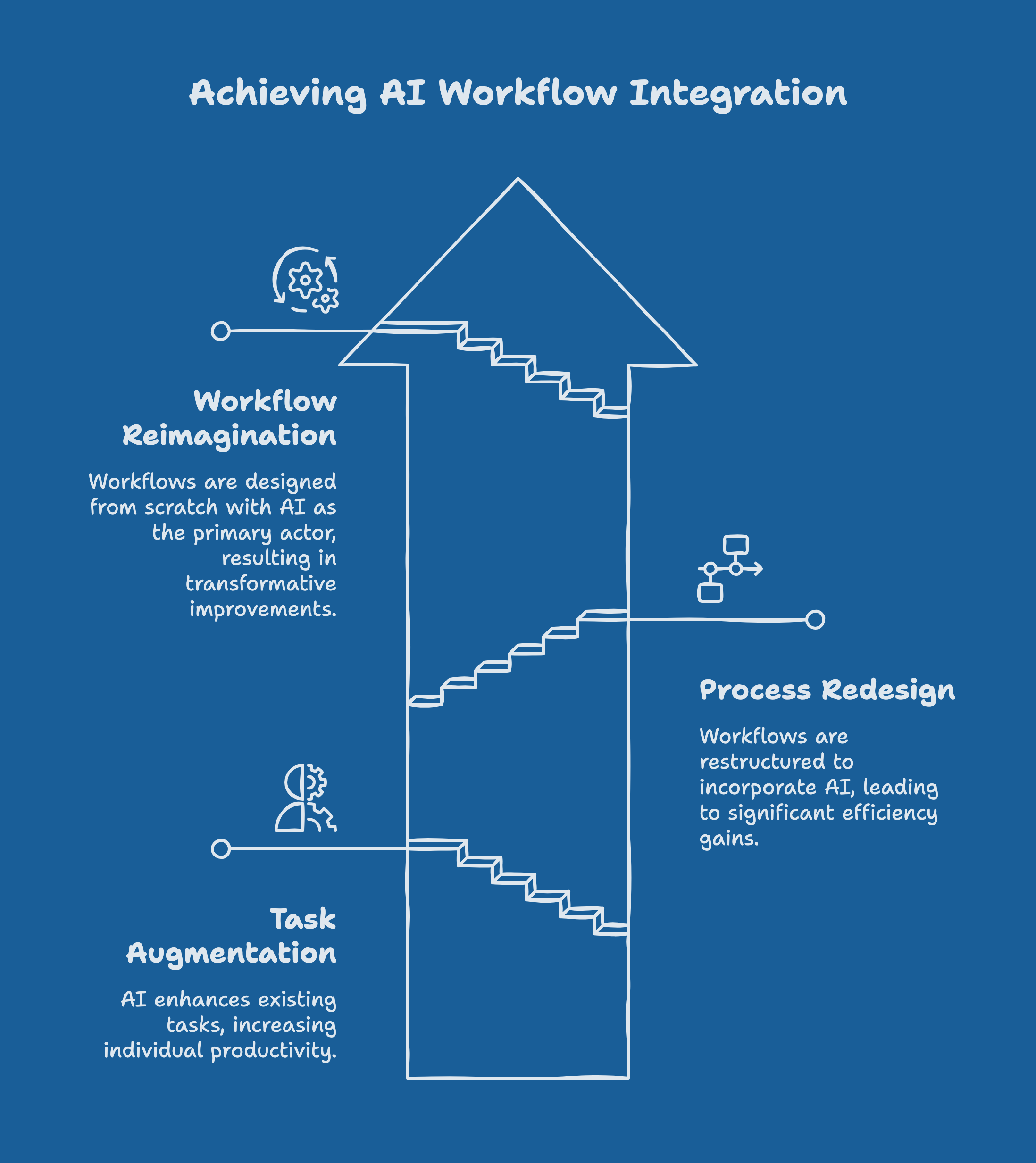
Not all AI integration is equal. Based on the current research and observable enterprise patterns, workflow integration with AI falls into three distinct levels, each with different characteristics, different ROI profiles, and different organizational demands.
Level 1: Task Augmentation. AI helps individuals do existing tasks faster within the current workflow. This is the copilot model: code assistants that accelerate development, writing tools that draft emails, summarization tools that condense documents, chatbots that answer customer questions. The workflow does not change. The sequence of steps, decision points, handoffs, and approvals remains the same. One or more steps simply get faster.
Task augmentation is where most enterprises are. Deloitte's State of AI in the Enterprise 2026 survey found that 37% of organizations are using AI with little or no change to existing processes. This is Level 1. The gains are real: individual productivity improvements of 20 to 40% are common, and Microsoft's 2026 Work Trend Index found that 58% of AI users are producing work they couldn’t have completed a year ago. But the gains are bounded by the workflow. A faster step in an otherwise unchanged process produces a faster step, not a faster process.
Level 2: Process Redesign. Workflows are restructured to incorporate AI at decision points, handoffs, and integration points. This goes beyond speeding up individual tasks to changing how the workflow flows. RAG pipelines that surface relevant information at decision points. Automated routing that replaces manual triage. AI-driven approval workflows that escalate only the exceptions. Intelligent document processing that extracts, validates, and routes information without human handling of routine cases.
30% of enterprises are at this level, redesigning key processes around AI. The ROI differential is significant. BCG documents a global bank that redesigned its operating model around AI, automating 30 to 50% of work, freeing millions of hours for higher-value activities, and projecting 150% ROI over 5 years. A global consumer company that redesigned its marketing workflows around AI achieved 15 to 20% P&L efficiency and saved over €250M. A pharma company that redesigned its drug discovery workflow end to end achieved 20% synthesis cost reduction, 40 to 50% cycle time acceleration, and a 100-fold expansion of viable drug candidates.
These are not incremental improvements. They are step-change gains that come from changing the workflow, not just the tools within it.
Level 3: Workflow Reimagination. Workflows are designed from scratch with agents as primary actors and humans as supervisors, exception handlers, and strategic decision-makers. This is not augmentation or redesign. It is a different architecture. The workflow starts with the outcome and works backward to the optimal sequence of agent and human activities, rather than starting with the existing process and finding places to insert AI.
34% of enterprises say they are starting to deeply transform, creating new products and services or reinventing core processes and business models. But "starting to" is a long way from operating at Level 3. Harvard Data Science Review's research on the agent-centric enterprise argues that traditional AI implementation, adding assistants to existing workflows, yields 20 to 40% incremental gains. Agent-centric workflow redesign, where the workflow is built around agent capabilities with humans providing oversight and judgment, yields 2 to 10x productivity improvements. The difference is not a refinement, it’s a category change.
The comparison between BCG's 2025 and 2026 data points to how quickly this is shifting. The number of organizations that have graduated to using AI to reshape workflows end to end or to invent new business models has nearly doubled: 42% in 2026 versus 22% in 2025. The movement is real, but most of that 42% are early in the journey.
Three Levels of Workflow Integration
What Level 3 Workflows Look Like
Level 3 is still emerging, but enough examples exist to identify the defining characteristics.
The Harvard Business Review's September-October 2026 article by Kris Johnson Ferreira and Jordan Tong, based on field research at Walmart, Amazon, Ericsson, Ramp, and Medtronic, provides the clearest framework. In agentic workflow orchestration, AI agents perform analyses, route information, surface trade-offs, and execute within guardrails. Humans contribute context and tacit knowledge, set guardrails, and make the final calls. The workflow is designed for this division of labor from the beginning, not adapted from a human-only process.
The defining characteristics of Level 3 workflows are worth spelling out.
Agent-led execution with human oversight (human-in-the-lead). The default state is that agents perform the work. Humans intervene for exceptions, judgment calls, and strategic decisions. This inverts the Level 1 model, where humans perform the work and agents assist. It also differs from Level 2, where humans still drive most of the workflow with AI handling specific steps. In Level 3, the agent drives the workflow and the human leads through oversight, guardrails, and exception management.
Outcome-managed rather than task-managed. Level 1 and Level 2 workflows are managed by tracking task completion: did the step get done, was the deliverable produced, was the approval obtained? Level 3 workflows are managed by tracking outcomes: did the customer's issue get resolved, did the procurement achieve the target cost, did the financial close meet accuracy requirements? The difference matters because outcome management lets the agent choose the optimal path to the result, rather than following a prescribed sequence of steps.
Cross-functional by design. Most enterprise workflows cross functional boundaries: a customer complaint touches customer service, logistics, finance, and sometimes product. Level 1 AI augments the steps within each function separately. Level 3 designs the workflow across functions, with agents connecting the information and actions that functional silos traditionally fragment. This is the cross-silo orchestration that the HBR research documents: agents moving information and surfacing trade-offs across boundaries that organizational structure would otherwise require meetings, emails, and escalations to cross.
Continuous learning and adaptation. Level 3 workflows generate data about their own performance and use it to improve. An agent-led customer resolution workflow does not just resolve the issue. It records the resolution path, the exception patterns, the escalation triggers, and the outcome quality, then uses that data to refine its own routing and execution. The workflow gets better over time without manual process improvement efforts.
The real-world examples are emerging rapidly. Walmart's inventory management agents monitor stock levels, forecast regional demand fluctuations, and adjust procurement orders across thousands of products simultaneously, compressing response times from days to minutes. Ramp's financial operations agents handle expense categorization, policy compliance checking, and anomaly detection as a continuous workflow rather than a periodic review. These are not hypothetical future-state designs. They are production systems running today.
The Level 1 Ceiling
Understanding why Level 1 hits a ceiling is important because it explains why more AI investment without workflow redesign produces diminishing returns.
The ceiling has three components.
First, the bottleneck shifts. When one step in a workflow gets faster, the constraint moves to the next slowest step. A financial analyst who drafts reports twice as fast still depends on the same review and approval process downstream. A developer who writes code three times as fast still depends on the same testing, review, and deployment pipeline. The faster step creates pressure on the unchanged steps, which often cannot absorb the increased throughput. BCG's research finds that companies pursuing workflow redesign are 24 points more likely to see measurable improvement and 22 points more likely to save employees a full day per week, precisely because they address the entire workflow, not just the steps where AI can help.
Second, the interfaces are wrong. Workflows designed for human-to-human handoffs have specific information packaging, communication patterns, and decision checkpoints that made sense for people working without AI. When an AI agent generates an output, the format, granularity, and content optimal for a human reviewer may be different from what the original workflow specified. But Level 1 does not change the interfaces. The agent's output gets squeezed into the old handoff format, losing information or adding friction.
Third, the measurement is misaligned. Level 1 workflows are measured by the metrics of the old workflow: time per task, output per person, completion rates. These metrics capture individual productivity gains but miss the workflow-level impact. An organization can show that every employee using AI is 30% more productive by task metrics while the end-to-end cycle time, quality, and cost of the workflow have not changed. The metrics say AI is working. The business results say it is not.
The Workflow Decomposition Method
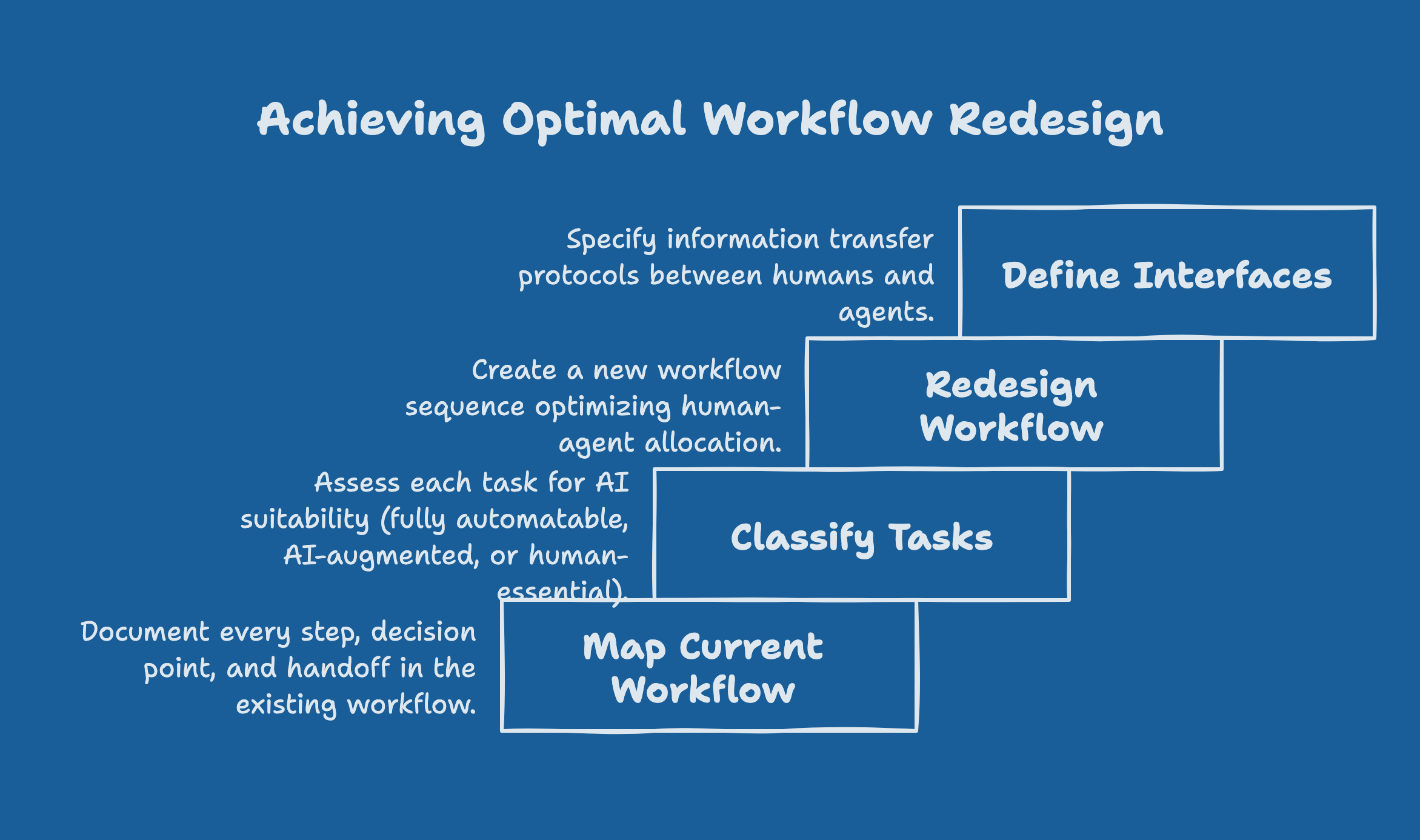
Moving from Level 1 to Level 2 or Level 3 requires a structured approach to workflow redesign. The most effective method is workflow decomposition: breaking an existing workflow into its constituent elements and rebuilding it around the optimal allocation of human and agent work.
The process has four phases.
Phase 1: Map the current workflow in full. Document every step, decision point, handoff, information dependency, and approval gate. Include the steps that happen informally: the emails asking for clarification, the hallway conversations that resolve ambiguities, the workarounds that bypass slow approval queues. Most enterprise workflows have a formal version (documented in process maps) and an actual version (how work gets done in practice). The actual version is what matters.
Phase 2: Classify every task by AI suitability. For each task in the workflow, assess whether it is fully automatable (an agent can perform it without human involvement given current capabilities), AI-augmented (an agent can perform it with human oversight or final approval), or human-essential (the task requires judgment, creativity, contextual understanding, or interpersonal skills that agents cannot reliably provide). The classification should be based on current agent capabilities, not projected future capabilities. Building a workflow around capabilities that do not yet exist is a common reason redesign efforts fail.
Phase 3: Redesign the workflow around the optimal human-agent allocation. This is not about inserting agents into the existing workflow sequence. It is about designing the optimal sequence of activities, decisions, and handoffs to achieve the workflow's outcome, given the available human and agent capabilities. The sequence may be very different from the current workflow. Steps that exist because humans could not access information fast enough may be eliminated. Approval gates that exist because humans make errors may be replaced with automated quality checks. Handoffs between functions that exist because of organizational structure may be replaced with cross-functional agent execution.
Phase 4: Define the interfaces. For every point where work passes between a human and an agent, or between agents, specify what information transfers, in what format, with what quality requirements, and with what escalation conditions. The interfaces are where most redesigned workflows fail in practice. A vague interface, such as "the agent sends the analysis to the reviewer," creates friction and errors. A precise interface, such as "the agent produces a risk assessment with confidence scores, flagging any item below 85% confidence for human review, with supporting evidence for each flag," creates a workflow that works.
Optimal Workflow Redesign
This is a 2 to 4 week effort per workflow, not a 2-day workshop. The decomposition requires input from the people who do the work, the people who manage it, and the people who receive its outputs. It requires data on current performance to establish baselines. And it requires an honest assessment of where AI is and is not ready for production use.
Why Most Redesign Efforts Fail
The research on AI workflow redesign failures points to a consistent root cause: organizations start with the technology instead of with the work.
"Where can we use AI?" is the wrong question. The right question is: "What outcome does this workflow produce, and what is the ideal sequence of decisions and actions to produce it?" The first question produces Level 1 deployments. The second question produces Level 2 and Level 3 redesigns.
Only about a fifth of leaders say their business processes are ready for agentic operation. The readiness gap isn’t primarily a technology gap. It is a process architecture gap. Organizations that saw real returns were about twice as likely to have redesigned the end-to-end workflow before choosing a model or platform. They started with the work, not the tool.
The other common failure mode is the pilot-to-production gap. Roughly 80% of the work required to move from pilot to production is data engineering, governance, workflow integration, and measurement infrastructure. When redesign efforts treat these as afterthoughts (build the AI, then figure out governance, monitoring, and measurement), the result is a pilot that works in controlled conditions and cannot operate in production. The 88% of AI pilots that never reach production are not failing because the AI does not work. They are failing because the workflow, governance, and measurement infrastructure around the AI was never designed.
The bridge from pilot to production must be built from day one. That means designing the redesigned workflow with production governance, monitoring, escalation protocols, performance measurement, and feedback loops before the first agent is deployed, not after the pilot succeeds.
The Agent Silo Problem
Even organizations that have moved beyond Level 1 face a structural challenge: agent fragmentation. The average enterprise now uses 12 or more agents, with 50% operating in isolated silos without central coordination.
Agent fragmentation recreates at the technology layer the same problem that functional silos create at the organizational layer. Each department deploys its own agents, connected to its own data, optimized for its own workflows, unable to share information or coordinate with agents in other departments. The customer service agent knows the customer's complaint history but not their purchase patterns. The procurement agent optimizes for cost but cannot factor in the quality feedback from operations. The marketing agent personalizes offers without visibility into the customer's open support tickets.
This is not an agent problem. It is a workflow architecture problem. When workflows are designed function by function (Level 1 or early Level 2), the agents that support them are naturally siloed. When workflows are designed cross-functionally (late Level 2 or Level 3), agents are connected by design because the workflow requires it.
Gartner projects that 40% of enterprise applications will embed task-specific AI agents by year-end 2026, but also warns that 40% of those agents will be demoted or decommissioned by 2027 due to governance gaps and fragmentation. The organizations that avoid this outcome will be the ones that design agent deployment as a workflow architecture decision, not a departmental technology choice.
The Competitive Implication
Workflow architecture is where the operating model gap becomes a competitive gap.
Organizations at Level 3 can respond faster, process more information, serve more customers, and adapt more quickly than organizations at Level 1, using the same underlying AI technology. The advantage isn’t in the models, it’s in how the work is organized around them. A company that redesigns its customer resolution workflow so that agents handle 80% of cases end to end, with humans leading on complex exceptions, will operate at a different speed and cost structure than a competitor that gives its customer service agents a chatbot assistant.
BCG's data shows that AI front-runner firms do not focus on the quantity of AI usage. They use AI to reimagine how work gets done: redesigning operating models, redrawing decision rights, restructuring teams around outcomes instead of tasks. These firms are pulling ahead by more than 11 percentage points in annual total shareholder returns.
The implication for enterprise leaders is that workflow architecture is not a technical decision to delegate to IT. It is a strategic decision about how the organization creates value, and it deserves the same executive attention as market strategy, capital allocation, and talent management.
Strategy Playbook
1. Workflow Integration Level Assessment. Classify your top 20 AI-touched workflows by integration level. Level 1: AI assists individuals within the existing process. Level 2: the process has been restructured to incorporate AI at decision points and handoffs. Level 3: the workflow is designed from scratch with agents as primary actors and humans providing oversight. If more than 70% are at Level 1, the operating model gap is primarily a workflow architecture problem, and incremental AI investment will produce diminishing returns.
2. High-Value Workflow Identification. Identify the 3 to 5 workflows where the gap between current performance and AI-native potential is largest. Prioritize by business impact: revenue influence, cost reduction potential, cycle time compression, and quality improvement. Avoid the common trap of prioritizing by ease of implementation, which biases toward low-value workflows where Level 1 augmentation is already sufficient.
3. Workflow Decomposition Sprint. For each priority workflow, run the four-phase decomposition: map the actual workflow, classify every task by AI suitability, redesign the workflow around optimal human-agent allocation, and define precise interfaces between human and agent steps. This is a 2 to 4 week effort per workflow, requiring input from operators, managers, and downstream consumers. Budget for it accordingly.
4. Pilot-to-Production Bridge. Design every redesigned workflow with production requirements from day one: monitoring dashboards, escalation protocols, performance baselines, governance controls, and feedback loops. The 88% of pilots that never reach production fail at operational infrastructure, not at AI capability. If the production governance plan is not part of the workflow design, the redesign is already at risk.
Arion Research advises enterprise leaders on AI strategy and the shift to a digital workforce.