Two Blueprints for the Agentic Enterprise: Salesforce's four layers and the Future Enterprise framework describe the same shift.
Where they agree, and where they don't, is the useful part.
At Dreamforce 2026, Marc Benioff presented a four-layer model of the agentic enterprise. Under the banner "AI replaces the UI," Salesforce laid out a stack that runs from an interface layer called AIforce down through an agents layer, an apps and semantics layer, and a data layer. In April, we published a research report, The Future Enterprise, that mapped the same transition from a vendor-neutral vantage point. Setting the two side by side is worth the exercise. When an independent analyst framework and the largest enterprise software vendor's flagship keynote reach for the same shape, the points where they agree tell you what is settled. The points where they diverge tell you what is still being decided.
The two maps
Salesforce describes four horizontal layers. The Interface Layer (AIforce) is the crowning announcement: instead of asking employees to log into dashboards, it pushes Salesforce data, logic, and agent actions out to where people already work, including Slack, Claude, Lightning, and custom applications. The Agents Layer (Agentforce) hosts the autonomous digital workforce. The Apps and Semantics Layer is the deterministic core, the layer Salesforce calls the "physics of the business," which holds business vocabulary, security, permissions, and headless workflow logic. The Data Layer (Data 360, with MuleSoft and Informatica) unifies fragmented records into an AI-ready foundation.
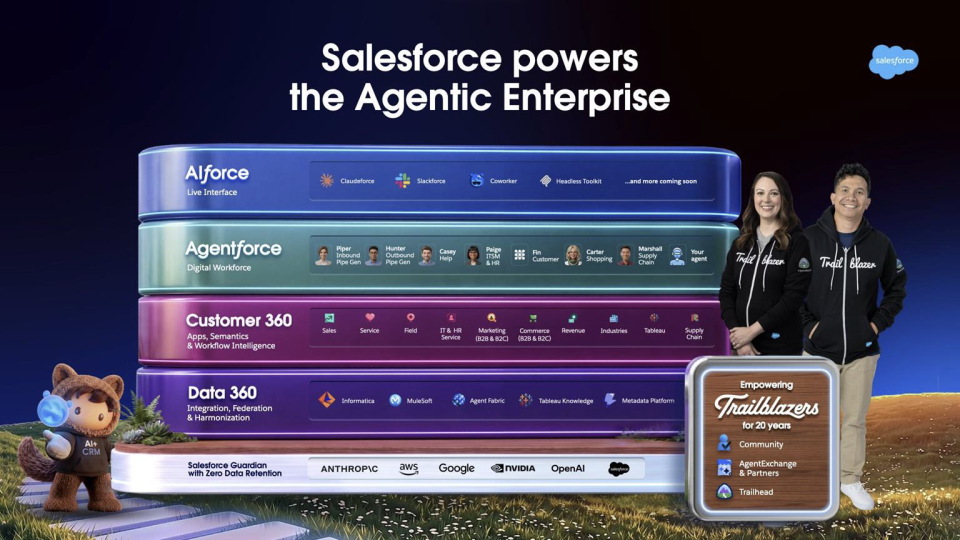
Salesforce Agentic Enterprise
Our Future Enterprise framework describes three horizontal layers, one piece of connective infrastructure, and a set of cross-cutting services. The Enterprise Platform is the foundation: the system of record plus the business rules and logic that survive after you strip away the UI and the rigid workflows. The Agentic Platform is where agents reason, execute, and get orchestrated. Collaboration is the interaction surface where four communication modes converge: agent-to-agent, human-to-agent, agent-to-human, and human-to-human. Between the agentic and collaboration layers sits the Agent Service Bus, the connective tissue that lets agents discover each other, negotiate, and resolve conflicts. Spanning all of it are four vertical services: Identity, Governance, Context and Persistent Memory, and Metering.
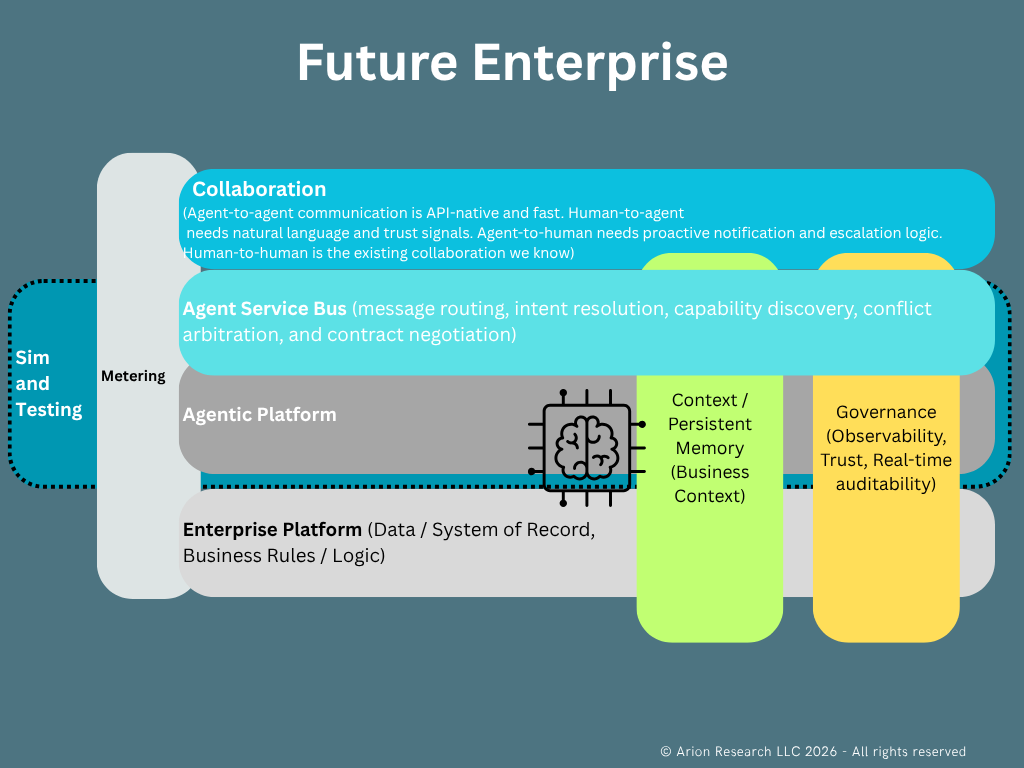
Arion Research Future Enterprise
Where the maps line up
The layers align almost one to one.
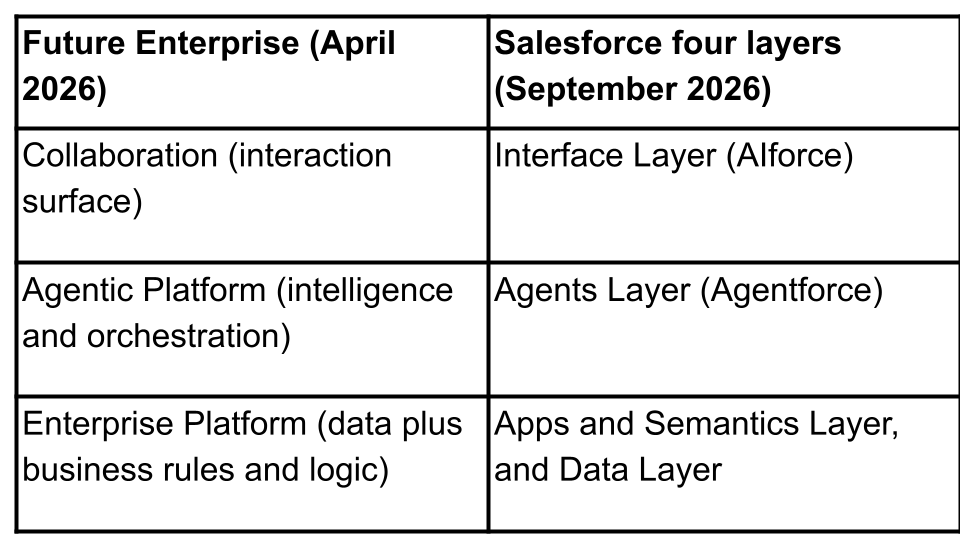
Architecture Comparison
That is a striking amount of agreement between two frameworks built independently, five months apart, from opposite ends of the market. Three convergences stand out.
The first is the collapse of the interface as the center of gravity. Our report argued that the UI and workflow layers are losing strategic importance because agents do not need screens or guided, pre-defined steps. Salesforce made the same claim the headline of its keynote. "AI replaces the UI" and "the UI layer loses strategic value" are the same observation stated with different intent.
The second is the shape of the stack itself. Both frameworks treat agents as a distinct architectural tier rather than a feature bolted onto applications, and both put a data foundation at the bottom. The idea that the enterprise stack is reorganizing into layers, with an autonomous agent tier as a first-class citizen, is now shared ground rather than a contrarian forecast.
The third is direction on pricing and orchestration, visible in public coverage of the event. The move away from a pure per-seat model toward action-based and consumption-oriented pricing is the path our report predicted when it argued that per-seat pricing breaks once a single agent does the work of many users.
Where the maps diverge
The differences are more interesting than the similarities, because they mark the questions that are still open.
Data and business logic: one foundation or two layers. Our framework folds data and business logic into a single Enterprise Platform. Salesforce splits them, giving business logic its own named tier, the Apps and Semantics Layer, above the Data Layer. This is not a cosmetic difference. Naming business logic as a distinct, deterministic layer is a statement that the rules, the vocabulary, and the guardrails are a durable asset in their own right, separable from both the raw data below and the agents above. Our report reached the same conclusion by a different route, arguing that data and business logic retain their value while the UI and workflow layers lose theirs, and that business logic is the asset that resists commoditization the longest. The two maps agree that business logic matters. They differ on whether it sits inside the foundation or stands on its own, and that difference points straight at the central strategic question both frameworks raise: who owns that layer, and on whose terms.
Orchestration as a layer, or as a bus. In the Salesforce model, orchestration lives inside the Agents Layer. In ours, the hardest orchestration problems live in a separate Agent Service Bus that sits above the agents and performs five functions: capability discovery, intent resolution, contract negotiation, conflict arbitration, and message routing. We singled this out as the most strategically important infrastructure that few vendors were building, precisely because current protocols handle routing and discovery well but leave negotiation and arbitration unsolved. A four-layer product architecture does not need to surface this as its own tier. A market architecture does, because the question of who mediates between agents that may disagree, and whether that mediator is neutral, does not resolve inside any single vendor's stack.
A product map versus a market map. This is the difference beneath the others. Salesforce is describing its own platform, and it describes it well. The interface layer reaches outward to Slack, Claude, and custom surfaces, which is genuine openness at the top of the stack. But the architecture is anchored on Salesforce's data, semantics, and agents. Our framework describes the market the enterprise operates in, which is why it foregrounds concerns a single-vendor map can treat as edges: federated identity that works across providers, governance that goes beyond compliance into behavioral and contextual layers, and cross-organizational agents where a buyer's procurement agent negotiates with a supplier's fulfillment agent across a trust boundary that no one vendor controls. These are not weaknesses in the Salesforce model. They are simply outside its frame.
The question both maps pose
The most consequential place the two frameworks meet is the business-logic layer, and they pose the same question from opposite sides.
Read one way, Salesforce elevating Apps and Semantics to a named tier confirms a thesis at the heart of our report: as data access commoditizes through shared protocols and model intelligence converges, the durable center of gravity becomes the business logic specific to each enterprise, the approval chains, pricing rules, and institutional knowledge that do not generalize. Salesforce building a dedicated layer for exactly that is evidence the industry now sees it the same way.
Read another way, the same move is the one enterprises should study hardest. Our report's strongest recommendation was to document, structure, and own your business logic independently of any vendor platform, in machine-readable and portable form, because the organizations that leave that logic buried inside vendor applications will have fewer options later. A vendor-owned business-logic layer is convenient, coherent, and deep. It is also the layer our framework argues enterprises have the most reason to keep portable. Both readings are defensible, and the tension between them is not resolved by either map. It is resolved by the architectural choices each enterprise makes over the next two to three years.
Two maps of one territory
The headline is not that one framework is right and the other wrong. It is that a vendor keynote and an independent analyst report, built separately, converged on substantially the same architecture. That convergence is itself the finding. The agent-native enterprise has moved from thesis to roadmap. The shape of the stack, agents as a distinct tier, the interface losing primacy, data and logic as the durable layers, is now common ground.
What remains contested is where the value accrues and who controls it. Whether orchestration stays inside vendor platforms or resolves into neutral infrastructure. Whether identity and governance become architectural layers that span organizations or remain features inside each vendor's walls. And whether business logic stays inseparable from the platforms that hold it today, or becomes something enterprises own and carry with them. Those are the questions the next phase decides. Two maps now describe the territory. The route through it is still being drawn.
Arion Research advises enterprise leaders on AI strategy and the shift to a digital workforce. Our April 2026 report, The Future Enterprise: How AI Agents Are Restructuring Enterprise Technology, is available at Arion Research.