The Enterprise App Collapse: How AI Agents Are Forcing a New Architecture
The enterprise software market just had its "oh" moment.
In February 2026, OpenAI launched Frontier, its agent platform for the enterprise. Within weeks, nearly $1 trillion in SaaS market capitalization evaporated. Investors called it the "SaaSpocalypse." Workday stock plummeted despite beating earnings. Salesforce CEO Marc Benioff went on the defensive, telling the market "this is not our first SaaSpocalypse." The message from Wall Street was blunt: the traditional enterprise application model is under existential pressure.
But the market reaction, dramatic as it was, misses the more interesting story. The real question is not whether AI agents will disrupt enterprise software. They will. The real question is what replaces the current architecture; and who controls the new one.
Enterprise Apps Are Bundles Ready to Unbundle
To understand what is happening, you need to see today's enterprise applications for what they are. Every major enterprise app; whether it is an ERP system from Oracle or SAP, a CRM platform from Salesforce, or an HCM suite from Workday; is a bundle of four things: a data model, business logic, a user interface, and workflow orchestration.
That bundle made sense in a world where humans were the primary users of enterprise software. Humans need interfaces. They need guided workflows. They need applications that present information in digestible forms and walk them through processes step by step.
AI agents need none of that.
Agents do not need a UI. They interact through APIs. They do not need rigid, pre-defined workflows. They can reason about what to do next based on context, rules, and goals. What agents do need is access to trusted data (the system of record), the business rules that govern how the enterprise operates, and the ability to take action.
This is the unbundling thesis: the four components that have been stitched together inside enterprise applications for decades are coming apart. The UI and workflow layers lose strategic importance. The data model and business logic retain their value but get consumed differently, by agents rather than by humans clicking through screens.
The question becomes: what does the stack look like when you reassemble those pieces for an agent-native world?
The Enterprise Shift
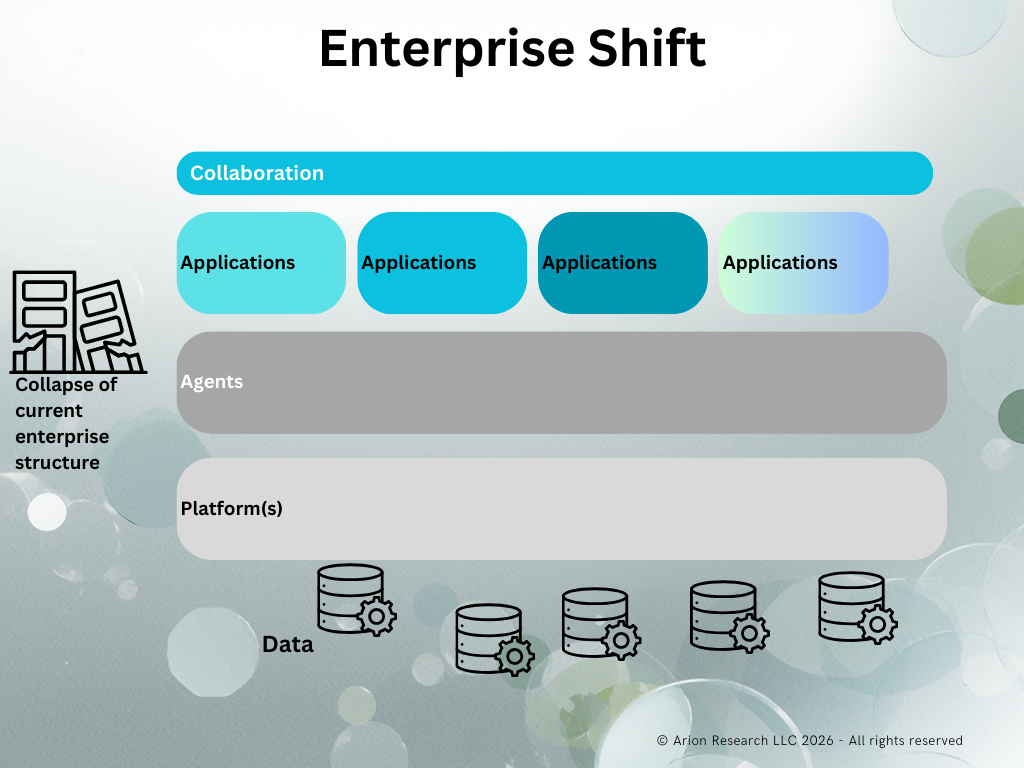
The first step in the transition is visible today. The traditional enterprise structure; collaboration tools sitting on top of siloed applications, each with its own data store; is already reorganizing.
Applications do not disappear in this phase. But they shrink in strategic importance. They become interchangeable modules rather than the center of gravity. A CRM system stops being the command center for sales and starts being one of several data sources that agents draw on to manage customer relationships. An ERP system stops being the place where finance teams live and starts being the transactional backbone that agents use to process invoices, reconcile accounts, and generate reports.
The platform layer and the agent layer absorb the functions that used to justify enterprise app lock-in. The differentiation shifts from "which application has the best features" to "which platform gives agents the best access to data, the most robust orchestration, and the strongest governance."
This is already causing real competitive anxiety. Oracle, for instance, is simultaneously an early Frontier customer and a vendor with 600+ embedded AI agents in its own Fusion Cloud applications. That dual positioning, partner and competitor at the same time, tells you everything about how unsettled the landscape is.
The Future Enterprise Architecture
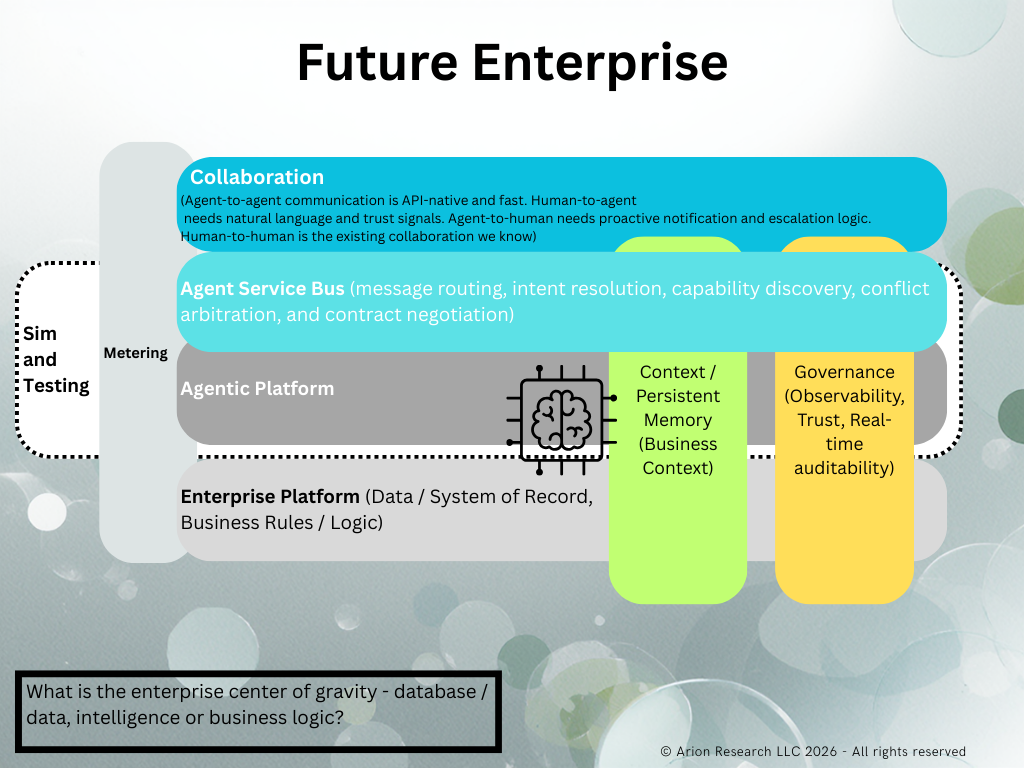
So what does the destination look like? I have been developing a layered architecture framework for what I am calling the "Future Enterprise." It has three horizontal layers, a critical piece of connective infrastructure, and several cross-cutting vertical services.
Enterprise Platform (the Foundation)
The base layer is the Enterprise Platform. It provides the system of record; validated, governed, transactional data; along with business rules and logic. This is what remains after you strip the UI and rigid workflows from today's applications. It is the "source of truth" that both agents and humans depend on.
This layer is where Oracle's database-centric strategy maps most directly. Oracle Database 26ai, with its in-database agents and vector capabilities, is a bet that the database itself becomes the center of the enterprise AI stack. It is also where SAP's business process expertise and Workday's HR domain knowledge live as durable assets, even if the application wrapper around them changes dramatically.
Agentic Platform (Intelligence and Execution)
The middle layer is where AI agents live and operate. It provides three things: agent orchestration (managing which agents run, when, and in what sequence), process and workflow orchestration (replacing the rigid workflow engines of traditional apps with dynamic, AI-driven execution), and the intelligence layer itself; the AI models that power reasoning and decision-making.
This is the layer that OpenAI is targeting with Frontier. It is also where Anthropic, Google, and Microsoft are competing. The Agentic Platform consumes data and business rules from the Enterprise Platform below and exposes capabilities to the Collaboration layer above.
A critical sub-component here is what I am calling the Agent Service Bus; the connective tissue that sits between the Agentic Platform and the Collaboration layer. If you remember the Enterprise Service Bus (ESB) from the SOA era, this is the next-generation version, but significantly more complex. It handles message routing between agents, intent resolution (understanding what an agent is trying to accomplish), capability discovery (which agent can do what), conflict arbitration (what happens when two agents want to modify the same record), and contract negotiation (how agents agree on terms, SLAs, and fallback behavior when delegating tasks to each other).
The Agent Service Bus may be the most strategically important piece of infrastructure in the entire stack, and no one has clearly won it yet.
Collaboration (the Interaction Surface)
The top layer is where all four communication modes converge: agent-to-agent, human-to-agent, agent-to-human, and human-to-human.
Each mode has different requirements. Agent-to-agent communication is API-native and fast. Human-to-agent interaction needs natural language and trust signals; people need to understand what agents are doing and why. Agent-to-human interaction needs proactive notification and escalation logic; agents need to know when to surface decisions to a human rather than acting autonomously. Human-to-human is the collaboration we already know.
The hard design problem is not any single mode. It is the transitions between them. A workflow might start as a human-to-human conversation ("we need to renegotiate this vendor contract"), escalate to human-to-agent ("draft the analysis and identify the key leverage points"), trigger agent-to-agent work (one agent pulls financial data, another analyzes contract terms, a third benchmarks market rates), and surface back as agent-to-human ("here is the recommended negotiation strategy with three scenarios"). Making those transitions seamless; so the humans involved experience it as one continuous workflow rather than four disconnected handoffs; is arguably the hardest UX challenge in the future enterprise.
The Vertical Services
Three cross-cutting services span the entire architecture:
Context and Persistent Memory. This is distinct from the transactional system of record. It is the organizational knowledge graph; contextual memory that spans interactions, accumulates institutional knowledge, and informs future decisions. OpenAI calls this "Business Context" in Frontier. It bridges the Enterprise Platform (structured data) and the Agentic Platform (agent reasoning), providing the persistent state that makes agents smarter over time. Think of it as the difference between an employee who has access to the company database and an employee who has worked at the company for ten years and understands the unwritten rules, the institutional history, and the political dynamics.
Governance. When agents execute transactions, make decisions, and interact with each other, the enterprise needs real-time auditability, explainability, and chain of custody for every action. This goes beyond traditional logging. It is deterministic proof of why an agent did what it did, with what authority, using what data. In regulated industries; finance, healthcare, government; governance becomes the gating factor for adoption. No amount of agent intelligence matters if you cannot prove to a regulator that the agent acted within authorized boundaries.
Metering. If per-seat pricing collapses (and it is collapsing; more on this in a moment), the platform needs native instrumentation for measuring consumption and attributing value. Metering must operate at every layer: data access and compute at the Enterprise Platform, agent invocations and task completions at the Agentic Platform, and outcomes delivered at the Collaboration layer.
Finally, the architecture needs a simulation and testing capability; a sandboxed environment where agent workflows can be tested against production-like data without executing real transactions. This is the DevOps equivalent for agentic systems. You would not deploy a major code change without testing it. You should not deploy an agent workflow that processes invoices, modifies contracts, or communicates with customers without testing it either.
The Center of Gravity Question
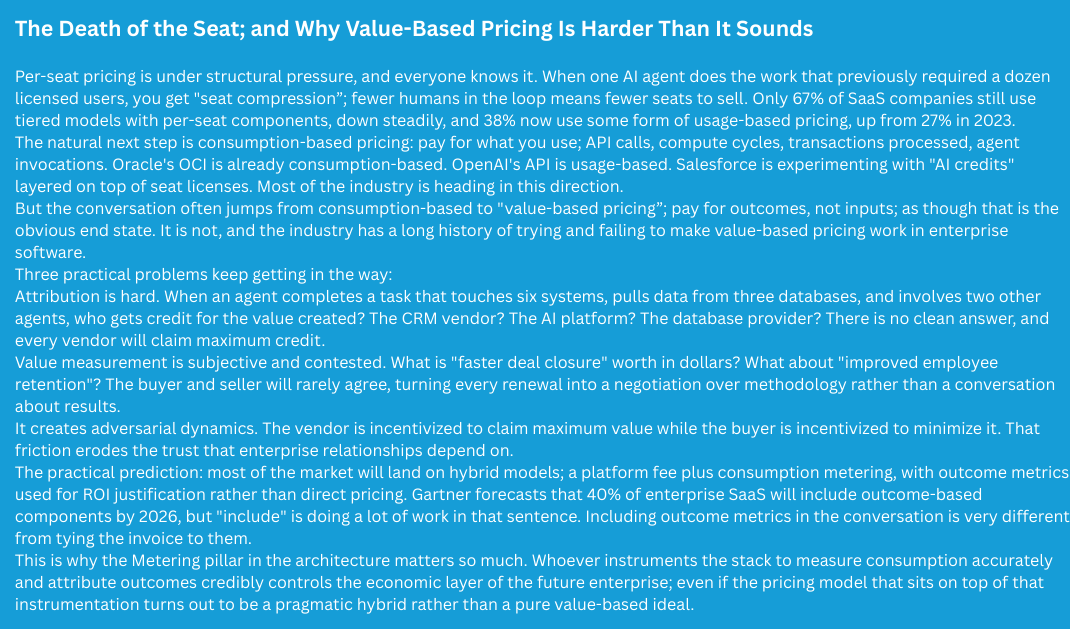
The framework raises a strategic question that every enterprise vendor and buyer needs to answer: what becomes the control point that everything else orbits around?
My take is that the answer depends on the time horizon.
In the near term (1-2 years), data wins. Agents need trusted, governed data to act on, and whoever controls that data controls the agents. This is Oracle's bet with Database 26ai. It is also why established SaaS vendors with deep data moats; the transactional histories, the customer records, the financial data; retain significant leverage even as their application layers get disrupted.
In the medium term (3-5 years), intelligence wins. Model capability determines what agents can do. As reasoning quality improves, the differentiator shifts from "who has the data" to "who has the smartest agents." This is OpenAI's bet with Frontier, and Anthropic's, and Google DeepMind's. The platform with the most capable models attracts the most developers, which attracts the most enterprise customers, which generates the most data to make the models even smarter. It is a flywheel.
In the long term (5+ years), business logic might reassert itself. Generic intelligence commoditizes; just as compute commoditized, just as storage commoditized, just as basic AI inference is already commoditizing. The differentiator becomes domain-specific reasoning: understanding the nuances of pharmaceutical supply chains, or insurance underwriting, or manufacturing quality control. That deep vertical expertise lives in today's SaaS incumbents, and it may prove harder to replicate than either raw data or general intelligence.
The smartest enterprises will not bet on just one of these. They will invest across all three; ensuring data quality and governance now, building optionality across AI platforms in the medium term, and deepening domain expertise continuously.
What This Means for Enterprise Leaders
If you are a CIO, CTO, or business leader trying to navigate this shift, here is what I would focus on:
Audit your application bundle. Look at each major enterprise application in your portfolio and ask: which of the four components (data model, business logic, UI, workflow) are we getting value from? Where are agents already capable of replacing the UI and workflow layers? That is where disruption hits first.
Evaluate your platform bets. Are you locked into one vendor's agent ecosystem, or are you building optionality? The Agent Service Bus layer is where lock-in risk is highest and where strategic flexibility matters most. Push your vendors on interoperability and avoid architectures that trap your agents inside a single platform.
Prepare for new collaboration modes. Your organization is going to need to work alongside agents as peers, not just use them as tools. That means rethinking roles, redefining processes, and, critically; building the trust infrastructure (governance, explainability, auditability) that makes human-agent collaboration viable in regulated, high-stakes environments.
Get serious about governance before regulators do. The governance pillar is not optional. It is the gating factor for enterprise adoption of agentic systems. The companies that build robust governance early will move faster than those who treat it as an afterthought and then scramble to bolt it on when regulators come asking questions. (Check out this new Governance-by-Design Research Report).
Rethink your pricing assumptions. Whether you are a software buyer or a software seller, the per-seat model is not the long-term equilibrium. Start planning for hybrid consumption models now and invest in the metering infrastructure that makes those models work.
The enterprise application model that has dominated for the past two decades is not going to disappear overnight. But it is being unbundled, restructured, and reassembled around a new architecture; one where agents are first-class participants, platforms matter more than applications, and the collaboration between humans and AI becomes the primary interface for how work gets done.
The companies that understand this shift and architect for it will thrive. The ones that cling to the old bundle will find themselves on the wrong side of the next SaaSpocalypse.