
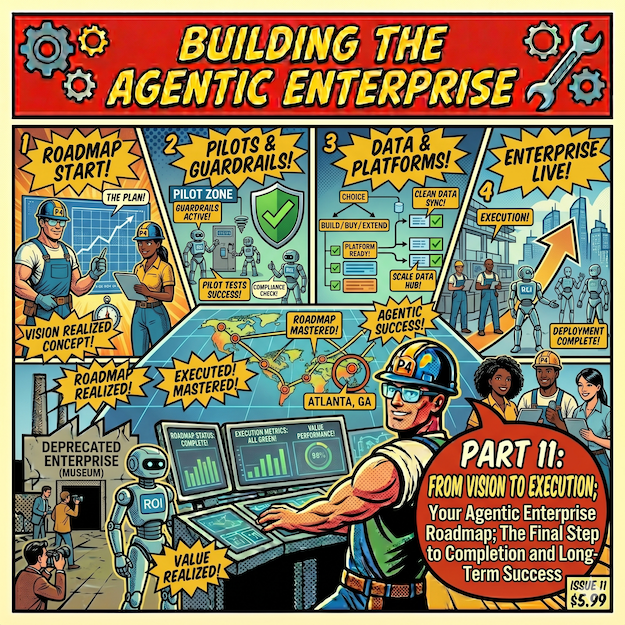
Building the Agentic Enterprise, Part 11: From Vision to Execution; Your Agentic Enterprise Roadmap
The final article in the "Building the Agentic Enterprise" series connects every dimension we have explored into a coordinated execution plan. Using the Dual Maturity Framework as the strategic backbone and the six readiness dimensions as the operational detail, it lays out a three-phase roadmap: Foundation (months 1 to 6), Expansion (months 6 to 18), and Transformation (months 18 to 36). The article covers the common pitfalls that derail agentic initiatives, a phase-based KPI framework for measuring progress, and the ongoing discipline of alignment that separates intentional transformation from hopeful experimentation. It closes with a consolidated readiness checklist that ties together the guidance from every article in the series, giving leaders a single diagnostic for where they stand and where to invest next.
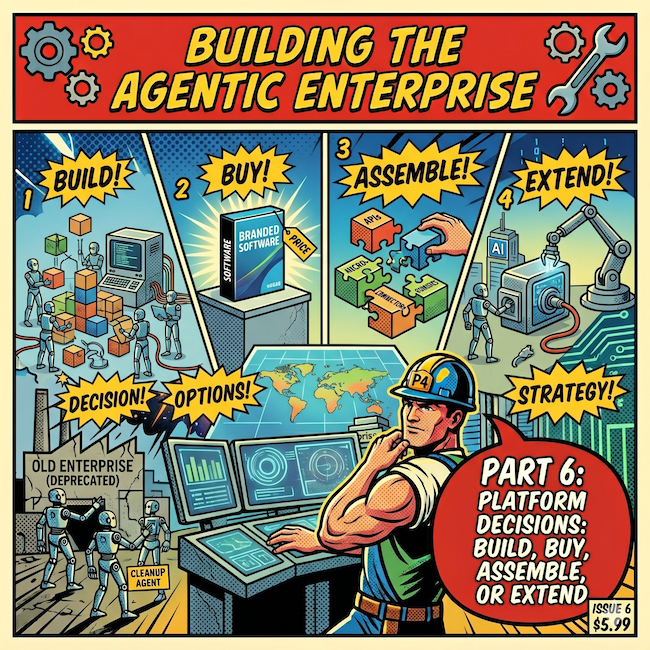
Building the Agentic Enterprise, Part 6: Platform Decisions: Build, Buy, Assemble, or Extend
The agentic platform landscape presents enterprise buyers with a decision more complex than the traditional build-versus-buy choice. In Part 6 of the Building the Agentic Enterprise series, we examine four platform strategies — extend what you have, buy a purpose-built platform, build your own, or assemble from best-of-breed components — and the tradeoffs each carries for speed, flexibility, and long-term positioning. We also explore why agentic AI lock-in is more severe than traditional software lock-in, compounding across model, orchestration, memory, and data layers simultaneously, and why open standards like MCP and A2A are becoming baseline requirements for vendor evaluation. The article includes a decision framework for matching platform strategy to organizational context and practical guidance on evaluating total cost of ownership, integration architecture, and planning for a market that will look very different in 18 months.
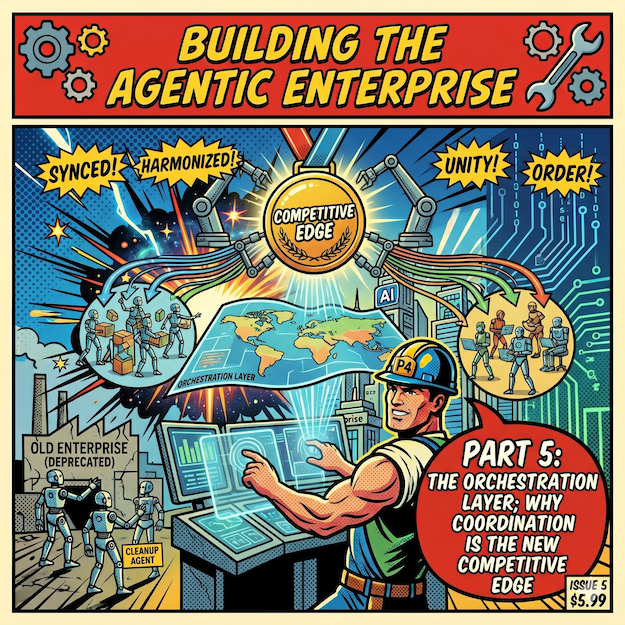
Building the Agentic Enterprise, Part 5: The Orchestration Layer; Why Coordination Is the New Competitive Edge
Single-agent deployments deliver value, but they hit a ceiling when work requires coordination across multiple agents, systems, and people. This article explains orchestration in business terms: the layer that decides which agent does what, in what order, with what information, and what happens when something goes wrong. It covers four orchestration patterns (sequential, parallel, hierarchical, and event-driven), draws a clear distinction between human-in-the-loop and the more effective human-in-the-lead model, and addresses the observability challenge that consumes 30 to 40 percent of implementation effort in production deployments. The article surveys the emerging infrastructure landscape, from enterprise platforms to open frameworks and interoperability standards like Google's A2A and Anthropic's MCP. The "What It Takes" section focuses on technical infrastructure readiness: API readiness, system interoperability, identity and access management at agent scale, compute costs, and shared state management.
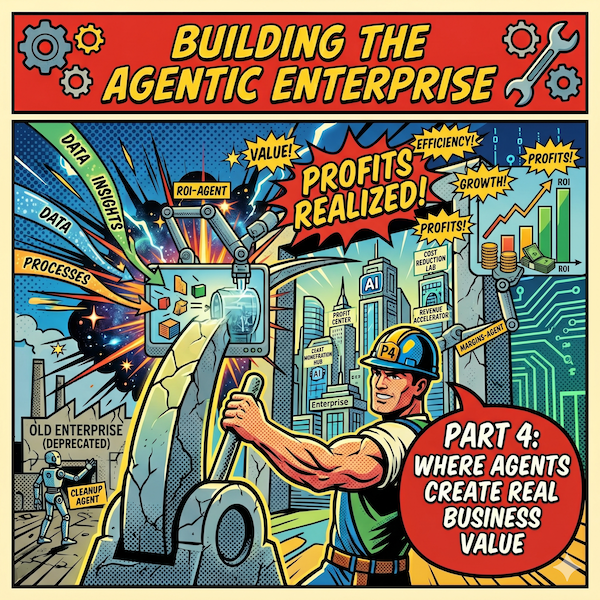
Building the Agentic Enterprise, Part 4: Where Agents Create Real Business Value
Where should you deploy agents first? This article maps the landscape of high-value agent use cases across six business functions; finance, HR, supply chain, customer operations, sales, and IT; with real production metrics showing what organizations are achieving today. It then identifies the six characteristics that make certain workflows better candidates for agentic AI than others: high volume, rule-based with defined exceptions, data-intensive and cross-system, handoff-heavy, measurable outcomes, and a well-understood current state. The "What It Takes" section focuses on process maturity; why agents cannot automate what you have not defined, and how to build the process foundation that successful deployments require.
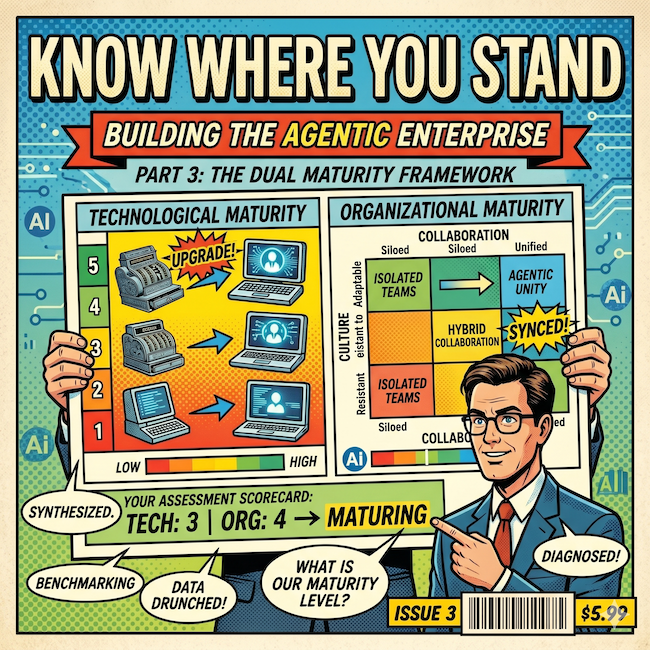
Building the Agentic Enterprise, Part 3: Know Where You Stand; The Dual Maturity Framework
Part 3 of the "Building the Agentic Enterprise" series introduces the Dual Maturity Framework, a strategic diagnostic that maps two dimensions most AI initiatives evaluate separately: how autonomous your AI is and how prepared your organization is to support that autonomy. The article defines five levels of Organizational AI Maturity (from No Capabilities to Strategic) and five levels of Agentic AI Capability (from Assistive to Full Agency), then shows how the Matching Matrix aligns them to reveal whether your organization is on track, overshooting into risk, or undershooting into lost value. With practical guidance on honest self-assessment across six readiness dimensions, this article gives leaders the framework to answer the question that matters most before investing in agentic AI: where do we stand today, and what do we need to build next?
Building the Agentic Enterprise, Part 2: Agents, Copilots, and Automation; A Business Leader's Guide
The agentic AI conversation is full of terms that everyone uses but not everyone means the same way. When your CIO, your operations lead, and your vendor's sales team each have a different mental model of what "agent" means, the result is strategic misalignment that shows up in every decision downstream. This article is a business leader's translation guide to agents, copilots, bots, RPA, orchestration, and autonomy levels, cutting through the jargon to build the shared vocabulary your organization needs before it can build shared infrastructure. It also walks through five levels of AI autonomy and offers practical guidance for spotting vendor marketing claims that don't hold up under scrutiny.
Building the Agentic Enterprise, Part 1: Why the Agentic Enterprise, Why Now
The enterprise AI conversation has shifted from 'how do we help people work faster' to 'how do we work differently.' This article explores why agentic AI marks a new inflection point for business, traces the convergence of forces making this the moment to act, and outlines the strategic readiness questions every organization should answer before moving forward. It's the first in an 11-part series on building the agentic enterprise.