This is the final article in a 10-part series exploring AI orchestration and the hybrid workforce. Each article has examined a critical dimension of how organizations coordinate multi-agent AI systems alongside human teams. This capstone installment maps the 2027-2030 trajectory, synthesizes the series into a consolidated readiness framework, and makes the case for starting the orchestration journey now.
The Convergence Ahead
Over the course of this series, we have examined orchestration across nine dimensions: the strategic imperative, architecture, multi-agent design patterns, human-in-the-lead roles, standards and interoperability, work redesign, governance, organizational readiness, and economics. Each dimension is necessary. None is sufficient alone. The fully orchestrated organization is the one that brings all nine together into a coherent capability.
That destination is not theoretical. The trajectory data points to a 2027-2030 window in which orchestration moves from an emerging practice to an organizational baseline. IDC projects 1.15 billion active AI agents by 2029, executing 217 billion actions per day. By 2028, 33 percent of enterprise software will include agentic AI, up from less than 1 percent in 2024. By 2030, 45 percent of organizations will orchestrate AI agents at scale. The question is not whether orchestration becomes standard. It is whether your organization builds the capability in time to benefit from the compounding advantages we documented in Part 9.
This article maps what is coming, defines what "fully orchestrated" means in practice, and provides the consolidated framework for assessing and building readiness across all nine dimensions.
The 2027-2030 Trajectory
Three converging trajectories will reshape enterprise operations over the next four years.
The first is agent proliferation. G2000 agent use will increase tenfold by 2027, with token and API call loads rising a thousandfold. By 2028, at least 15 percent of day-to-day work decisions will be made autonomously through agentic AI, up from effectively zero in 2024. Forty percent of enterprise applications will feature task-specific AI agents by end of 2026, up from less than 5 percent in 2025. The agentic AI workflow orchestration platform market is projected at $14.76 billion by 2031. This is not a technology trend. It is an infrastructure shift comparable to cloud adoption, and it is moving faster.
The second trajectory is B2B commerce transformation. Gartner projects that 90 percent of B2B buying will be AI-agent intermediated by 2028, pushing over $15 trillion of B2B spending through agent exchanges. One in four enterprise software purchases will be made by AI agents with no human involvement. Forrester projects that by 2026, one-third of B2B transactions will involve autonomous agents managing invoicing, reconciliation, or spend control. The payment infrastructure is already in place: Stripe and Tempo launched the Machine Payments Protocol in March 2026, Mastercard opened Agent Pay to all U.S. cardholders in November 2025, and the Linux Foundation's x402 Foundation launched in July 2026 with 40 members including Visa, Mastercard, Stripe, and AWS.
The implications for enterprise software are profound. Gartner warns that $234 billion in enterprise application SaaS spending is at risk from "agentic arbitrage" by 2030. When agents complete tasks across multiple enterprise systems directly, users no longer need to interact with each software interface, breaking the link between user growth and revenue growth that underpins SaaS business models. Seat-based pricing is already declining, from 21 percent to 15 percent in one year, while hybrid pricing models surged to 41 percent. The enterprise software market is being restructured around agent-mediated workflows.
The third trajectory is workforce transformation at scale. Gartner projects that AI will create more jobs than it eliminates beginning in 2028, with more than 500 million net new human jobs by 2036. The WEF projects 170 million new roles created and 92 million displaced by 2030, a net gain of 78 million. But 39 percent of existing role skills will be transformed within five years, and by 2029, at least 50 percent of knowledge workers will develop new skills to work with, govern, or create AI agents. By 2027, 75 percent of hiring processes will include certifications for workplace AI proficiency. The AI skills wage premium has reached 62 percent, with AI-specific jobs growing 8x faster than the overall job market. The hybrid workforce is not arriving. It is here, and it is scaling.
What "Fully Orchestrated" Means
The destination is not full automation. It is not humans removed from decision-making. It is not AI running the organization.
Gartner's CIO survey provides the clearest vision: by 2030, 75 percent of IT work will be done by humans augmented with AI, 25 percent by AI alone, and 0 percent by humans without AI. This is an augmentation-dominant model where every process has the optimal blend of human and AI capability, coordinated effectively.
The fully orchestrated organization has five characteristics. First, every significant business process has been decomposed into human-led, AI-led, and collaborative tasks using the framework from Part 6, and those allocations are dynamic, adjusting as agent capabilities improve and business context changes. Second, agents from multiple vendors coordinate through open standards (MCP and A2A, as discussed in Part 5), with an agent control plane providing discovery, authentication, routing, and monitoring. Third, human roles are designed for orchestration, not just execution, with the director, supervisor, collaborator, and reviewer roles from Part 4 explicitly defined for each workflow. Fourth, governance is embedded in the orchestration layer itself, with runtime policy enforcement, accountability maps, and tiered governance proportional to agent autonomy, as detailed in Part 7. Fifth, the organization continuously learns: data improves agents, agents improve people, people redesign work, and redesigned work generates better data. Bain calls this the "learning flywheel," and it is what creates the compounding advantage that makes orchestration maturity self-reinforcing.
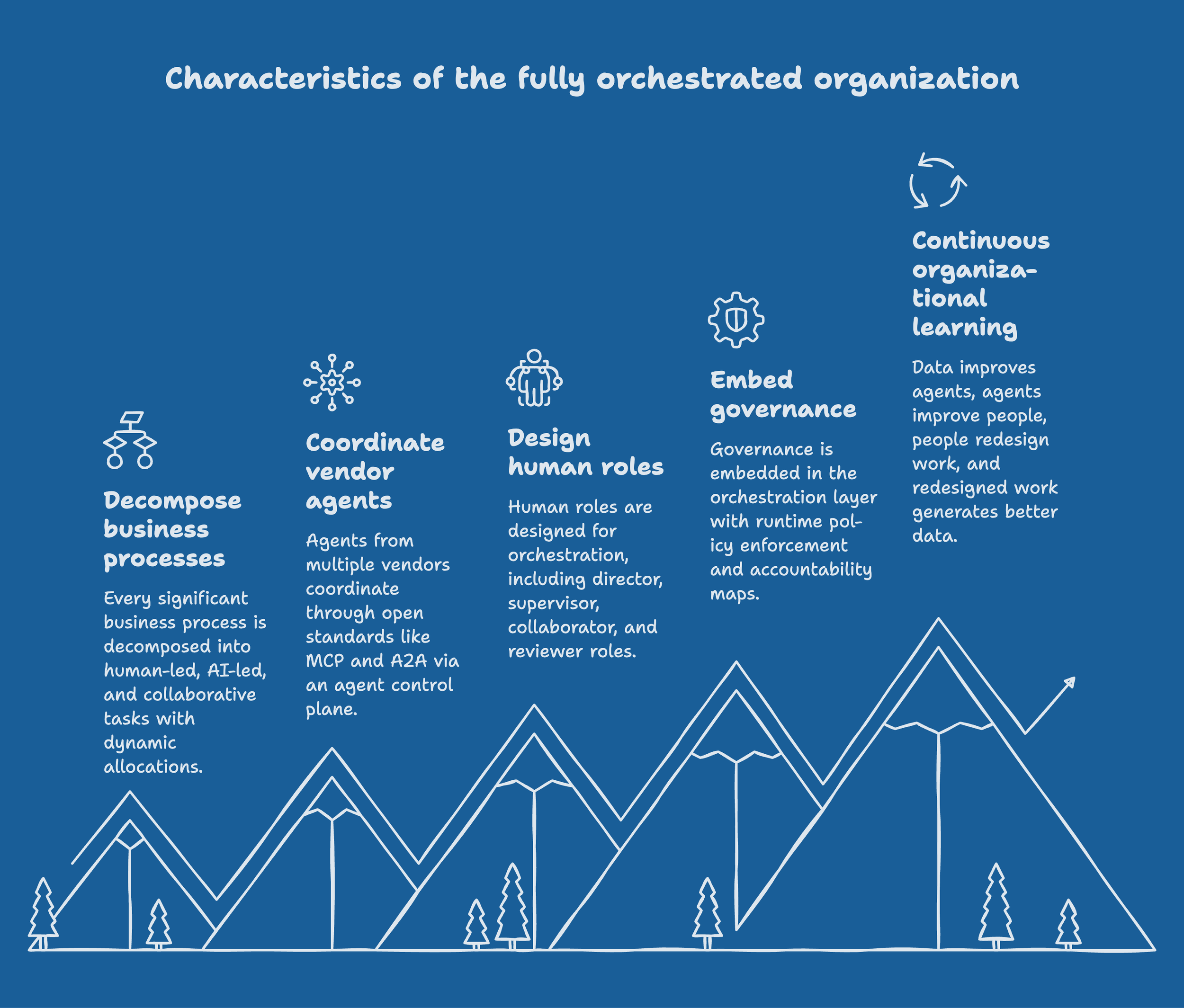
The Fully Orchestrated Organization
This vision is not aspirational for all organizations. Wells Fargo has 35,000 bankers accessing 1,700 internal procedures in 30 seconds, down from 10 minutes, through supervisor agents routing to specialized knowledge agents. IBM's orchestrated workflows generated $4.5 billion in annual productivity savings. Walmart's four super agents coordinate across the retail value chain, driving cross-functional gains that no single agent could produce. These are production systems, not pilots, and they demonstrate what orchestration maturity looks like in practice.
The Competitive Divide
The gap between orchestration leaders and laggards is widening, and the data suggests it may become permanent.
BCG's 2025 analysis found that the 5 percent of companies qualifying as "future-built" for AI achieve 1.7x revenue growth, 3.6x three-year total shareholder return, and 1.6x EBIT margin compared to laggards. Accenture found that organizations with the greatest AI maturity have been growing 4.7x faster year over year than those with the least. McKinsey reports that the spread in digital and AI maturity between leaders and laggards increased 60 percent between 2016-2019 and 2020-2022. The gap is not narrowing. It is accelerating.
Four sources of first-mover advantage explain why. The data advantage is the most durable: early orchestration deployments generate proprietary workflow data that feeds the learning flywheel, building a performance edge competitors cannot purchase. The learning curve advantage is the hardest to compress: institutional knowledge about AI change management, governance, multi-agent coordination, and trust calibration develops through experience, not training. The talent advantage compounds: AI-capable organizations attract top technical talent, creating a virtuous cycle. And the forgiveness advantage has a closing window: customers and regulators tolerate AI experimentation while the technology is novel, but that tolerance is finite.
Only 6 percent of organizations achieve significant enterprise-wide AI impact today. Only 17 percent have deployed AI agents at all, though 60 percent expect to within two years. The organizations that build orchestration capability during this window, while the technology is still maturing and the competitive landscape is still forming, will compound their advantages. Those that wait for the technology to settle will find that the organizational capability gap has become the binding constraint, and organizational capability cannot be purchased or deployed quickly.
The Governance-by-Design Imperative
As we argued in Part 7, governance must be designed into the orchestration layer, not bolted on after deployment. This principle becomes more urgent as orchestration scales.
Gartner projects that by 2030, 50 percent of AI agent deployment failures will be due to insufficient governance platform runtime enforcement. By 2030, fragmented AI regulation will quadruple and extend to 75 percent of the world's economies, driving over $1 billion in compliance spending. IDC warns that companies not prioritizing AI-ready data by 2027 will suffer a 15 percent productivity loss. And by 2030, 20 percent of G1000 organizations will face lawsuits, fines, or CIO dismissals from inadequate AI agent governance.
The governance-by-design thesis, which will be the subject of my forthcoming book, is that the organizations who treat governance as infrastructure rather than overhead will scale AI fastest. This is not a paradox. It is the consistent finding across every dimension of this series: the organizations that invest in the organizational foundations, governance, skills, culture, change management, and measurement, capture disproportionate value from the technology. Those that rush to deploy without these foundations join the 40 percent whose projects are canceled.
The Consolidated Readiness Framework
The nine dimensions examined across this series form a comprehensive readiness assessment. Each dimension should be evaluated independently, because organizational maturity varies across them, and improvement in any one dimension produces value even before the others mature.
1. Strategic Clarity (Part 1). Does the organization have a clear orchestration vision that connects multi-agent AI to business outcomes? Is orchestration framed as a business capability rather than a technology project? Have you identified the coordination gaps between your current AI deployments?
2. Architecture and Platform (Part 2). Have you chosen an orchestration architecture (workflow, agent, and human-AI layers) appropriate to your scale and maturity? Have you evaluated your existing platforms for native orchestration capabilities? Do you have an architecture decision framework for when to use platform-native versus dedicated orchestration?
3. Multi-Agent Design Maturity (Part 3). Are you matching design patterns (sequential, parallel, hierarchical, mesh) to workflow types? Are you avoiding premature complexity by following the progression from single-agent mastery to supervised multi-agent? Do you have cost and token management practices for multi-agent systems?
4. Human Role Design (Part 4). Have you defined human roles (director, supervisor, collaborator, reviewer) for each orchestrated workflow? Are decision authority tiers (Tier 1, 2, 3) mapped to each decision point? Do you have escalation designs that prevent both escalation fatigue and the moral crumple zone?
5. Standards and Interoperability (Part 5). Have you assessed your platforms for MCP and A2A support? Are you weighting interoperability in every vendor evaluation? Have you quantified your lock-in exposure and made it a conscious decision rather than an accidental consequence?
6. Work Redesign (Part 6). Have you decomposed priority workflows into human-led, AI-led, and collaborative tasks? Have you redesigned roles, not just tasks, to reflect the hybrid workforce? Are managers equipped to orchestrate both human and AI team members?
7. Governance Maturity (Part 7). Do you have accountability maps for every orchestrated workflow? Is governance tiered proportionally to agent autonomy? Are governance policies executable (governance-as-code) rather than documented only? Do you have an agent inventory that includes shadow agents?
8. Organizational Readiness (Part 8). Have you assessed orchestration skills across the four levels (AI literacy, tool proficiency, orchestration design, governance capability)? Do you have an orchestration champions program? Are managers modeling orchestration behaviors? Is psychological safety sufficient for AI experimentation?
9. Economics and ROI (Part 9). Do you have a full cost model that accounts for the 5-to-1 services multiplier, governance costs, and the 15x token multiplier? Are you measuring cost per outcome rather than cost per token? Do you have a self-funding model with 90-day value proofs? Is your ROI evaluation horizon realistic (12 to 18 months)?
Orchestration Playbook: The 90-Day Quick Start
Conduct the nine-dimension readiness assessment. Score your organization across each of the nine dimensions above using a simple maturity scale: not started, early stage, developing, established, and advanced. The assessment should take a cross-functional team no more than two days. The output is a heat map that shows where your organization is strongest and where the gaps are widest. Prioritize the dimensions where gaps pose the greatest risk to your planned or active AI deployments. This assessment becomes the baseline for quarterly reviews.
Select one orchestration initiative with clear economics. Choose a high-volume workflow where orchestration can demonstrate measurable value within 90 days. Apply the task decomposition framework from Part 6 to identify human-led, AI-led, and collaborative tasks. Define the human roles from Part 4. Build the governance requirements from Part 7 into the design from day one. Use the cost model from Part 9 to set economic targets. This first initiative should be scoped to succeed, not to impress.
Build the organizational foundation in parallel. While the first initiative runs, invest in the organizational capabilities that Part 8 identified as the binding constraint. Launch an orchestration champions program. Equip managers with hands-on experience. Begin the cultural work of building psychological safety for AI experimentation. These investments take longer than technology deployment, so starting them in parallel with the first initiative ensures they are maturing as orchestration scales.
Establish the governance infrastructure. Implement the minimum viable governance framework from Part 7: accountability maps for active workflows, tiered governance classifications for all deployed agents, an agent inventory that includes shadow agents, and a quarterly orchestration governance review. These four elements protect every AI investment the organization makes and are less expensive to build now than to retrofit later.
Set the 12-month roadmap. Based on the readiness assessment and first initiative results, build a 12-month roadmap that sequences orchestration investments across the nine dimensions. The roadmap should include quarterly milestones, economic targets, and governance checkpoints. Share it with the three audiences from Part 9: CFOs (economics), business leaders (workflow outcomes), and IT leaders (architecture sustainability). Update it quarterly based on what you learn.
The orchestration journey is not a technology deployment. It is an organizational transformation that happens to involve technology. The organizations that start now, even imperfectly, will build the compounding advantages in data, talent, learning, and workflow optimization that late movers cannot quickly replicate. The technology will continue to evolve. The standards will mature. The regulations will arrive. But the organizational capability to orchestrate human judgment and AI capability toward business outcomes, that is built through practice, not procurement.
Start now. Start small. Start with governance. And start building the organization that can learn, adapt, and orchestrate its way to sustained competitive advantage.
This concludes the "Orchestrating the Hybrid Workforce" series. For the companion frameworks from all three series, including the Agentic AI Readiness Assessment, visit arionresearch.com. The themes of governance-by-design, accountability in multi-agent systems, and orchestration architecture will be developed further in the forthcoming "Governance-by-Design" book. Follow Arion Research for ongoing analysis at arionresearch.com/blog.