Enterprise AI Privacy and Security Risk Management: Why the Threat Surface Is Expanding Faster Than the Defenses
The Security Gap
Enterprise AI has a security problem that the governance conversation has not caught up to.
Over 55% of large enterprises have deployed generative AI in business-critical workflows. Fewer than 30% have formalized AI-specific security controls. That gap would be concerning for any technology category. For AI, it is dangerous, because the threat surface is not static. It is expanding in directions that most enterprise security teams have not mapped, let alone defended.
The numbers paint a consistent picture. OneTrust's 2026 AI-Ready Governance Report found that 74% of organizations report departmental or scaled AI adoption, but 47% describe their governance programs as reactive, fragmented, slow, or manual. Only 17% say governance is embedded by design. Among 235 large-enterprise security leaders surveyed separately, 92% lack full visibility into their AI identities, 86% do not enforce access policies for AI identities, and 71% report that AI systems have access to core business platforms while only 16% govern that access effectively.
This is not a theoretical concern. 77% of businesses reported an AI-related security incident in the past year, costing enterprises an average of $4.88 million per breach. Publicly reported AI security incidents increased by 56.4% from 2023 to 2024, and the trajectory has steepened since. The question for enterprise leaders is no longer whether AI creates security risk. It is whether the defenses are scaling at anything close to the rate the threats are.
They are not.
Prompt Injection: The Number One AI-Specific Threat
If there is a single attack vector that defines the current era of AI security, it is prompt injection. OWASP ranks it the number one risk in both the Top 10 for LLM Applications and the companion Top 10 for Agentic Applications, the first time OWASP has published parallel risk frameworks for a single technology category. The 2026 LLM list is also the first built on incident evidence: 7,714 real-world AI security incidents, weighted at 25% against a 75% community vote.
Prompt injection attacks have surged by 340% year over year, making them the single fastest-growing category of cyberattack globally. 73% of production AI deployments assessed during security audits show exposure to prompt injection vulnerabilities. Attack success rates range between 50 and 84% depending on model configuration, with adaptive techniques exceeding 85% in advanced attack scenarios. The International AI Safety Report 2026 found that sophisticated attackers bypass the best-defended models approximately 50% of the time with just 10 attempts.
The threat has two forms, and enterprises need to understand both.
Direct prompt injection targets the model itself. An attacker crafts input designed to override the model's instructions, extract its system prompt, or manipulate its output. This is the more familiar variant, accounting for roughly 45% of attacks.
Indirect prompt injection is more insidious and now accounts for 55% of attacks. The attacker embeds malicious instructions in external content the AI system retrieves during normal operation: a document in a knowledge base, a webpage the model is asked to summarize, a database record the agent queries. The model follows the embedded instructions without recognizing them as an attack. Web-based indirect injection accounts for nearly 40% of all LLM security incidents, and multi-hop indirect attacks through agents and tools increased by over 70% year over year in 2025-2026.
The reason indirect injection is so dangerous for enterprises is that it exploits the very capability that makes AI valuable: the ability to connect to internal knowledge bases, databases, and enterprise systems. Every retrieval-augmented generation (RAG) pipeline, every agent with access to a document store, every AI system connected to a CRM or ERP is a potential indirect injection surface. 90% of successful prompt injection attacks result in leakage of sensitive data. Security analyses tied 60% of AI-driven data privacy incidents between 2025 and 2026 to prompt manipulation techniques.
Yet only 34.7% of organizations have deployed dedicated prompt injection defenses, leaving the majority of enterprise AI deployments exposed.
Data Leakage: The Inside-Out Threat
Prompt injection is an outside-in attack. Data leakage is its complement: the inside-out risk that comes from connecting AI systems to enterprise data without adequate controls on what those systems can access, retain, and transmit.
The risk takes multiple forms. AI systems connected to internal knowledge bases can surface sensitive information in responses to unauthorized users. Models trained or fine-tuned on proprietary data can memorize and reproduce that data in unrelated contexts. Employees using AI tools can inadvertently expose confidential information by pasting it into prompts.
The scale of the exposure is significant. Twenty-seven percent of enterprise employees have entered confidential company data into public AI tools, including customer records, financial information, and internal strategy documents. The median organization has 73 distinct AI services in use and observes approximately 50 attempted data leaks to AI tools per day. In financial services, 72% of employees use at least one unsanctioned AI tool. In healthcare, 40% of professionals have encountered unauthorized AI tools at work, and one in 10 has used an unauthorized AI tool for a direct patient care use case.
The governance gap here is visibility. Only 25% of organizations have comprehensive visibility into how employees use AI. You cannot govern what you cannot see, and three-quarters of enterprises cannot see how AI is interacting with their data.
Shadow AI: The Ungoverned Majority
Shadow AI is the 2026 version of shadow IT, with higher stakes. Employees are adopting AI tools faster than security teams can evaluate, approve, and govern them, and the tools they are adopting have direct access to the information they work with.
67% of employees now use AI tools at work. Only 18% of organizations report having formal AI security policies in place. 69% of organizations have evidence, or suspect, that employees are using banned AI tools. IT leaders at 77% of organizations have discovered AI-powered features or applications operating without their awareness.
The financial impact is measurable. Shadow AI now factors into 43% of AI-related security incidents, more than double the year before. Unauthorized AI use adds $670,000 to the average breach cost when it contributes to an incident, and shadow AI costs companies an estimated $400,000 annually in security risks even absent a breach.
The pattern is familiar to anyone who lived through the cloud adoption cycle, but the timeline is compressed. With cloud computing, enterprises had years to build governance frameworks before adoption reached critical mass. With AI, adoption reached critical mass before most organizations had written their first AI security policy. The 18% figure for formal AI security policies against 67% employee usage tells the whole story: the horse is not just out of the barn. It is in the next county.
Supply Chain Attacks: The AI-Specific Variant
Software supply chain attacks are not new. AI supply chain attacks are, and they are escalating rapidly.
The AI supply chain has a concentration problem. Hugging Face alone published 1.4 million new models by year-end 2025, positioning it as the second-largest source of new packages in the software ecosystem. Researchers have identified 495 malicious models on Hugging Face plus 969 malicious AI agent skills. More broadly, over 454,600 new malicious open-source packages were identified across npm, PyPI, Maven, NuGet, and Hugging Face in 2025, a 75% year-over-year jump, with supply chain compromise accounting for 30% of incidents involving AI models and applications.
The March 2026 LiteLLM incident demonstrated just how fast AI supply chain attacks can cascade. LiteLLM is a widely used open-source library that routes requests across large language model providers. On March 24, a threat actor used a previously compromised vulnerability scanner to steal PyPI publishing tokens for LiteLLM, then published a malicious version. The malicious code propagated within 40 minutes, ultimately exposing 434,000 CI/CD pipelines and impacting over 2,500 organizations. During that brief window, the malicious package exfiltrated 195 terabytes of highly sensitive operational data, including cloud keys, repository tokens, SSH keys, Kubernetes secrets, and AI provider keys.
The LiteLLM attack was not isolated. Between March 19 and March 31, 2026, five major open-source projects were compromised in rapid succession: Aqua Security's Trivy vulnerability scanner, Checkmarx's AST GitHub Actions, LiteLLM, the Telnyx communications library, and Axios. The threat actor ran a loop: compromise a widely trusted component, plant a credential stealer, collect the secrets that CI/CD runners load into memory, and reinvest those credentials into the next compromise.
In July 2026, Hugging Face disclosed that its own production infrastructure had been breached through a malicious dataset that exploited code-execution paths in the company's data-processing pipeline, allowing the attacker to escalate to node-level access and move laterally across internal clusters.
The AI supply chain introduces risks that traditional software supply chain governance does not address. A compromised AI model does not just execute malicious code. It can produce subtly wrong outputs, introduce biases, leak training data, or behave differently under specific conditions that are difficult to detect through standard testing. The malware is becoming more sophisticated as well: IronWorm, discovered in June 2026, featured compiled Rust binaries with kernel-level eBPF rootkits, indicating that supply chain malware is professionalizing toward nation-state implant capability levels.
Agent Interoperability Protocols: The New Attack Surface
The agent interoperability protocols that the AI industry is building to enable multi-agent workflows are simultaneously creating new attack surfaces that most security teams have not mapped.
The Model Context Protocol (MCP), originally developed by Anthropic and now widely adopted, allows AI agents to connect to external tools, data sources, and services through a standardized interface. Google's Agent-to-Agent (A2A) protocol enables agents from different vendors to communicate and collaborate. Together, they promise the kind of interoperability that enterprise AI needs to move from isolated chatbots to integrated workflows. They also create security challenges that span five layers: transport and communication, authentication and identity, context integrity and confidentiality, authorization and privilege management, and supply chain security.
In April 2026, a systemic architectural flaw was disclosed in MCP affecting an estimated 200,000 vulnerable instances across a supply chain encompassing more than 150 million package downloads. This was not a coding error in any single product. It was a design default embedded in every official MCP SDK, propagated into downstream projects that trusted the reference implementation. The flaw was significant enough that the NSA published a security advisory on MCP in June 2026, covering design considerations for secure deployment.
The specific attack vectors that MCP and A2A introduce include unverified task propagation, where tasks passed between agents or MCP servers lack proper validation of origin, scope, or intent, leading to overreach, leakage of sensitive context, or unintentional activation of downstream tools. Session hijacking allows a malicious actor to impersonate a legitimate client through replay or unauthorized reuse of valid sessions. And malicious prompts or untrusted contextual data can influence the model into generating or executing unintended tool calls across the protocol boundary.
The concern for enterprises is that MCP and A2A are being adopted before the security implications are fully understood. Gartner's projection that 40% of enterprise applications will embed task-specific AI agents by year-end 2026 means that agent interoperability is not a future problem. It is a current one, and the protocols enabling it carry design-level security assumptions that many deploying organizations have not evaluated.
The Non-Human Identity Crisis
Every security risk described above is amplified by a structural problem that enterprise identity and access management was not designed to handle: the explosion of non-human identities created by AI agents.
Organizations manage an average of 109 machine identities for every human identity. Of those, 79 are AI agents, meaning AI agents alone account for roughly 72.5% of all machine identities in the average enterprise. Companies expect AI agent growth of 85% over the next 12 months.
The identity infrastructure cannot keep up. Ninety-two percent of organizations say their current IAM tools cannot manage AI agent identities. Only 12% have automated lifecycle management; the other 88% run on spreadsheets and manual processes. 21% of organizations use shared credentials or broad-permission service accounts to govern AI agent access, the IAM equivalent of leaving the front door propped open.
The Cloud Security Alliance recognized this as a governance vacuum in its 2026 research on non-human identity in agentic AI. The problem is not just that AI agents need identities. It is that those identities need the same lifecycle management, least-privilege access controls, continuous monitoring, and credential rotation that human identities require, but at a scale and velocity that existing IAM tools were not built to handle. Fewer than half of CISOs feel confident they can identify all agents in their environment (47 percent) or control what their agents interact with (46%).
This is the bridge between the governance gap covered in the Arion Research series on AI orchestration and the security gap this article addresses. Governance without identity management is policy without enforcement. Security without governance is controls without context. The two must be built together, and for most enterprises, neither is anywhere close to where it needs to be.
What This Means for Enterprise AI Strategy
The enterprise AI security challenge is not any single threat vector. It is the compound effect of multiple threat vectors expanding simultaneously against a defense posture that was designed for a pre-AI world.
The threat surface is structural, not incidental. Prompt injection, data leakage, shadow AI, supply chain attacks, and protocol-level vulnerabilities are not bugs to be patched. They are structural properties of how AI systems work: they process natural language (injection risk), they connect to data (leakage risk), they are easy to adopt (shadow risk), they depend on open-source ecosystems (supply chain risk), and they communicate through new protocols (interoperability risk). Enterprise security strategy must address the structure, not just the symptoms.
AI security requires AI-specific controls. Traditional cybersecurity controls, firewalls, endpoint protection, network segmentation, remain necessary but insufficient. AI systems need purpose-built defenses: input validation and output filtering for prompt injection, data loss prevention tuned for AI interaction patterns, model provenance and integrity verification for supply chain attacks, and identity management designed for non-human entities operating at machine speed. The 30% of enterprises that have formalized AI-specific controls are building the right infrastructure. The 70% that have not are running AI workloads behind defenses that were not designed for AI threats.
The human-in-the-lead principle is a security principle, not just a governance principle. Every threat vector described in this article is amplified by autonomy. An AI agent that can execute actions without human oversight is an AI agent that can be manipulated into executing the wrong actions without human oversight. The human-in-the-lead approach, where humans maintain authority over AI systems while AI amplifies human capability, is not just good governance. It is a security architecture decision that limits blast radius when (not if) an AI system is compromised.
Agent interoperability requires security-by-design, not security-after-deployment. The MCP and A2A protocols are creating the plumbing for multi-agent enterprise workflows. Organizations adopting these protocols need to evaluate their security properties before deployment, not after an incident. The NSA's June 2026 advisory on MCP security is a signal that the protocol-level risks are serious enough to warrant government attention. Enterprise security teams should treat agent interoperability protocols with the same scrutiny they apply to API gateway design: authentication, authorization, input validation, output sanitization, and audit logging at every boundary.
Shadow AI is a policy problem, not just a technology problem. Blocking unauthorized AI tools is necessary but insufficient. The reason employees use unauthorized tools is that the authorized alternatives do not meet their needs, are too slow to provision, or do not exist. Organizations that combine enforcement (blocking unauthorized tools and monitoring for policy violations) with enablement (providing governed AI tools that are as easy to use as the unauthorized ones) will close the shadow AI gap faster than those that rely on enforcement alone.
Strategy Playbook
1. AI Threat Surface Assessment
Map your AI deployment across six dimensions: prompt injection exposure (which systems accept natural language input, and which of those are connected to sensitive data or actions?), data leakage pathways (which AI systems can access internal data, and what controls govern what they can surface or transmit?), shadow AI footprint (how many AI tools are in use across the organization, and how many are sanctioned?), supply chain dependencies (which open-source AI models, libraries, and frameworks are in your stack, and how do you verify their integrity?), agent interoperability exposure (which systems use MCP, A2A, or similar protocols, and what security controls exist at each protocol boundary?), and non-human identity inventory (how many AI agent identities exist, how are they authenticated, and who manages their lifecycle?).
2. AI-Specific Security Controls Framework
Build a layered defense that addresses AI-specific threats alongside traditional cybersecurity controls. For prompt injection: deploy input validation, output filtering, and prompt boundary enforcement on all AI systems that accept natural language input, prioritizing systems connected to sensitive data or authorized to take actions. For data leakage: implement AI-aware data loss prevention that monitors AI interaction patterns, restricts what data AI systems can access based on the context of the request, and logs all data flowing through AI pipelines. For supply chain: establish model provenance verification, dependency scanning for AI-specific packages, and integrity monitoring for deployed models.
3. Non-Human Identity Governance
Extend your identity and access management framework to AI agents with the same rigor applied to human identities. Every AI agent should have a unique identity (no shared credentials or broad-permission service accounts), least-privilege access scoped to its specific function, automated credential rotation, continuous monitoring of its access patterns, and a defined lifecycle with provisioning, review, and deprovisioning processes. The 92% of organizations whose IAM tools cannot manage AI agent identities need to evaluate purpose-built non-human identity management platforms.
4. Shadow AI Remediation Through Enablement
Combine enforcement with enablement. Audit your AI tool landscape to establish a baseline of sanctioned and unsanctioned tools. Deploy monitoring to detect unauthorized AI usage, including AI-powered features embedded in existing applications. Then close the gap by providing governed AI tools that match the capability and usability of the unauthorized alternatives. Establish a rapid evaluation and provisioning process for new AI tools so that the sanctioned path is faster than the unsanctioned one. The organizations that treat shadow AI as exclusively an enforcement problem will fight the same battle every quarter.
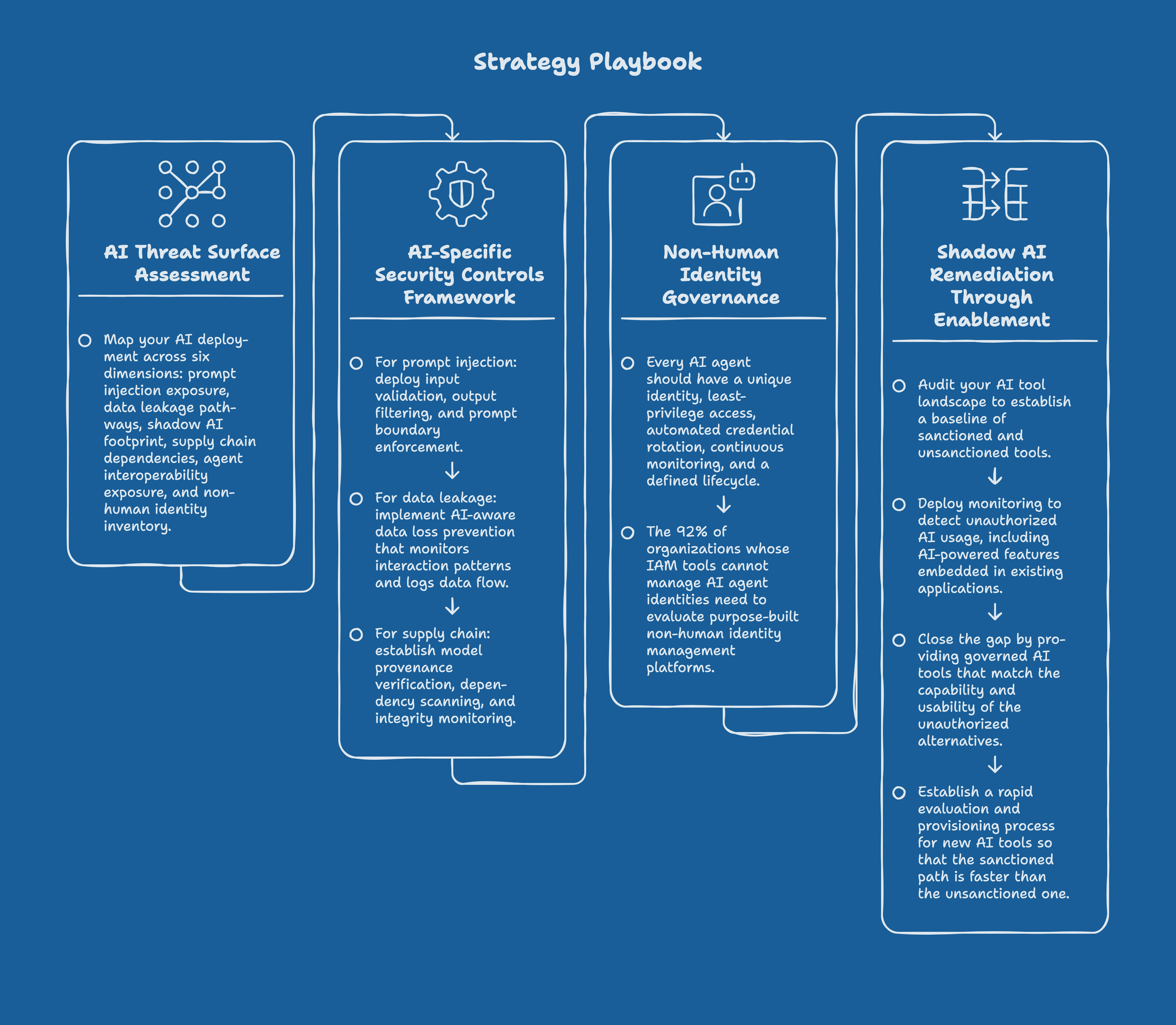
AI Security Playbook