AI Strategy is Business Strategy, Part 4: Competitive Strategy in the Agentic Era
This is the fourth article in a 12-part series arguing that AI strategy and business strategy must be the same strategy. Each article examines a critical dimension of strategic AI alignment and includes a "Strategy Playbook" section with actionable guidance.
The Rules Are Changing
For three decades, competitive strategy in technology-intensive industries followed a familiar pattern. Scale conferred advantage. Access to capital, distribution, and talent determined winners. Fast followers could study what leaders did, replicate the parts that worked, and enter markets at lower cost. These dynamics produced a relatively stable competitive landscape where incumbents with resources and patience could outrun most threats.
Agentic AI is breaking that pattern. The sources of competitive advantage are shifting from scale and access to learning velocity and orchestration capability. The competitive dynamics are shifting from linear to compounding. And the strategic logic that governed technology adoption for decades, including the fast-follower playbook that many executives still rely on, no longer applies.
This article examines how agentic AI is reshaping competitive dynamics, what the data says about the widening gap between AI leaders and laggards, where the most disruptive market restructuring is occurring, and what organizations must protect versus what is being commoditized.
The Learning Flywheel as Competitive Moat
Traditional competitive moats are built on scale, brand, switching costs, and network effects. Agentic AI introduces a new moat mechanism that Bain calls the learning flywheel: data improves agents, agents improve people, people redesign work, and redesigned work generates better data. The flywheel turns on its own, and the gap between leaders and followers gets structurally harder to close every quarter.
The learning flywheel is different from prior technology advantages in one critical respect: it compounds. A company that deploys AI agents in customer service does not just reduce costs today. It generates interaction data that improves agent performance tomorrow. Better agent performance handles more complex cases, which generates richer data, which enables further improvement. Each cycle through the flywheel widens the performance gap between the organization running the flywheel and the competitor that has not started it.
In 2026, the flywheel mechanism is moving beyond simple data collection. Companies are creating active feedback loops: human edits to AI drafts, accepted versus rejected recommendations, and structured workflow data collected over time. These proprietary feedback signals are the raw material of competitive advantage in the agentic era. They cannot be purchased. They can only be generated through operational experience with AI systems integrated into real workflows.
This is why the orchestration capability explored in the "Orchestrating the Hybrid Workforce" series is a competitive variable, not just an operational one. Organizations that coordinate multiple agents across workflows generate richer data, more feedback loops, and faster learning cycles than those running isolated AI tools. The orchestration layer is where the flywheel spins fastest because it connects data flows across functions rather than confining them to departmental silos.
Data moats reinforce this dynamic. As frontier AI models commoditize, becoming widely accessible and relatively affordable, proprietary data becomes the durable differentiator. An AI system trained on a decade of proprietary customer service logs, exclusive supply chain data, or unique operational patterns delivers insights and performance that no generic model can replicate. Companies building data moats today will be structurally harder to compete against in three to five years. Purchased data creates parity. Proprietary operational data, generated by the flywheel, creates advantage.
The Compounding Divergence
The gap between AI leaders and laggards is no longer a competitive nuance. It is a structural chasm that is widening, not narrowing.
BCG's analysis of "future-built" companies, roughly 5 percent of the global total, found they achieve 1.7 times revenue growth, 3.6 times three-year total shareholder return, and 1.6 times EBIT margin compared to AI laggards. These future-built firms plan to spend more than twice as much on AI as laggards and expect twice the revenue uplift and 40 percent greater cost reductions in areas where they apply AI.
Accenture's research shows that organizations with the greatest AI maturity have been growing 4.7 times faster year over year than those with the least maturity. Companies with fully modernized, AI-led processes achieve 2.5 times higher revenue growth, 2.4 times greater productivity, and 3.3 times greater success at scaling generative AI use cases.
McKinsey's analysis found that the average spread of digital and AI maturity scores between top and bottom performers jumped 60 percent between 2016-2019 and 2020-2022. Bain's 2025 Technology Report confirmed that AI leaders are delivering 10 to 25 percent EBITDA improvements across their operations while most organizations remain mired in experimentation.
The critical insight is that these gaps do not converge over time. They accelerate. Each quarter, the leaders' learning flywheels spin faster while laggards remain in the pilot stage, accumulating technology costs without operational learning. The compounding dynamics we examined in the orchestration series explain why: data advantages feed agent improvements, agent improvements feed workflow optimization, and workflow optimization generates more data. Organizations without this flywheel running are not standing still. They are falling behind at an accelerating rate relative to those that have it.
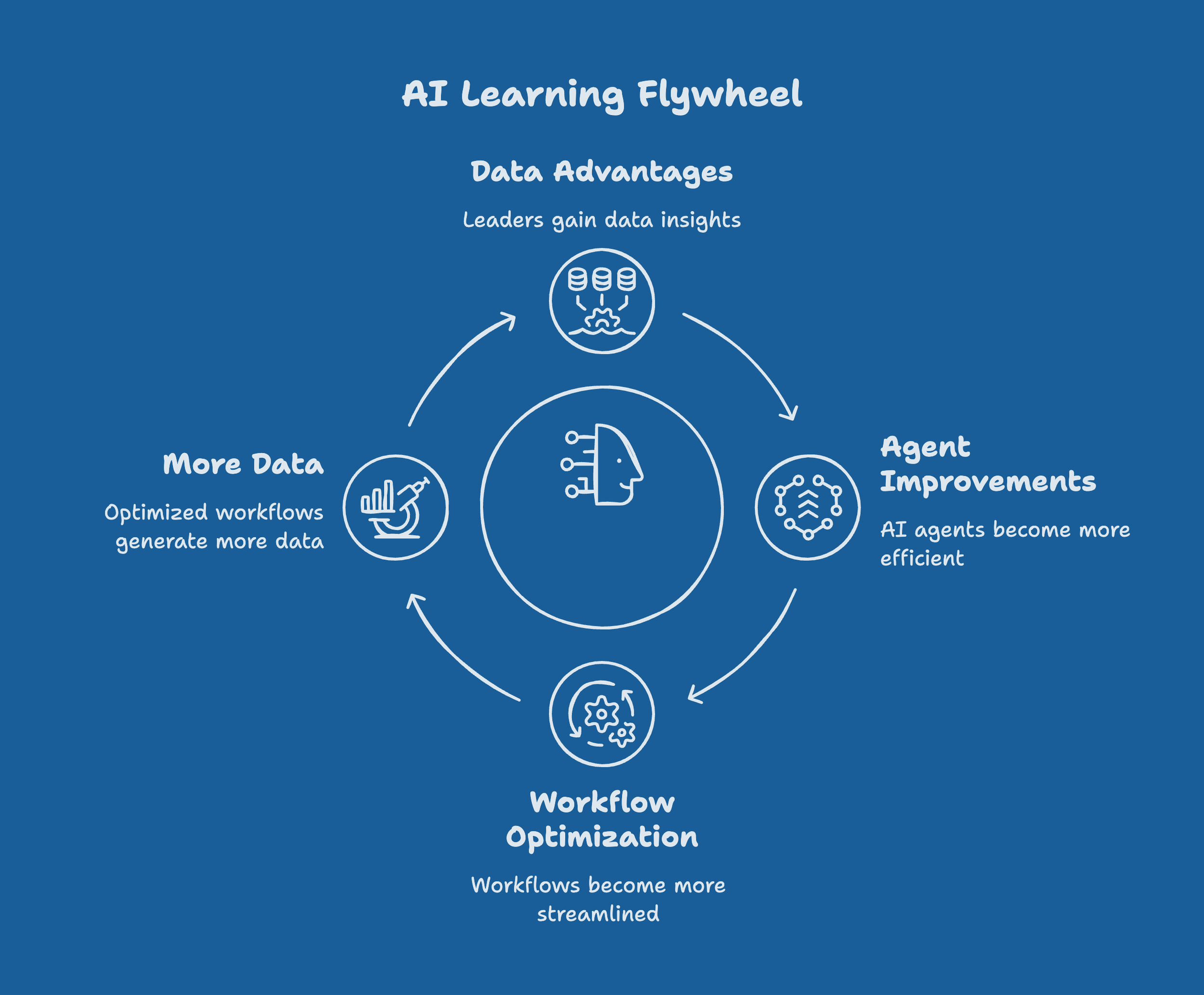
AI Learning Flywheel
Four First-Mover Advantages in the Agentic Era
The orchestration series identified four first-mover advantages that apply directly to competitive strategy. Each is reinforced by the compounding dynamics of agentic AI.
Data advantage. Organizations that deploy AI agents in production workflows generate proprietary operational data that improves agent performance over time. This data, interaction patterns, edge cases, failure modes, workflow optimization signals, cannot be acquired by competitors who have not run the same workflows. The earlier an organization begins generating this data, the larger its proprietary dataset grows, and the wider its performance advantage becomes.
Learning curve advantage. Orchestrating AI agents alongside human teams is an organizational skill that develops through practice. Organizations that start earlier build institutional knowledge about which workflows to automate, how to design human-agent collaboration, how to govern multi-agent systems, and how to measure outcomes. This institutional knowledge, embedded in processes, training programs, and organizational culture, is a competitive asset that cannot be purchased or quickly replicated.
Talent advantage. AI-capable talent gravitates toward organizations that are serious about AI deployment. The best data scientists, AI engineers, and orchestration designers want to work where they can build and ship at scale, not where they are constrained to proof-of-concept exercises. Organizations that establish credible AI operations attract stronger talent, which accelerates their advantage. The 62 percent AI skills wage premium and 3.2-to-1 demand-to-supply ratio, data from the orchestration series, means the talent market is a zero-sum competition. Organizations that attract AI talent deprive their competitors of the same talent.
Forgiveness advantage. Organizations that are early in AI adoption operate in an environment of greater customer, employee, and regulatory tolerance for imperfection. Early movers can experiment, make mistakes, and learn while stakeholders are still forming expectations. Late movers will face higher expectations, less patience for errors, and more established competitors whose performance sets the benchmark. The forgiveness window is narrowing. As AI-powered experiences become the norm, the tolerance for organizations that are "still figuring it out" shrinks.

Agentic AI First Mover Advantage
Agentic Arbitrage and Market Restructuring
Beyond competitive dynamics between existing players, agentic AI is restructuring entire markets. The most significant restructuring is happening in three areas.
B2B commerce transformation. Gartner predicts that by 2028, 90 percent of B2B buying will be intermediated by AI agents, routing more than $15 trillion through automated, machine-to-machine exchanges. One in four enterprise software purchases will be made by AI agents with no human in the loop. Entire procurement cycles, from supplier identification through option evaluation to order execution, may complete without a human buyer ever navigating a vendor's website.
This is not incremental automation. It is a structural change in how markets operate. Sellers whose catalogs, APIs, and content are machine-readable will be discoverable by purchasing agents. Those whose value propositions depend on human-readable marketing, relationship-based selling, or complex pricing structures will be filtered out of agent-mediated procurement. The shift from human-navigated buying to agent-intermediated buying restructures competitive advantage from brand awareness and sales relationships to data quality, API accessibility, and outcome transparency.
SaaS market disruption. The SaaS industry faces a structural challenge. A new class of AI-native startups, built from day one with AI at the core of their architecture, is reaching revenue milestones at unprecedented speeds. Bessemer Venture Partners identifies companies it calls "Supernovas" that reach $40 million in annual recurring revenue in year one and $125 million by year two. The barriers to creating software have dropped so dramatically that the build-versus-buy decision is shifting toward build across many categories.
The per-seat pricing model that powered SaaS growth is breaking. Bloomberg estimates subscription-based pricing could decline from 60 percent of software pricing models to 30 percent over the next decade, while outcome-based pricing shifts from 10 percent to 60 percent. The median public SaaS company now trades at 3.4 times enterprise value to revenue, a decade-plus low, driven partly by AI disruption expectations. Meanwhile, AI-native companies command 25 to 50 times revenue multiples in private rounds. The market is pricing in a structural shift, not a cyclical correction.
Value chain compression. Activities that occupied entire departments or companies are being compressed or eliminated by AI agents. Information gathering that required analysts, basic analysis that required consultants, routine processing that required operations teams, and standard customer interactions that required service representatives are all being performed by agents at a fraction of the cost and time. Mid-level expertise, once a premium asset, is becoming a utility.
The strategic question for every organization is which parts of its value chain are vulnerable to this compression and which are defensible. The answer determines whether AI is an opportunity or an existential threat.
What to Protect and What Is Being Commoditized
The agentic era is creating a clear division between capabilities that are becoming commoditized and those that remain defensible.
Being commoditized: routine processing and data entry, standard information gathering and synthesis, basic analysis and reporting, scripted customer interactions, template-driven content creation, and rules-based decision-making. Any activity that follows predictable patterns, operates on structured or semi-structured data, and requires consistency rather than judgment is a candidate for agent automation. Organizations that compete primarily on performing these activities efficiently face existential risk because agents will perform them at near-zero marginal cost.
Remaining defensible: proprietary data assets generated through unique operational experience, deep domain expertise embedded in organizational processes and culture, customer relationships built on trust and proven track record, regulatory licenses and compliance infrastructure, creative and strategic judgment applied to novel situations, and the orchestration capability that connects agents, people, and workflows into coherent systems. These capabilities share a common characteristic: they are developed over time through experience, cannot be purchased or quickly replicated, and create value that increases with organizational maturity.
The defensive strategy for incumbents is to strengthen what is defensible while accepting the commoditization of what is not. Organizations that try to protect commoditizing activities through pricing pressure, switching costs, or contractual lock-in are fighting a losing battle. The organizations that redirect resources from defending the indefensible to strengthening their genuine advantages will maintain competitive position through the transition.
Simon-Kucher's analysis of defensibility in the agentic era reinforces this distinction. Workflow control, taking ownership of the orchestration layer where work is coordinated and executed, offers high switching costs. AI exposes point solutions to disintermediation risk while workflow controllers have greater defensibility. The strongest moat is an AI system that becomes the operating system for a specific business process, weaving itself into the fabric of a company's operations.
The Fast-Follower Myth
Perhaps the most dangerous competitive assumption in the current environment is that the fast-follower strategy still works.
In prior technology waves, fast followers succeeded because the underlying technology was stable enough to study, the integration requirements were predictable, and the learning curves were manageable. A company that waited two years to adopt cloud computing could study best practices, select mature platforms, and deploy with lower risk and cost than early movers.
AI does not follow this pattern. The compounding dynamics of the learning flywheel mean that the gap between early movers and followers widens over time rather than narrowing. Two years ago, Bain warned that it was "already too late to wait and see." The 2025 data confirms: AI leaders are delivering 10 to 25 percent EBITDA improvements while most organizations remain mired in experimentation.
The fast-follower strategy fails in AI for three interconnected reasons. First, data advantages are cumulative. An organization that has been running AI agents in production for two years has generated two years of proprietary operational data that improves performance. A fast follower starting today begins with no proprietary data. The performance gap on day one of the follower's deployment is larger than the gap was two years earlier when the leader started. Second, organizational learning does not transfer. The institutional knowledge of how to orchestrate AI agents, design human-agent collaboration, and govern multi-agent systems develops through practice. It cannot be acquired through case studies, consulting engagements, or vendor partnerships. Third, talent flows toward leaders. The best AI talent joins organizations with production-scale deployments, not those running pilots. By the time a fast follower is ready to scale, the talent market has been claimed by the leaders.
The strategic implication is that "wait and see" is not a risk-neutral position. It is a high-risk strategy with compounding costs. Every quarter of delay widens the gap in data assets, organizational capability, and talent access. The forgiveness window that allowed early movers to experiment and learn is closing. The organizations that start now face a competitive catch-up challenge. Those that wait another year face a structural disadvantage that may become permanent.
Strategy Playbook
Competitive AI assessment. Map your organization's AI maturity against your top three competitors across five dimensions: production deployment breadth (how many workflows have AI agents in production), data asset depth (what proprietary operational data are you generating and using), orchestration sophistication (how coordinated are your AI investments across functions), talent density (what is your ratio of AI-capable practitioners to total headcount), and learning velocity (how quickly do you move from experiment to production to optimization). Score each dimension on a 1-to-5 scale. Any dimension where a competitor scores two or more points higher is a strategic vulnerability that requires immediate attention.
Identifying your defensible advantages. Conduct a value chain audit that categorizes every major activity as defensible (proprietary data, domain expertise, regulatory license, relationship capital, orchestration capability) or commoditizing (routine processing, standard analysis, scripted interactions, template-driven work). For each commoditizing activity, estimate when AI agents will perform it at competitive quality and lower cost. For each defensible activity, identify the investment required to strengthen and extend the advantage. The goal is to shift resources from protecting commoditizing activities to deepening defensible ones.
The agentic arbitrage exposure audit. Identify which of your revenue streams are vulnerable to agent-mediated disruption by answering three questions for each stream. First, could a purchasing agent evaluate your offering without human interaction? If yes, is your product data, pricing, and value proposition machine-readable? Second, could an AI agent replicate the core value you deliver to customers? If the answer is "partially," quantify the portion and estimate the timeline. Third, does your pricing model survive agent-mediated procurement? Seat-based, opaque, and relationship-dependent pricing models are vulnerable. Outcome-based, transparent, and performance-verified models are more resilient.
Strategic response framework. Based on your competitive assessment and exposure audit, determine your response posture for each market segment. Lead when you have a data advantage, talent advantage, or domain expertise that competitors cannot quickly replicate, and when the market rewards early movers with compounding returns. Fast-follow when the competitive dynamics are linear rather than compounding, when the technology is standardizing, and when the integration requirements are well understood. This is increasingly rare in AI. Leapfrog when you have a structural advantage, such as unique data assets, regulatory position, or customer relationships, that allows you to skip an intermediate stage and deploy at a higher level of sophistication than current leaders. Leapfrog strategies are high-risk but can succeed when the structural advantage is genuine.
This article is the fourth in the "AI Strategy is Business Strategy" series. For the companion frameworks from all prior series, including the Dual Maturity Quick Diagnostic and Agentic AI Readiness Assessment, visit arionresearch.com. Follow Arion Research for ongoing analysis at arionresearch.com/blog.