AI Strategy is Business Strategy, Part 5: AI and Business Model Transformation
This is the fifth article in a 12-part series arguing that AI strategy and business strategy must be the same strategy. Each article examines a critical dimension of strategic AI alignment and includes a "Strategy Playbook" section with actionable guidance.
Beyond Optimization
The first four articles in this series addressed the strategy gap, strategy archetypes, CEO leadership, and competitive dynamics. Each assumed that the organization's business model remains intact while AI reshapes how that model operates. This article challenges that assumption by looking at I enabled business model innovation. AI is not just optimizing existing business models. It is enabling entirely new ones while threatening established ones. The strategic question is not "how do we add AI to our business?" It is "how does AI change what our business can be?"
The distinction matters because organizations that limit AI to operational efficiency within their current model are optimizing a structure that may be under an existential threat. The February 2026 market correction, which erased $285 billion from SaaS company valuations in 48 hours, was not a reaction to poor quarterly results. It was the market's conclusion that AI agents could replace entire categories of knowledge work that software companies had been charging per seat to support. Gartner estimates that $234 billion of enterprise application software spending is exposed to agentic disruption between now and 2030, roughly 20 percent of all enterprise SaaS spending.
It appears that the correction was a signal, not an anomaly. Every organization whose business model depends on performing activities that AI agents can perform cheaper, faster, or more consistently faces some version of the same threat. The question is whether to wait for the disruption or to embrace the transformation.
The Business Model Disruption Landscape
The pricing model disruption and evolution is the most visible indicator of business model disruption, and it is accelerating much faster than most leaders anticipated.
Pure per-seat pricing fell from 21 percent to 15 percent of SaaS companies between 2025 and 2026, according to Bessemer Venture Partners. Hybrid pricing, combining a base fee with variable consumption or outcome components, grew to 41% of AI vendors, up from 27% the year before. A Cruxy survey of 300 SaaS CEOs in April 2026 found that 97% plan to retire seat-based pricing within two years. IDC forecasts that 70% of software vendors will move away from pure per-seat models by 2028, driven by digital workers reducing the number of human seats needed.
Bloomberg projects that subscription-based pricing could decline from 60% of software pricing models to 30% over the next decade, while outcome-based pricing shifts from 10% to 60%. Companies using outcome-based components, like Intercom's $0.99 per resolved ticket model, report 31% higher customer retention and 21% higher satisfaction.
The pricing shift is not a revenue model adjustment; it’s a business model transformation. When revenue depends on the number of humans using a product, and AI agents are reducing the number of humans needed, the revenue foundation erodes. When revenue depends on outcomes delivered, the business model aligns with how AI creates value rather than fighting against it.
Four Patterns of AI-Driven Business Model Innovation
AI-driven business model innovation follows four patterns, each with different risk profiles, investment requirements, and strategic implications.
Pattern 1: Efficiency transformation - Same business model, lower cost structure. The organization continues to create and capture value the same way but uses AI to reduce the cost of production and delivery. This is the most common pattern and the least strategically differentiated. Examples include accounting firms automating audit procedures, law firms using AI for document review, and manufacturers implementing predictive maintenance. The business model does not change; the economics do. The risk is that efficiency gains become table stakes in an industry: when every competitor achieves the same cost reductions, the advantage goes to zero.
Pattern 2: Experience transformation - Same business model but with a higher value delivery. The organization uses AI to deliver a qualitatively better product or service within its existing business model. Examples include healthcare providers using clinical decision support to improve outcomes, wealth management firms providing AI-powered personalized advisory, and retailers delivering individualized shopping experiences. The business model structure doesn’t change, but the value proposition strengthens. Experience transformation creates differentiation that efficiency transformation can’t because it’s harder to replicate and more visible to customers.
Pattern 3: Model extension - New revenue streams developed from AI capabilities. The organization creates additional revenue sources by monetizing AI-generated capabilities, data assets, or platform services that its existing operations can produce. Examples include financial institutions monetizing fraud detection algorithms, logistics companies selling route optimization as a service, and professional services firms offering AI-powered advisory tools alongside human consulting. Model extension leverages existing assets to create new value without replacing the core business. The risk is that extension opportunities attract competition from AI-native companies that can pursue the same opportunity without the legacy cost structure / overhead.
Pattern 4: Model creation - Entirely new businesses enabled by AI. The organization builds or acquires a structurally different business model that couldn’t exist without AI. Examples include AI-native businesses that automate activities previously requiring specialized humans, outcome-based service models that replace hourly billing, and agent marketplace platforms that mediate entire categories of transactions. Model creation carries the highest risk and the highest potential strategic upside. It’s the Platform-First archetype described in Part 2.
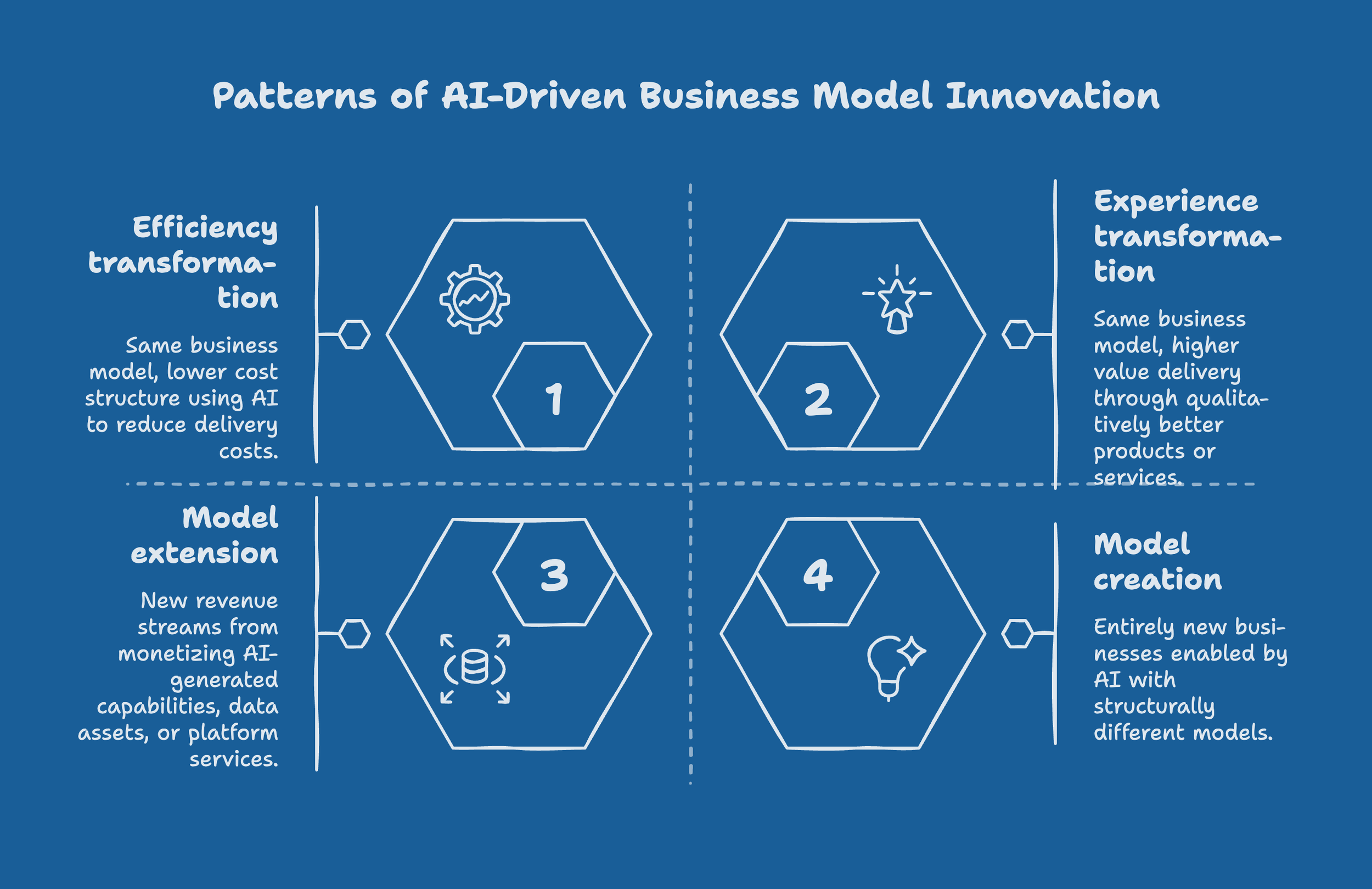
4 Patterns of Business Model Innovation
The strategic question isn’t which pattern to pursue but how to sequence them. Most organizations should start with efficiency or experience transformation to build AI capability and fund later stages, then extend into new revenue streams as competence develops, and explore model creation only when they have the necessary high quality data, maturity, and market position to execute.
Platform Economics in the Agentic Era
The most consequential business model transformation is the emergence of platform economics driven by multi-agent ecosystems. Agent marketplaces create multi-sided markets where agents serve other agents, buyer agents negotiate with seller agents, and orchestrator agents coordinate specialist agents across functional or organizational boundaries.
The infrastructure enabling this transformation is rapidly maturing. The Model Context Protocol (MCP), donated to the Linux Foundation's Agentic AI Foundation in December of 2025, reached 97 million monthly SDK downloads by March 2026, comparable to React's adoption but achieved in 16 months rather than three years. Every major AI provider now supports MCP natively. The Agent-to-Agent (A2A) protocol, with 50+ launch partners, enables communication and coordination among agents built on different frameworks by different vendors. Together, MCP handles the vertical connections between agents and tools while A2A handles the horizontal interactions between agents, forming the complete interoperability stack.
These protocols are creating the conditions for platform economics because they enable multi-sided markets. Companies that build orchestration platforms that coordinate multiple agents from multiple vendors to serve customers, create network effects: the more agent activity, the more valuable the platform becomes to every participant. The more customers use the platform, the more agents are attracted to it. These are the same dynamics that powered platform businesses like app stores, payment networks, and marketplace platforms.
The agentic AI market grew from roughly $5 billion in 2024 toward a projected $196 billion by 2034. Gartner projects that 40% of enterprise applications will incorporate AI agents by the end of 2026, up from 5% in 2025. By 2028, one in four enterprise software purchases will be made by AI agents with no “human in the loop”. The scale of this market, and the platform dynamics it enables, creates opportunities for organizations that position themselves as orchestration platforms rather than just point solution providers.
Monetization of agent ecosystems is shifting with platform economics. The biggest insight from the emerging agent marketplace economy is that AI is not the product; it’s the delivery engine. Organizations do not sell AI; they sell AI enabled outcomes. In Q2 2026, eight agent marketplaces matter, each with different economics, review rules, and distribution dynamics. A2A economies are emerging: orchestrator agents that coordinate specialist agents, marketplace agents that broker between buyer and seller agents, and compliance agents that verify that other agents operate within defined governance boundaries. These are new value creation layers that did not exist 18 months ago.
For most organizations, platform economics is not the starting point; it’s the destination. The sequencing framework from Part 2 applies: build capability through efficiency and experience transformation, extend into new revenue streams as data assets and orchestration competence develop, and pursue platform plays when the organization has the scale, data, and market position to create multi-sided dynamics.
Value Chain Restructuring
AI agents are compressing, eliminating, or transforming activities across every industry's value chain. Understanding where compression is occurring and where new value is being created is essential for business model strategy and transformation.
Activities being compressed or eliminated include information aggregation (agents can gather, synthesize, and present information from multiple sources in seconds), routine analysis (pattern recognition, anomaly detection, and standard analytical tasks that previously required analysts), transaction processing (order fulfillment, invoice reconciliation, claims adjudication, and other high-volume transactional work), standard customer interactions (issue resolution, order status, appointment scheduling, and other service encounters), and content generation (reports, summaries, email and other correspondence, and other template-driven written output).
Activities where new value is being created include orchestration design (designing how agents, humans, and workflows coordinate is a new and valuable capability), outcome verification (as AI handles more execution, the human role shifts toward “human-in-the-lead” verification that outcomes meet quality, compliance, and strategic standards), strategic judgment (interpreting AI-generated analysis, making decisions under uncertainty, and navigating ambiguous situations where pattern recognition is insufficient), relationship stewardship (managing the human relationships that AI can’t replicate, including trust-building, empathy, negotiation, and creative problem-solving), and governance (managing the rules, standards, and accountability structures for multi-agent systems).
The strategic implication is that business models built on performing compressible activities are at risk, while business models built on performing value-creating activities are strengthened by AI. An organization whose revenue depends on transaction processing, information gathering, routine analysis, or transforming its model before AI agents perform those activities at near-zero marginal cost. An organization whose revenue depends on strategic judgment, relationship management, or orchestration capability is positioned to capture more value as AI handles the routine work that used to consume human capacity.
The Incumbent's Dilemma
Established companies face a structural challenge when pursuing business model innovation: the new model often cannibalizes the existing one. A software company that shifts from seat-based to outcome-based pricing may see short-term revenue decline even as it positions for long-term growth (as exhibited in several prominent software company recent earnings reports). A professional services firm that automates 60% of billable work must find new value propositions for the capacity it frees. A manufacturer that moves from selling products to selling outcomes must restructure its entire revenue recognition, sales compensation, and customer success model.
This is the classic innovator's dilemma, amplified by AI's speed and scope. The structural asymmetry between incumbents and AI-native startups makes it especially acute. Startups have no installed base of seat revenue to cannibalize, no board conditioned on net revenue retention, and can lead with pricing models that customers prefer because no legacy revenue model would be undercut.
The most effective response is a dual operating model: running the existing business for cash generation while building the new business model with operational independence. The critical requirement is genuine independence. The new model needs separate P&L accountability, separate leadership, separate incentive structures, and explicit permission to cannibalize the core business. Without this independence, the core business's margin requirements, planning cycles, and risk tolerance will constrain the new model creating a high risk of failure.
Organizations that execute the dual operating model successfully share three characteristics. First, CEO sponsorship and protection of the new model from the core business's gravitational pull, connecting directly to the CEO's AI agenda from Part 3. Second, clear metrics for the new model that differ from the core business, recognizing that outcome-based models have different unit economics, growth patterns, and payback periods than seat-based or subscription models. Third, a defined transition timeline that specifies when and how the new model replaces the core model, preventing indefinite parallel operation that drains resources without producing transformation.
The alternative to managed self-disruption is disruption by others. The organizations that lead with outcome-based pricing, agent-mediated service delivery, and platform economics will set the competitive standard. Those that protect legacy models will find their customers migrating to competitors and AI-native entrants that deliver better outcomes at lower cost with more transparent pricing.
Strategy Playbook
Business model vulnerability assessment. Score your current business model against five AI disruption vectors. First, pricing model exposure: does your revenue depend on input-based pricing (seats, hours, licenses) that AI agents erode? Score 1 (outcome-based) to 5 (purely seat-based). Second, activity compression risk: what percentage of the activities your business model monetizes can be performed by AI agents at competitive quality? Score 1 (under 10%) to 5 (over 60%). Third, data defensibility: does your model generate proprietary data that improves over time, or does it rely on commodity inputs? Score 1 (strong data moat) to 5 (no proprietary data). Fourth, switching cost durability: are your switching costs based on integration depth and workflow embedding, or on contractual lock-in that agents can navigate around? Score 1 (deep workflow integration) to 5 (contractual only). Fifth, agent accessibility: can purchasing agents evaluate and buy your offering without human interaction, or does your value proposition require human-mediated selling? Score 1 (fully agent-accessible) to 5 (depends on human sales). A total score above 15 indicates high vulnerability; and above 20 indicates an urgent transformation need.
The four-pattern diagnostic. Determine which business model innovation pattern fits your strategic position by answering four questions. First, can AI reduce your cost structure by more than 30% without changing what you sell? If yes, efficiency transformation is the foundation. Second, can AI improve the quality, personalization, or responsiveness of what you deliver enough to justify premium pricing or reduce churn? If yes, experience transformation creates differentiation. Third, do your operations generate data, algorithms, or capabilities that other organizations would pay to access? If yes, model extension creates new revenue. Fourth, could your market be restructured by agent-mediated transactions, outcome-based pricing, or platform dynamics? If yes, model creation is a strategic necessity. Most organizations answer yes to multiple questions. The diagnostic determines sequencing, not exclusivity.
Revenue stream risk mapping. Categorize each revenue stream as high risk (activity can be performed by agents at competitive quality within 12 months, pricing model is input-based, no proprietary data moat), medium risk (activity partially automatable, pricing model could shift, some proprietary advantage), or low risk (activity requires human judgment or relationships, pricing already outcome-aligned, strong data moat). For high-risk streams, develop transformation plans with 12-month timelines. For medium-risk streams, begin experimentation with alternative models. For low-risk streams, invest to strengthen defensibility.
First steps toward business model experimentation. Run a minimum viable model test by selecting one revenue stream or customer segment and offering the new business model alongside the existing one. For pricing model shifts, offer one customer cohort outcome-based pricing and compare retention, satisfaction, and lifetime value against the seat-based cohort. For model extension, package one AI-generated capability as a standalone offering and test willingness to pay. For platform plays, identify one workflow where agents from multiple vendors could coordinate and test the orchestration model. The minimum viable model test produces data, not commitment. It answers the question "does this model work?" before the organization commits to transformation.
For the companion frameworks from all prior series, including the Dual Maturity Quick Diagnostic and Agentic AI Readiness Assessment, visit arionresearch.com. The themes of strategic alignment, governance-by-design, and orchestration architecture will be developed further in the forthcoming "Governance-by-Design" book. Follow Arion Research for ongoing analysis at arionresearch.com/blog.