AI Strategy is Business Strategy, Part 6: The Data Strategy-Business Strategy Link
This is the sixth article in a 12-part series arguing that AI strategy and business strategy must be the same strategy. Each article examines a critical dimension of strategic AI alignment and includes a "Strategy Playbook" section with actionable guidance.
The Missing Foundation
The first five articles in this series addressed the strategy gap, strategy archetypes, CEO leadership, competitive dynamics, and business model transformation. Each of those arguments rests on an assumption this article examines directly: that the organization has the data foundation to execute its AI strategy.
Most do not. And the reason is not technical. It is strategic.
Data strategy in most organizations is an IT-led initiative designed around availability, storage efficiency, and compliance. It optimizes for making data accessible to users (analysts) and applications. That is a necessary but insufficient foundation for AI. AI requires data that’s not just available but curated based on an explicit strategy: structured for machine consumption, designed to capture operational knowledge and learning, governed for quality and provenance, and aligned to support specific business outcomes.
The gap between what data strategies deliver and what AI strategies require is one of the primary reasons AI investments underperform. Gartner predicts that organizations will abandon 60% of AI projects unsupported by AI-ready data through 2026. A Dun & Bradstreet survey found that 97% of organizations have active AI initiatives, but only 5% believe their data is ready to support AI at enterprise scale. IDC warns that companies not prioritizing AI-ready data by 2027 will suffer a 15% productivity loss. The pattern is consistent: organizations invest heavily in AI technology while underinvesting in the data foundation that determines whether that technology produces results.
The data-strategy disconnect mirrors the broader strategy gap from Part 1. Just as AI strategies fail when they are technology deployment plans disconnected from business outcomes, data strategies fail when they are infrastructure plans disconnected from the strategic priorities of the business. Data strategy is not an IT initiative. It is a business strategy enabler that determines whether AI investments produce competitive advantage or expensive mediocrity.
The Data-Strategy Disconnect
The scale of the disconnect between data strategy and AI ambition is striking. 73% of enterprise data leaders rank data quality as the primary barrier to AI success, surpassing issues like model accuracy, compute costs, and talent. Gartner estimates that poor data quality costs organizations an average of $12.9 million per year. MIT Sloan research shows that 15 to 25% of revenue is lost to poor data quality. When AI spending scales, and it is projected to surpass $2 trillion in 2026, the cost of poor data quality scales with it.
The problem is not that organizations lack data. Most are drowning in it. The problem is that the data they have was collected for reporting, business intelligence, and operational automation. AI, especially agentic AI, requires something different: data that captures the context of decisions, the nuance of workflows, the patterns of customer behavior, and the feedback loops that enable learning. Traditional data strategies were built for dashboards. AI strategies require data strategies built for intelligence.
IDC's 2026 FutureScape research identifies the core tension. By 2025, 80% of enterprises failed to treat data as a product and put in place the discipline to unlock its value for all stakeholders. That failure delays AI-fueled business models because AI systems need data that is owned, governed, semantically defined, and provably current. Properties that data-as-a-product provides and traditional data management does not.
The strategic implication is that data readiness is not a prerequisite to check off before AI deployment. It is a continuous capability that must be designed into the business strategy. Organizations that treat data as a one-time infrastructure investment will find their AI initiatives stalling as models degrade, agents make poor decisions, and the learning flywheel described in Part 4 never begins to turn.
Data as Competitive Moat
As frontier AI models commoditize, becoming widely accessible at declining costs, the durable source of competitive advantage shifts to proprietary data. The model is the engine, but data is the fuel. Two organizations running the same model on different data will produce dramatically different results. The organization with richer, more relevant, more current data will outperform, and the gap will widen over time as operational data accumulates.
Proprietary data comes in three strategic categories, each with different competitive value.
Workflow data captures how work gets done within the organization: process patterns, decision sequences, exception handling, and the operational context that surrounds every business activity. When AI agents are embedded in workflows, every interaction generates data about what works, what fails, and what could be improved. This data is unique to each organization because no two organizations perform the same work the same way. Workflow data is the most defensible category because it can only be generated through operational experience.
Customer interaction data captures the full context of customer relationships: preferences, behaviors, communication patterns, service histories, and the signals that predict needs before customers articulate them. This data powers experience transformation, the second archetype from Part 2, by enabling AI systems to deliver increasingly personalized and responsive service. Customer interaction data appreciates over time because longer relationships produce richer understanding.
Domain-specific knowledge captures the expertise, edge cases, regulatory nuance, and contextual judgment that define performance in a particular industry or function. A financial services firm's decade of fraud detection patterns, a manufacturer's equipment failure signatures, or a healthcare provider's clinical decision histories are examples. This data is the foundation of differentiation in industries where specialized knowledge creates value.
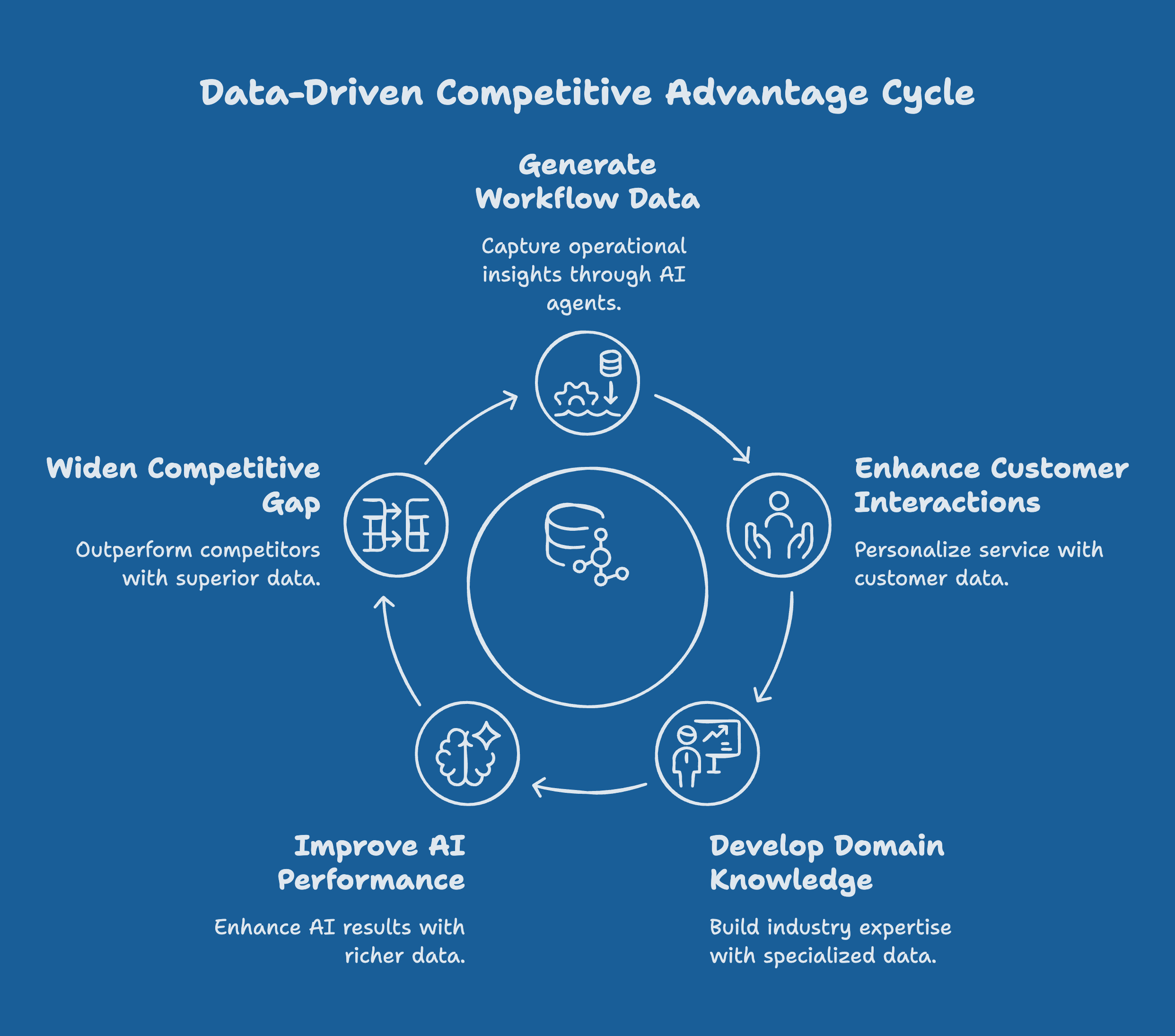
Data Driven Competitive Advantage
The strategic distinction is between data that creates parity and data that creates advantage. Purchased data, third-party datasets, and publicly available information create parity because every competitor has access to the same inputs. Proprietary operational data, generated by the learning flywheel, creates advantage because it is unique, cumulative, and self-reinforcing. Organizations that treat data primarily as a cost center to be managed efficiently are optimizing for parity. Organizations that treat data as a strategic asset to be cultivated are investing in advantage.
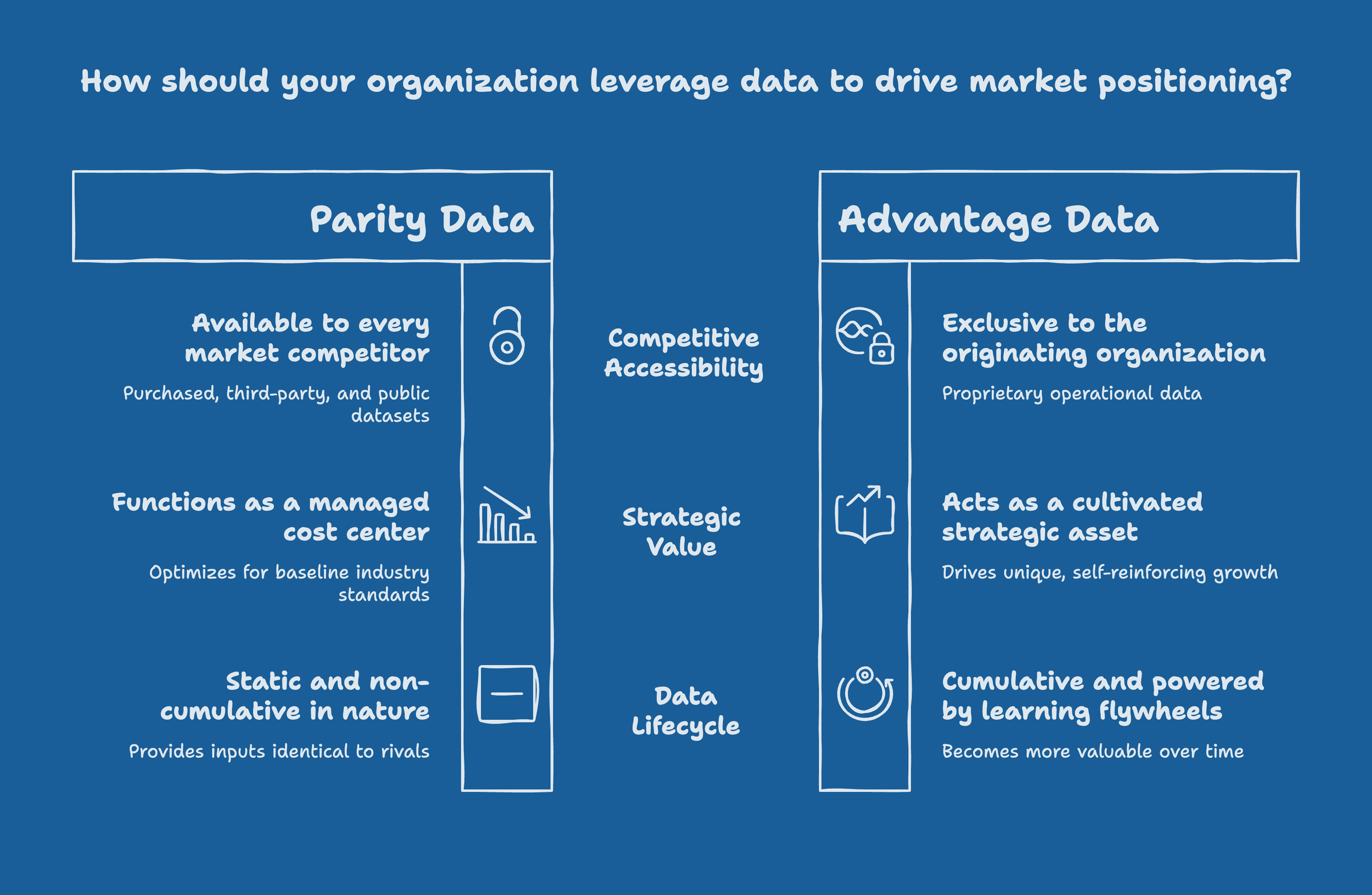
Parity Data v Advantage Data
The Learning Flywheel Dependency
Part 4 introduced Bain's learning flywheel as a competitive moat mechanism: data improves agents, agents improve people, people redesign work, and redesigned work generates better data. The flywheel is the engine of compounding competitive advantage. But the flywheel has a prerequisite that most organizations have not addressed: the data strategy must be designed to capture and recycle operational learning.
The flywheel breaks when data strategy fails in any of four ways.
Capture failure. The organization deploys AI agents but does not instrument the workflows to capture the interaction data that improves performance. Agent outputs, human corrections, accepted versus rejected recommendations, and performance feedback all constitute learning signals. Without deliberate capture, these signals dissipate. The agent performs the same way on day 300 as it did on day one, and no competitive advantage accumulates.
Quality failure. The organization captures data but does not maintain the quality standards that make it useful for training and improvement. Dirty data, inconsistent labeling, missing context, and outdated records degrade AI performance rather than improving it. When poor quality data enters machine learning workflows, its inaccuracies, biases, and inconsistencies propagate across downstream systems.
Integration failure. The organization captures high-quality data but stores it in departmental silos that prevent the cross-functional learning the flywheel requires. A customer service agent that cannot access sales interaction data, or a supply chain optimization system that cannot see demand signals from marketing, operates with partial information. The flywheel spins fastest when data flows across functions, connecting insights from one domain to decisions in another.
Feedback failure. The organization captures, cleans, and integrates data but does not close the loop by feeding operational learning back into agent improvement. The data sits in a warehouse rather than informing model fine-tuning, prompt engineering, or workflow redesign. The flywheel stalls because the "data improves agents" link is broken.
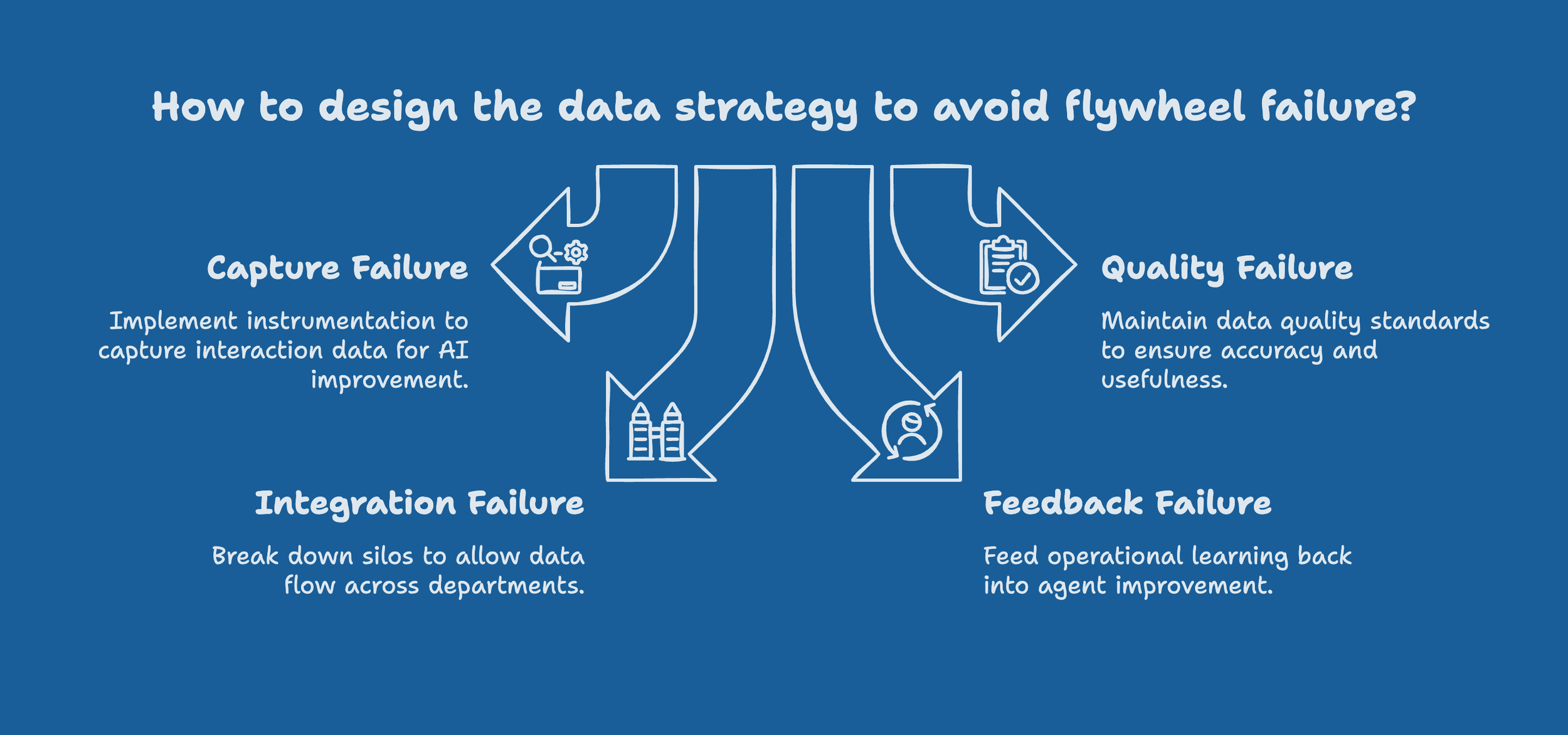
Data Flywheel Failure
Each of these failures is a data strategy failure, not a technology failure. The technology to capture, clean, integrate, and recycle operational data exists. What is missing in most organizations is the strategic intent to design the data strategy around the flywheel mechanism. The organizations pulling ahead are not doing so because they have better AI models. They are pulling ahead because their data strategies are designed to make those models smarter with every operational cycle.
Strategic Data Architecture
Data architecture for the AI era is not a one-size-fits-all decision. The right architecture depends on the organization's strategy archetype, data maturity, and operational complexity. But several principles apply regardless of context.
Design for AI consumption, not human consumption. Traditional data architectures optimize for human analysts: clean visualizations, aggregated metrics, and periodic reporting. AI systems need raw, granular, context-rich data delivered in real time or near real time. Feature stores, vector databases, knowledge graphs, and semantic layers are becoming standard components of AI-ready architectures because they structure data for machine reasoning rather than human interpretation.
Build for the flywheel, not the dashboard. The architecture must support bidirectional data flow: operational data flows into AI systems for learning, and AI-generated insights flow back into operations for action. This is a different architectural pattern than the traditional extract-transform-load pipeline that moves data from operational systems to analytical systems. The flywheel requires data to cycle continuously between operations and intelligence.
Embrace hybrid architecture. The debate between data mesh, with its decentralized domain ownership, and data fabric, with its centralized integration layer, is converging toward hybrid approaches. McKinsey's October 2025 survey found hybrid architectures achieved 52% success rates compared to 41% for fabric and 38% for pure mesh implementations. The practical answer is that domain teams should own and govern their data, while a centralized fabric layer handles cross-domain integration, quality enforcement, and AI pipeline orchestration.
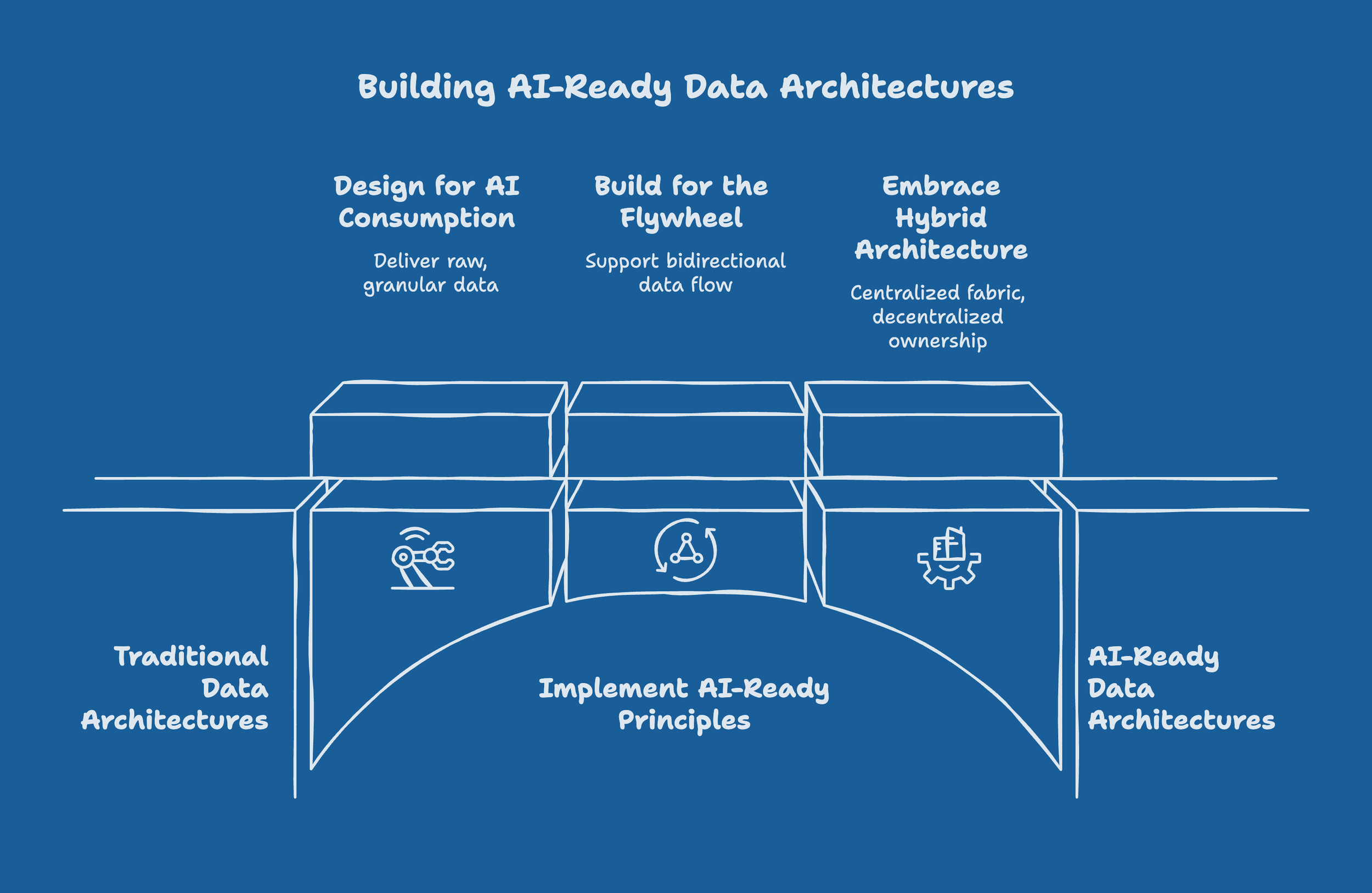
AI-Ready Data Architecture
The build-versus-buy decision for data infrastructure is a strategic choice that connects directly to the archetype framework from Part 2. Efficiency-First organizations should buy proven data platforms that deliver reliable AI-ready infrastructure without extensive custom development. Growth-First and Experience-First organizations need selective building: custom data pipelines for the proprietary data that creates their competitive advantage, purchased infrastructure for everything else. Platform-First organizations may need to build significant data infrastructure because their competitive position depends on data capabilities that do not exist as commercial products.
In 2026, 67% of enterprises have deployed generative AI, but only 20% are confident in their underlying data infrastructure. Architectures built in 2020 to 2023 were not equipped for AI-native workloads. Organizations that adopt the right architecture can cut implementation time in half and reduce costs by about 20% when scaling new systems. The architecture decision is not academic. It determines whether AI investments produce returns or remain stranded by inadequate data infrastructure.
Data Governance as Strategic Governance
Data governance in most organizations is a compliance function. It ensures that data handling meets regulatory requirements, that sensitive information is protected, and that access controls are enforced. These are necessary activities. But they are not sufficient for the AI era, and they are not strategic.
Strategic data governance goes beyond compliance to address three questions that directly affect competitive position. First, what data should we invest in creating, capturing, and maintaining to serve our strategic priorities? Second, how do we ensure data quality standards that make AI systems reliable enough to trust with business-critical decisions? Third, how do we balance data accessibility for AI innovation with data protection for regulatory compliance and competitive defense?
The data classification framework from the mid-market series provides a practical starting point. Open data is widely shared and used for general AI training and benchmarking. Internal data is restricted to the organization and used for proprietary AI applications. Restricted data requires the highest protection levels due to regulatory, competitive, or ethical sensitivity. Each classification level carries different governance requirements, different AI use cases, and different risk profiles.
The regulatory landscape is adding urgency to strategic governance. The EU AI Act becomes fully applicable in August 2026, requiring documented data governance for high-risk AI systems, with penalties reaching 7% of global annual turnover, exceeding GDPR. Cross-border data transfer requirements continue to evolve, with $1.3 billion in fines issued in 2025 alone. IDC projects that 70% of enterprise AI workloads will involve sensitive data by 2026. Organizations that treat data governance as a compliance checkbox rather than a strategic capability will find themselves constrained in ways that limit AI deployment.
But governance is not just about constraint. Done well, governance creates strategic value. Data provenance tracking enables organizations to verify the quality and origin of the data powering their AI systems, which builds trust in AI-driven decisions. Data quality standards ensure that the learning flywheel operates on reliable inputs, preventing the garbage-in-garbage-out dynamic that undermines AI performance. Access governance enables controlled data sharing within the organization and with partners, expanding the data available for AI without creating unacceptable risk.
The governance design from the orchestration series applies directly: governance should be embedded in data workflows, not bolted on as an afterthought. Automated quality checks, real-time provenance tracking, and policy-as-code approaches enable governance that scales with AI deployment rather than constraining it.
The Synthetic Data Question
Synthetic data, artificially generated data that mimics the statistical properties of real data, is growing rapidly as an AI training resource. The synthetic data generation market is projected to reach $2.1 billion by 2028, growing at a 45.7% compound annual rate. Enterprise interest is driven by three factors: data scarcity in domains where real data is limited or expensive to collect, privacy compliance in regulated industries where real customer data cannot be used for training, and bias correction when real datasets reflect historical patterns the organization wants to move beyond.
The strategic question is not whether to use synthetic data but when it supplements real data effectively and when it becomes a liability.
Synthetic data works well for augmenting training datasets when real data is insufficient, for stress-testing AI systems against edge cases that rarely occur in operational data, and for enabling AI development in domains with strict privacy constraints. It is a legitimate tool for accelerating AI development when used alongside real data.
Synthetic data becomes a liability when organizations use it as a substitute for the proprietary operational data that creates competitive advantage. Synthetic data can replicate statistical patterns, but it cannot capture the contextual nuance, the operational exceptions, and the accumulated institutional knowledge embedded in real workflow data. An organization that relies primarily on synthetic data for AI training is building its competitive position on data that any competitor could generate. The proprietary advantage disappears.
The strategic principle is that synthetic data should supplement the data capture strategy, never replace it. Organizations should invest in capturing real operational data for the domains that create competitive advantage and use synthetic data for the domains where real data is unavailable, too expensive, or too sensitive to use directly.
Data Partnership and Ecosystem Strategy
No organization generates all the data its AI strategy requires. Data partnerships, structured agreements to share, exchange, or jointly create data with external parties, are becoming a strategic necessity. IDC's 2026 FutureScapes predicts that by 2028, 60 percent of enterprises will collaborate on data through private data exchanges or clean rooms.
Data partnerships create value in three ways. First, they expand the training data available for AI systems beyond what the organization can generate internally, improving model performance in domains where internal data is limited. Second, they enable new AI capabilities that require data the organization does not possess, such as a retailer accessing supply chain data to improve demand forecasting or a healthcare provider accessing pharmaceutical data to enhance clinical decision support. Third, they create shared learning that benefits all participants, as in industry consortia that pool data to address common challenges like fraud detection or safety monitoring.
But data partnerships carry strategic risks that must be managed. The most significant is data dependency: if a partnership provides data that becomes essential to the organization's AI systems, the partner gains leverage that can be exercised through pricing, access restrictions, or competitive use of the same data. The second risk is competitive leakage: sharing data, even in aggregated or anonymized form, may reveal operational patterns or strategic intentions that competitors could exploit. The third is quality degradation: if the partner's data quality declines, the organization's AI performance declines with it.
The governance framework for data partnerships should address four dimensions. First, strategic alignment: does the partnership serve the organization's strategy archetype, or does it create dependency that constrains strategic flexibility? Second, competitive protection: does the agreement prevent the partner from using shared data to benefit the organization's competitors? Third, quality assurance: does the agreement specify data quality standards, freshness requirements, and remedies for quality failures? Fourth, exit strategy: can the organization maintain its AI capabilities if the partnership ends, or has it created an operational dependency that would be disruptive to unwind?
The organizations that approach data partnerships strategically, treating them as competitive levers rather than procurement transactions, will have access to richer, more diverse data for their AI systems. Those that treat data partnerships as vendor relationships will find themselves dependent on data they do not control for AI capabilities they cannot sustain independently.
Strategy Playbook
Strategic data audit. Map every significant data asset in the organization against two dimensions: strategic importance and AI readiness. Strategic importance is scored 1 (no connection to strategic priorities) to 5 (directly enables a primary strategic outcome). AI readiness is scored 1 (inaccessible, poor quality, no governance) to 5 (machine-readable, high quality, governed, with established feedback loops). Plot assets on a 2x2 matrix. High importance, low readiness assets are the urgent priorities: these are the data assets that your strategy depends on but your AI systems cannot use effectively. Low importance, high readiness assets are candidates for deprioritization or partnership. The audit should cover at minimum: customer interaction data, operational workflow data, financial performance data, market and competitive intelligence, product and service usage data, and employee productivity data.
Data moat assessment. For each data asset identified in the strategic audit, answer three questions. First, is this data proprietary or available to competitors? Purchased datasets, public data, and industry-standard benchmarks create parity. Proprietary operational data, customer interaction histories, and domain-specific knowledge create advantage. Second, does this data appreciate over time? Data that grows more valuable with continued collection and that enables the learning flywheel is a moat. Data that becomes stale, is easily replicated, or does not feed learning systems is not. Third, could a competitor generate equivalent data within 24 months? If yes, the moat is shallow. If the data requires years of operational experience to accumulate, the moat is deep. Assets that are proprietary, appreciating, and difficult to replicate are your data moats. Invest disproportionately in their capture, quality, and strategic use.
Data architecture decision framework. For each major component of your data infrastructure, determine the right approach using three criteria. First, strategic differentiation: does this component create competitive advantage? If yes, build it or customize it deeply. If no, buy a proven commercial solution. Second, maturity and availability: do commercial solutions exist that meet your requirements? If mature commercial options exist, the build case weakens significantly. If your requirements are unique enough that no commercial product addresses them, building is justified. Third, integration complexity: how many other systems must this component connect to, and how critical is that integration to your AI strategy? High integration complexity favors platforms that handle interoperability natively. Low integration complexity allows more freedom to select best-of-breed components. Apply this framework to five architecture decisions: data ingestion and integration, data quality and governance, feature stores and AI-ready data layers, analytics and reporting, and data orchestration across domains.
The 90-day data strategy alignment plan. Weeks one through two: conduct the strategic data audit and data moat assessment. Identify the top five data assets that are strategically critical but not AI-ready. Weeks three through four: assess current data architecture against the requirements of your strategy archetype. Identify the three most significant gaps between what your architecture delivers and what your AI strategy requires. Weeks five through six: design the data capture strategy for the learning flywheel. For each major AI initiative, define what operational data must be captured, how it will be fed back into agent improvement, and what quality standards apply. Weeks seven through eight: evaluate data governance against strategic and regulatory requirements. Identify governance gaps that constrain AI deployment or create compliance risk. Weeks nine through ten: assess data partnership opportunities and risks. Identify two to three partnerships that could expand your AI capabilities and evaluate them against the four-dimension governance framework. Weeks eleven through twelve: present the data strategy alignment plan to the CEO and executive team, framing data investment as strategic investment with specific connections to business outcomes, competitive positioning, and the learning flywheel.
This article is the sixth in the "AI Strategy is Business Strategy" series. For the companion frameworks from all prior series, including the Dual Maturity Quick Diagnostic and Agentic AI Readiness Assessment, visit arionresearch.com. The themes of strategic alignment, governance-by-design, and orchestration architecture will be developed further in the forthcoming "Governance-by-Design" book. Follow Arion Research for ongoing analysis at arionresearch.com/blog.