AI Strategy is Business Strategy, Part 3: The CEO's AI Agenda
This is the third article in a 12-part series arguing that AI strategy and business strategy must be the same strategy. Each article examines a critical dimension of strategic AI alignment and includes a "Strategy Playbook" section with actionable guidance.
The Leadership Gap That Explains the Results Gap
The first two articles in this series established that the gap between AI investment and business outcomes is strategic, not technical, and that organizations must choose a strategy archetype that matches their competitive position rather than defaulting to efficiency. Both of those arguments lead to the same place: the CEO's office.
AI strategy alignment begins at the top. Not because CEOs need to understand transformer architectures or fine-tuning parameters, but because the decisions that determine whether AI produces business results, which priorities to fund, how to allocate capital, what outcomes to measure, and who is accountable, are CEO-level decisions. When they are delegated entirely to IT or innovation teams, strategy alignment fails. The people making AI investment decisions lack either the authority or the context to connect those investments to business outcomes.
The data on this point is unambiguous. IBM's 2026 CEO Study, surveying over 2,000 CEOs across 33 countries, found that 83 percent say AI success depends more on people's adoption than on technology. Yet only 25 percent of workers use AI regularly as part of their job, even though 86 percent of CEOs believe their people are ready for it. BCG's Fourth Annual AI at Work survey, based on 11,749 workers across 14 markets, found that the share of employees who feel positive about generative AI rises from 15 percent to 55 percent with strong leadership support. Without it, the majority of the workforce approaches AI with indifference or anxiety.
The gap between CEO conviction and organizational reality is where AI strategies go to die. CEOs believe in AI. They fund AI. They talk about AI. What most of them are not doing is the operational work of embedding AI into how the organization plans, invests, executes, and learns. That operational work is the CEO's AI agenda, and it is the subject of this article.
What the CEO Must Own
The CEO's role in AI is not to manage deployments, evaluate vendors, or supervise model selection. It is to own four strategic decisions that no one else in the organization has the authority or perspective to make.
Strategic direction. The CEO determines which strategy archetype the organization pursues, which business outcomes AI must deliver, and in what sequence. As Part 2 established, the choice between Efficiency-First, Growth-First, Experience-First, and Platform-First is a competitive positioning decision that shapes the entire AI investment portfolio. This decision cannot be made by the CIO, who lacks visibility into competitive strategy, or by business unit leaders, who optimize for their own P&L rather than enterprise-level positioning. Only the CEO has the cross-functional authority and strategic perspective to make this call.
Capital allocation principles. The CEO sets the rules for how AI competes for investment against other strategic priorities. This goes beyond approving an AI budget. It means establishing the criteria by which AI investments are evaluated: business outcome targets, payback expectations, portfolio balance across archetypes, and the threshold for killing initiatives that are not producing results. BCG's 2026 AI Radar found that companies plan to double their AI spending in 2026, accounting for about 1.7 percent of revenues. The question is not how much to spend but how to allocate what is spent, and that allocation must be governed by strategic logic, not technology enthusiasm.
Performance expectations. The CEO defines what business outcomes AI must deliver and by when. This means translating strategic direction into measurable targets that connect AI investment to P&L impact. The absence of clear performance expectations is why so many AI programs drift into perpetual piloting. Without a CEO who says "this investment must produce X result by Y date or we redirect the resources," AI initiatives operate in a measurement vacuum where activity substitutes for impact. Nine in ten CEOs now say they are starting to see initial value from AI. But "initial value" is not strategic impact. The CEO's job is to define the difference and hold the organization to it.
Organizational accountability. The CEO determines who is responsible for AI-driven business outcomes, not just AI deployments. This is the most consequential and most neglected of the four decisions. In most organizations, IT is responsible for deploying AI tools and business units are responsible for adopting them. Nobody owns the business outcome. The CEO must assign outcome ownership: a single executive accountable for each major AI initiative's business result, with authority over both the technology deployment and the workflow redesign required to produce that result. IBM's 2026 study found that organizations that redesigned five core business areas, technology, finance, HR, operations, and cross-functional collaboration, are four times more likely to have delivered on business objectives. That kind of cross-functional redesign only happens when accountability is clear and runs through the CEO.
Board-Level AI Governance
If the CEO's role is to ensure AI produces business results, the board's role is to ensure the CEO has the frameworks, accountability, and competence to do so. This distinction matters. Board-level AI governance is not operational oversight. It is fiduciary responsibility applied to a new category of strategic risk and opportunity.
The current state of board preparedness is inadequate. NACD's 2025 Board Practices and Oversight Survey found that only 36 percent of boards have implemented a formal AI governance framework and just 6 percent have established AI-related management reporting metrics. Three in four boards have approved major AI investments, but fewer than half have set governance expectations or made AI risk a standing agenda item. The gap between investment commitment and governance oversight is itself a fiduciary risk.
Two novel fiduciary duties are emerging in the AI era. The first is AI due care: the obligation to exercise informed, technologically literate oversight of algorithmic systems that affect the organization's operations, customers, and risk profile. The second is AI loyalty oversight: the obligation to ensure that AI systems serve the organization's interests and do not introduce unmanaged conflicts, biases, or dependencies. The EU AI Act, with enforcement beginning in 2026, requires organizational accountability for high-risk AI systems. The SEC's 2026 examination priorities elevated cybersecurity and AI concerns above cryptocurrency.
What boards need is not technical expertise in AI. What they need is a governance structure that answers four questions. First, what business outcomes is the organization's AI investment designed to produce, and are they being achieved? Second, what risks does AI introduce, including operational, regulatory, reputational, and competitive risks, and are they being managed? Third, does the organization have the talent, governance, and accountability structures to execute its AI strategy? Fourth, is the CEO's AI agenda integrated into the strategic plan, or is it running as a parallel technology initiative?
The board should receive quarterly AI briefings structured around these four questions, not technology demonstrations. AI governance should be a standing agenda item for the full board or a designated committee, with the same rigor applied to AI oversight as to financial reporting and risk management.
The CAIO Question
The explosive growth of the Chief AI Officer role, from 26 percent of organizations in 2025 to 76 percent in 2026 according to IBM, reflects a genuine need for concentrated AI leadership. But the CAIO role works only when it clarifies accountability. When it fragments accountability, it makes the strategy gap worse.
The CAIO role works when it serves as the operational integrator between technology capability and business outcomes. In this configuration, the CAIO reports to the CEO, has authority across business units, owns the AI portfolio, and is measured on business results. IBM's research found that companies with a CAIO had a 5 percent higher return on AI investments and scaled 10 percent more AI initiatives. The role concentrates accountability for value creation and risk control that used to be scattered across IT, data, and line leadership.
The CAIO role fragments accountability when it becomes another technology executive reporting to the CIO or CTO. In this configuration, the CAIO owns AI deployments but not business outcomes. Business unit leaders retain outcome accountability without control over the AI investments that affect their results. The CIO retains technology infrastructure authority without accountability for AI-specific business impact. The result is a three-way split in which deployment, adoption, and outcome are owned by different executives with different incentives and no mechanism for alignment.
The diagnostic question is simple: does your CAIO have the authority to redirect AI investment based on business outcome data, including killing projects and reallocating resources across business units? If the answer is yes, the role is working. If the CAIO can recommend but not decide, the role is advisory rather than accountable, and the strategy gap persists.
For smaller organizations, the mid-market series examined the fractional CAIO model: an external advisor or part-time executive who provides strategic AI direction without the overhead of a full-time C-suite position. The principle is the same regardless of scale. What matters is that someone with strategic authority owns the connection between AI investment and business outcomes, and that person has a direct line to the CEO.
Fewer than 10 percent of both boards and CEOs believe AI strategy should be led by a CAIO, according to BCG's 2026 survey. Nearly three-quarters of CEOs say they are the chief decision maker on AI. The CAIO question is not whether the role exists but whether it complements or complicates the CEO's ownership of AI strategy.
CEO Behaviors That Predict Success
Beyond the four strategic decisions, three CEO behaviors consistently distinguish organizations that produce AI results from those that do not.
Personal engagement with AI tools. CEOs who use AI themselves send a signal that no speech or strategy document can match. They give managers and employees greater incentive to experiment, learn, and build confidence. They make it clear to their senior leadership team that AI is everyone's mandate, not someone else's project. BCG's 2026 research found that CEOs who spend at least eight hours a week building their AI capabilities are significantly more likely to generate meaningful value from the technology. BCG identifies 15 percent of CEOs as "trailblazers" who are decisive on AI strategy and have upskilled nearly three-quarters of their employees. The correlation is clear: CEO personal engagement predicts organizational AI maturity.
Gallup's 2026 data reinforces this at every level of management. Employees whose managers actively support AI use are 8.7 times more likely to say their work has been transformed by AI. But only 30 percent of employees say their manager supports AI use at work. The cascade starts at the top: CEO engagement drives executive team engagement, which drives manager engagement, which drives employee adoption. Break the cascade at any level and adoption stalls.
Investment in change management and workflow redesign. The single strongest predictor of enterprise-level AI impact, according to McKinsey, is whether an organization redesigned its workflows when deploying AI. BCG's data quantifies the dividend: employees at companies pursuing workflow redesign are 24 percentage points more likely to see measurable business impact, 22 percentage points more likely to save at least a full workday per week, and 20 percentage points more likely to report increased job satisfaction. Yet only 37 percent of organizations invest meaningfully in change management for AI rollouts. Seventy percent of adoption challenges stem from people and process issues, not technology.
The CEO who funds a $50 million AI technology deployment with a $500,000 change management budget is not making a cost decision. That CEO is making a strategy decision that predicts failure. The 93/7 budget split identified in Part 1, with 93 percent going to technology and 7 percent to people and workflows, is a CEO decision that reveals what the organization truly believes AI success requires.
Visible strategic ownership. Half of CEOs believe their job is on the line if AI does not pay off. But belief in AI's importance is not the same as visible ownership of the AI agenda. Visible ownership means the CEO chairs the quarterly AI portfolio review, not the CIO. It means AI performance is a standing item in the CEO's executive team meetings. It means the CEO personally communicates the AI strategy to the organization, defines the expected outcomes, and holds leaders accountable for results. McKinsey's 2025 research identified the critical insight: the biggest barrier to scaling AI is not employees, who are ready, but leaders, who are not steering fast enough.
The mid-market series identified CEO proximity as a structural advantage for smaller organizations. In a 200-person company, the CEO is two or three levels from every employee. Strategic direction translates to operational reality faster because the communication chain is shorter and the feedback loop is tighter. Large enterprises must build structures that simulate this proximity: executive champions embedded in business units, cascading communication protocols, and direct CEO engagement with AI initiatives at the working level, not just at the review level.
The Strategic Planning Cycle
The most consequential CEO behavior is integrating AI into the annual strategic planning cycle rather than running it as a parallel technology initiative. When AI has its own planning process, separate from business planning, it operates outside the discipline of strategic prioritization, capital allocation, and performance management that governs every other strategic investment.
Integration means AI appears in the strategic plan as a capability that serves business objectives, not as a separate technology initiative. It means AI investment proposals compete for capital against non-AI alternatives using the same criteria: expected business impact, risk-adjusted return, strategic alignment, and resource requirements. It means AI performance is reviewed in the same cadence and with the same rigor as every other strategic priority.
The planning cycle integration follows a natural annual rhythm. In the strategic assessment phase, typically months one through three, the organization evaluates its competitive position, identifies strategic priorities, and determines where AI can serve those priorities. This is when archetype selection or revalidation occurs. In the portfolio allocation phase, months three through six, AI investments are proposed, evaluated against business outcome targets, and funded as part of the overall capital plan. In the execution phase, months six through twelve, AI initiatives are deployed with business outcome milestones, reviewed quarterly against targets, and adjusted or terminated based on results.
The quarterly strategic AI review is the CEO's primary governance mechanism. It is not a technology review. It is a business review that examines three questions: which AI investments are producing business results, which are not, and what should we do about it? The attendees are the CEO, the CAIO or equivalent, business unit leaders who own AI-driven outcomes, and the CFO. The CIO or CTO participates but does not lead. The framing is business outcomes, not technology metrics.
This approach eliminates the parallel track problem identified in Part 1. When AI strategy is produced by the technology organization and presented to the business for approval, it is a technology strategy wearing a business strategy costume. When AI strategy is embedded in how the organization plans, invests, and measures performance, it is a business strategy that uses technology as a means.
Strategy Playbook
The CEO's AI checklist: five questions. Every CEO should be able to answer these without consulting the CIO. One: which strategy archetype are we pursuing, and what three business outcomes must AI deliver in the next 12 months? Two: what percentage of our AI investment is allocated to our primary archetype versus other categories, and does the allocation match our strategic intent? Three: who is accountable for each AI-driven business outcome, and do they have authority over both the technology and the workflow redesign? Four: what is our AI investment per employee for change management and training, and how does it compare to our AI technology spend? Five: when did I last use AI tools personally, and when did I last discuss AI performance with my executive team in a business context rather than a technology context?
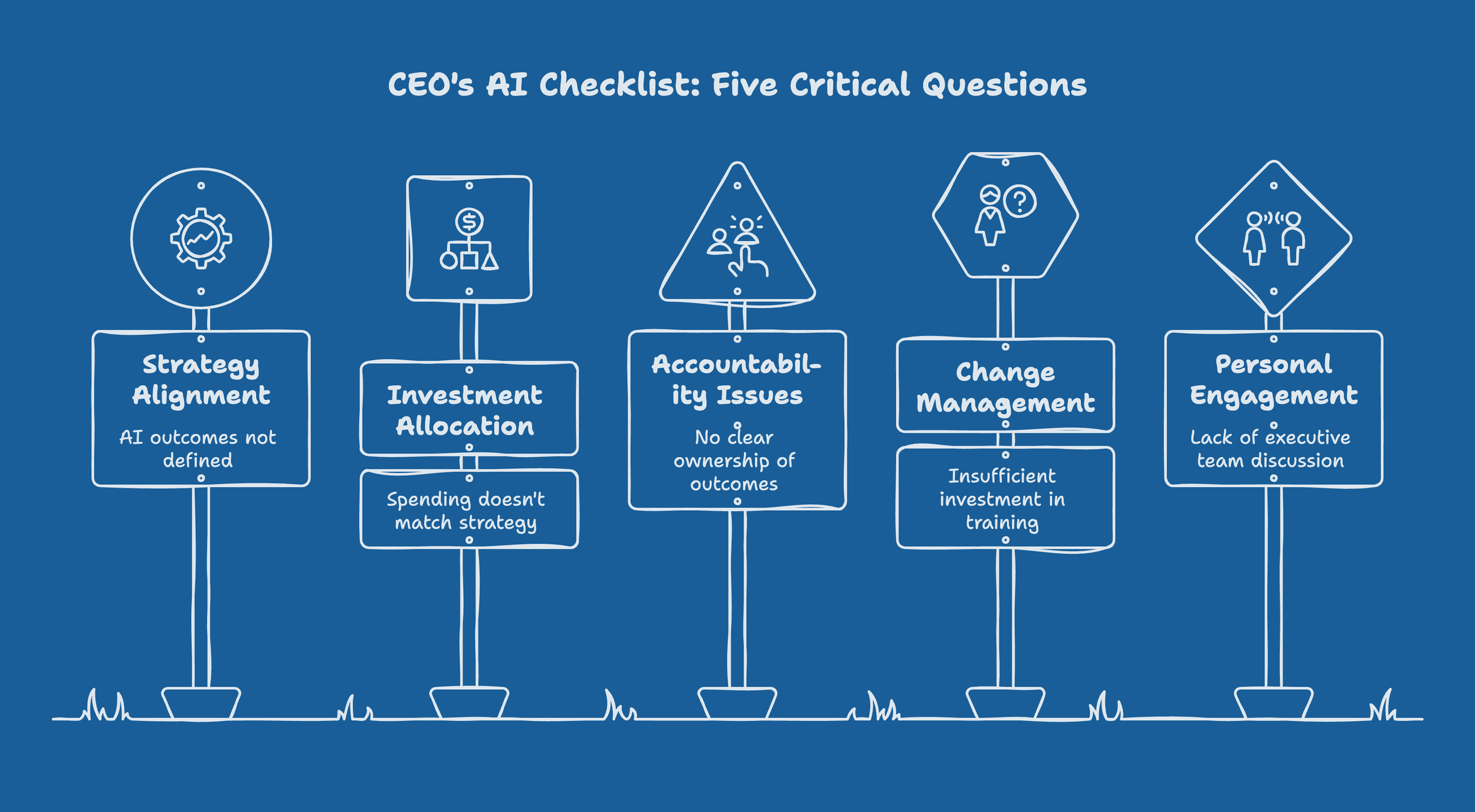
The CEO’s AI Checklist
The board AI briefing template. Structure quarterly board briefings around four areas. First, strategic alignment: are AI investments producing the business outcomes they were funded to deliver? Report the three largest AI initiatives by investment, their target outcomes, current performance against targets, and the decision (continue, scale, redirect, or terminate). Second, risk posture: what operational, regulatory, and competitive risks does the AI portfolio introduce, and are they managed within the board's risk appetite? Third, organizational readiness: does the organization have the talent, governance, and accountability structures to execute the AI strategy? Report CAIO effectiveness, training investment per employee, and workflow redesign coverage. Fourth, competitive context: how does the organization's AI maturity compare to key competitors, and what is the trajectory?
Integrating AI into the strategic planning cycle. Months one through three: conduct the strategy alignment audit from Part 1, validate or update archetype selection from Part 2, and assess competitive position. Months three through six: propose AI investments as part of capital allocation, evaluate against business outcome criteria, and fund the portfolio. Months six through twelve: execute with quarterly portfolio reviews chaired by the CEO, applying kill/continue/scale decisions based on outcome data.
The CEO's 90-day AI agenda. Week one: personally use three AI tools relevant to your role for at least four hours. Weeks two through three: conduct the five-question strategy alignment audit from Part 1 with your executive team. Week four: review the current AI portfolio and categorize every investment by archetype. Weeks five through six: assign business outcome owners for each major AI initiative and define 12-month targets. Weeks seven through eight: establish the quarterly strategic AI review cadence with clear agendas and attendance. Weeks nine through ten: review AI training investment and change management resourcing against the 93/7 benchmark. Weeks eleven through twelve: brief the board using the template above and request formal AI governance integration.
This article is the third in the "AI Strategy is Business Strategy" series. For the companion frameworks from all prior series, including the Dual Maturity Quick Diagnostic and Agentic AI Readiness Assessment, visit arionresearch.com. The themes of strategic alignment, governance-by-design, and orchestration architecture will be developed further in the forthcoming "Governance-by-Design" book. Follow Arion Research for ongoing analysis at arionresearch.com/blog.