
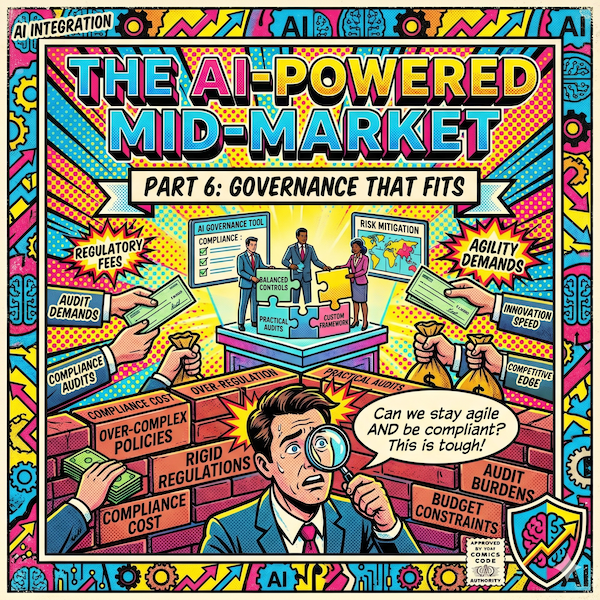
The AI-Powered Mid-Market, Part 6: Governance That Fits
67 percent of employees are already using AI at work, but only 18 percent of organizations have formal AI policies in place. That gap between adoption and governance is costing real money: shadow AI breaches average $4.2 million each. Part 6 of "The AI-Powered Mid-Market" series makes the case that mid-market organizations need governance that fits on a page, not governance that fills a binder. The article introduces a minimum viable governance framework covering four areas: approved tools, data handling rules, decision authority tiers, and incident response. It provides a practical three-tier model for decision authority (where AI acts freely, where it recommends and a human decides, and where humans lead with AI providing information), a simple data classification system, and guidance on vendor governance, regulatory readiness for the EU AI Act and state-level AI laws, and building policies your people will follow. The Mid-Market Playbook closes with four actions: draft a one-page acceptable use policy, define decision authority for current AI use cases, map regulatory exposure, and establish a quarterly governance review cadence.

How Agentic AI Powers Data-Driven Compliance in Finance
Traditional compliance operates reactively. Teams follow rule-based checklists, manually review flagged transactions, and scramble to meet reporting deadlines. The work is labor-intensive, expensive, and prone to human error. Yet here's the paradox: as regulations multiply, so does the data available to ensure compliance. Financial institutions now have access to transaction histories, communication logs, external datasets, and behavioral patterns that could dramatically improve compliance outcomes. The problem? Humans simply can't process it all fast enough.
Agentic AI transforms this equation. Instead of treating compliance as a manual policing function, it becomes a proactive, data-driven intelligence layer that works continuously, learns from every interaction, and scales effortlessly across regulatory domains.