Beyond Trial and Error: How Internal RL is Redefining AI Agency
Generally, artificial intelligence agents have learned the same way toddlers do: by taking actions, observing what happens, and gradually improving through countless iterations. A robot learning to grasp objects drops them hundreds of times. An AI learning to play chess loses thousands of games. This external trial-and-error approach has produced remarkable results, but it comes with a cost. Every mistake requires real-world interaction, whether that's computational resources, physical wear on hardware, or in some cases, actual safety risks.
Now, a subtle but profound shift is underway. Rather than learning exclusively through external actions and environmental feedback, advanced AI systems are beginning to learn through internal reasoning and simulation. They're developing the ability to think through possibilities, evaluate potential outcomes, and refine their strategies before ever taking action in the real world.
While traditional Reinforcement Learning (RL) has mastered games and specific control tasks, Internal RL marks a leap toward long-horizon planning and safer, more efficient AI. The breakthrough lies in moving the trial-and-error process inside the model itself, where mistakes cost nothing and thinking becomes a form of practice.
Traditional Reinforcement Learning: The Foundation
Reinforcement Learning is a method where an agent learns to make decisions by performing actions and receiving feedback in the form of rewards or penalties from its environment. Think of it as training by experience: the agent tries something, sees if it works, and adjusts its behavior accordingly.
This approach has proven remarkably effective in certain activities:
Mastery of Complex Dynamics: RL has achieved superhuman performance in closed environments with clear rules. AlphaGo's victory over world champion Go players demonstrated that RL could master games with complexity that exceeds the number of atoms in the universe. Similar successes followed in Chess, video games like StarCraft and Dota 2, and various control tasks.
Optimization Excellence: When there's a clear reward signal to maximize over time, RL excels. It can find optimal policies that squeeze every bit of performance from a system, whether that's minimizing energy consumption in a data center or maximizing points in a game.
Discovery of Novel Strategies: RL agents often develop approaches that humans haven't considered. They're not constrained by conventional wisdom or established playbooks, which allows them to explore solution spaces more thoroughly.
But for all these strengths, traditional RL faces significant limitations:
Sample Inefficiency: Learning even simple tasks can require millions of interactions. A human child might learn to stack blocks after a dozen attempts. An RL agent might need thousands or millions of trials to achieve the same competence.
Safety and Cost Concerns: Trial and error is dangerous when the stakes are real. A self-driving car can't learn by crashing. A medical treatment AI can't learn by harming patients. Even in benign scenarios, the computational cost of running millions of simulations or physical experiments becomes prohibitive.
The Long-Horizon Problem: Perhaps most critically, traditional RL struggles when goals require thousands of coordinated steps and feedback is sparse or delayed. Planning a multi-day project, managing a complex supply chain, or conducting a scientific investigation all require maintaining focus on distant objectives while handling immediate concerns. Traditional RL tends to lose the thread.
The New Frontier: Internal Reinforcement Learning
Internal RL applies reinforcement learning principles not to the model's external physical outputs, but to its internal processing. Instead of learning what actions to take in the world, the model learns what thoughts to think.
The mechanism works through several interconnected processes:
Latent Simulation: Rather than acting in the real world and observing consequences, the model simulates possible trajectories in its internal representation space. It imagines what might happen without having to experience it physically.
Reasoning as Action: Each step in a chain of thought, each intermediate conclusion or consideration, becomes part of an action space to be optimized. The model doesn't just generate a final answer; it learns to generate productive reasoning steps that lead to better outcomes.
Hierarchical Structure: Recent research reveals that autoregressive models naturally develop temporal abstractions. They organize information into high-level groupings that function like managers in hierarchical RL, guiding the lower-level generation of specific tokens and thoughts. This isn't imposed from outside; it emerges from the model's architecture and training.
The key innovation here is evaluation before commitment. The model can explore a chain of thought, assess whether it's heading in a productive direction, and refine its approach before producing a final action or answer. It's the difference between thinking out loud and thinking before speaking.
Comparative Analysis: External vs. Internal
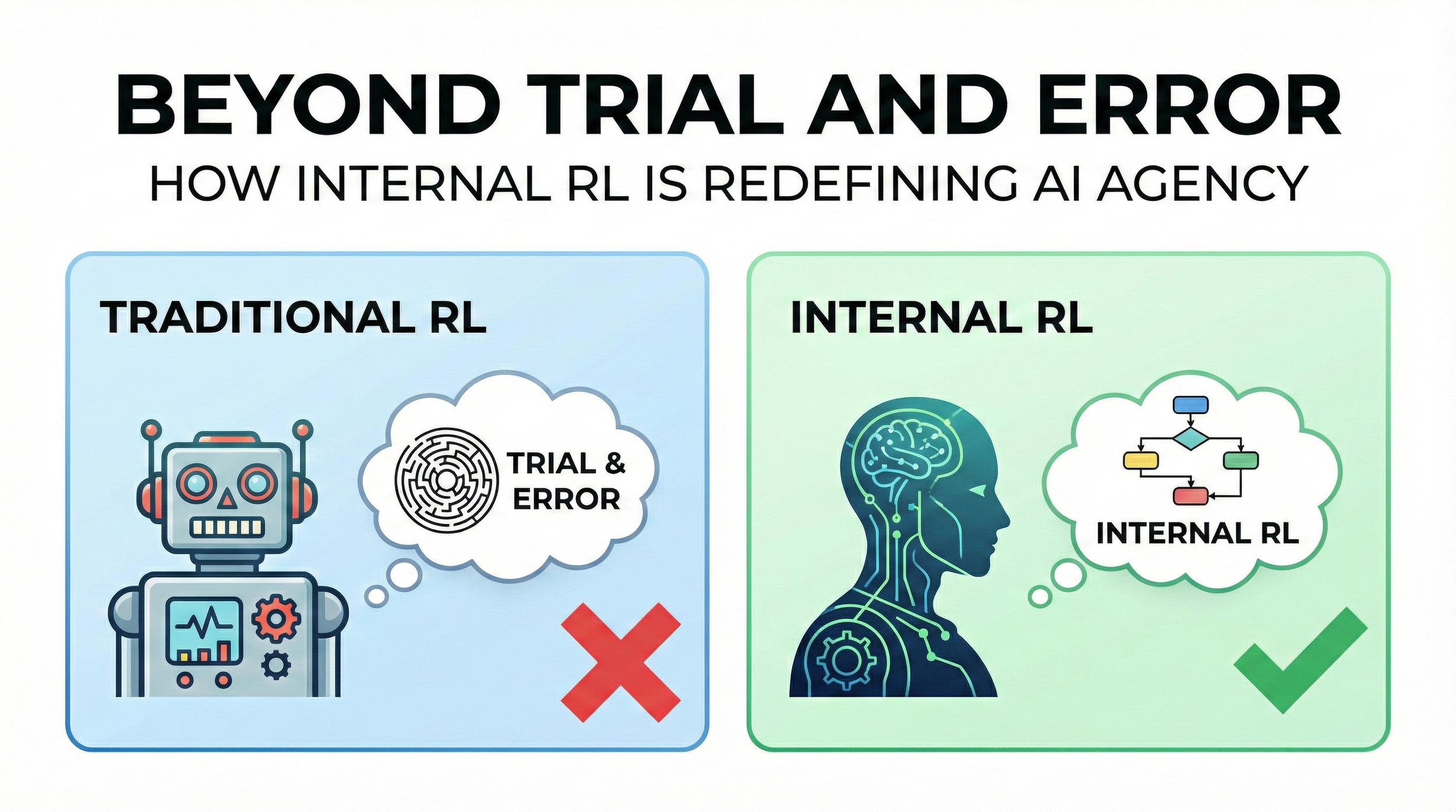
The contrast between traditional and internal RL becomes clearest when we examine their feedback loops:
Traditional RL: Action → Environment → Reward
The agent does something in the world, observes what happens, and receives a signal about whether that was good or bad. Learning is tied directly to environmental interaction.
Internal RL: Thought → Internal Evaluation/World Model → Refinement → Action
The agent generates internal reasoning, evaluates it against goals or an internal model of how things work, refines the thought process, and only then commits to an external action. Learning happens primarily in the imagination.
This shift has profound implications for safety and efficiency. In Internal RL, the agent can fail safely in its imagination. It can explore dangerous or dead-end approaches without consequence, learning from simulated mistakes rather than real ones. This drastically reduces the need for real-world samples and the risks associated with external exploration.
The scope of capability also expands dramatically. Traditional RL tends to be reactive, responding to immediate circumstances with actions optimized for near-term rewards. Internal RL enables proactive, long-term planning. By breaking complex tasks into manageable temporal abstractions, the model can maintain sight of distant goals while handling immediate details. It's the difference between navigating turn-by-turn and having a strategic route in mind.
Created by Google Nano Banana
Implications & Future Outlook
Internal RL addresses one of the most stubborn problems in AI: maintaining coherent pursuit of goals across thousands of steps. Traditional agents often "forget" what they're trying to accomplish when tasks stretch over long horizons. They get lost in the details or distracted by local optima. By maintaining high-level temporal states, internal RL agents can keep their eye on the prize while adapting to circumstances.
This approach also shows promise for generalization. When an agent learns productive patterns of reasoning rather than just task-specific behaviors, those patterns can potentially transfer to entirely new domains without retraining from scratch. The model learns how to think through problems, not just what to do in specific situations.
The implication is clear: while traditional RL built the body of AI agents, giving them the ability to act and respond, Internal RL is building the mind. It's creating agents that think before they act, that plan before they proceed, that simulate before they commit.
We're moving from AI that learns by doing to AI that learns by thinking about doing. The trial and error hasn't disappeared; it's just moved inside, where it's safer, faster, and more powerful. That shift might be the key to unlocking truly capable long-horizon agents that can tackle the complex, multi-step challenges that define the real world. (Relevant research)