Native vs. External Agents: The Depth-Breadth Trade-off in Enterprise AI
This is the third article in the"Future Enterprise" series, exploring how AI agents are restructuring enterprise technology. The series examines the architectural layers, competitive dynamics, and strategic decisions that will define the next era of enterprise software.
Every major enterprise software vendor now has an AI agent story. ERP vendors have embedded agents in finance, procurement, and supply chain workflows. CRM platforms have agents handling lead qualification, customer service, and campaign orchestration. HCM suites have agents managing onboarding, scheduling, and benefits administration. At the same time, horizontal AI platforms are building agents that sit outside these applications and orchestrate across them.
This creates a strategic choice that every enterprise technology buyer and vendor needs to confront: do you bet on native agents that are deeply embedded in specific applications, or external agents that operate across applications from a horizontal platform? The answer is not obvious, and getting it wrong has real consequences for cost, flexibility, and competitive positioning.
Two Models for Enterprise Agents
Before we can evaluate the trade-offs, we need to be precise about what native and external agents are. The distinction is not just about where the agent runs. It is about how deeply the agent understands the system it operates on.
Native Agents: Deep and Narrow
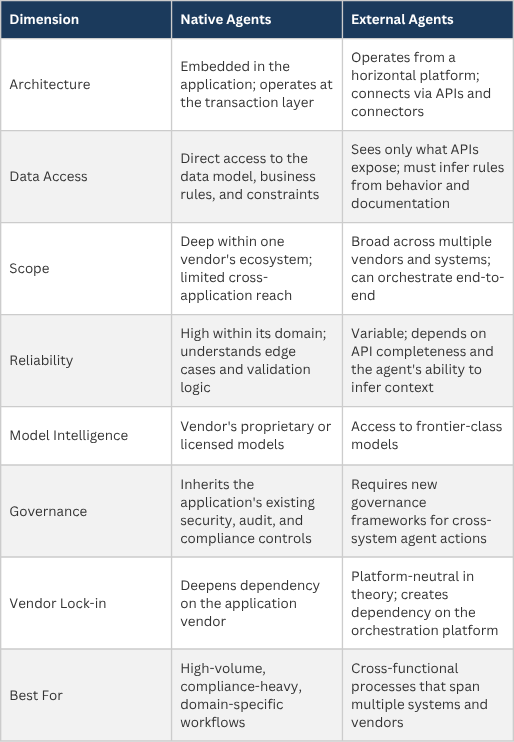
Native agents are built into enterprise applications by the application vendor. They operate at the transaction layer; directly inside the data model, the business logic, and the process engine. A native accounts payable agent does not interact with the ERP through an API. It lives inside the ERP. It has direct access to the validation rules, the approval chains, the GL mapping, the tax logic, and the exception handling that governs invoice processing.
This architectural proximity gives native agents several structural advantages. They understand the data model intimately; the relationships between entities, the constraints, the referential integrity rules. They know the business rules without having to infer them from documentation or API behavior. They can operate within the application's transaction boundaries, which means they participate in the same commit/rollback logic as any other operation.
Major enterprise vendors are investing heavily here. ERP vendors have embedded hundreds of AI agents across finance, supply chain, HR, and customer experience. CRM platforms are building agents that understand the full lifecycle of customer relationships. HCM suites are deploying agents that navigate the compliance-heavy world of human resources with embedded knowledge of labor laws, benefit structures, and organizational policies.
The limitation is scope. Native agents only work within their vendor's ecosystem. An ERP agent that brilliantly processes invoices cannot help with the CRM workflow that originated the sales order, or the procurement system that negotiated the vendor contract, or the banking integration that executes the payment. Each agent is deep within its domain but blind to everything outside it.
External Agents: Broad and Shallow
External agents operate from a horizontal platform, outside any specific enterprise application. They connect to applications through APIs, connectors, and integration layers. They can orchestrate workflows that span multiple systems from multiple vendors.
The most prominent example is OpenAI's Frontier platform, launched in February 2026, which positions itself as the orchestration layer for enterprise AI agents. But the pattern extends to other horizontal platforms building similar capabilities. The value proposition is clear: a single agent (or a team of agents) that can work across your entire technology stack rather than being confined to one vendor's applications.
External agents have their own structural advantages. They can see the full picture; orchestrating a process that touches CRM, ERP, HCM, and custom systems in a single workflow. They are vendor-neutral, at least in theory, which means they do not contribute to lock-in with any specific application vendor. And they benefit from the most capable AI models available, since horizontal platforms typically have access to frontier-class reasoning, although most native agents also allow connection to proprietary model or “bring you own” model including the frontier models, that is also vendor neutral. Bring your own model though, usually requires additional licenses which can impact both cost and ROI.
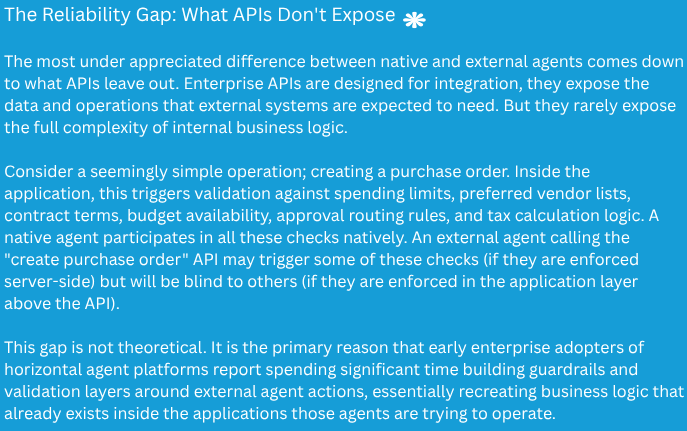
The limitation is depth. An external agent interacting with an ERP system through an API sees only what the API exposes. It does not have direct access to the validation rules, the business logic, or the transactional boundaries that native agents operate within. If the API does not expose a particular rule or constraint, the external agent does not know about it. This creates a reliability gap: the external agent may attempt actions that violate business rules it cannot see or miss edge cases that a native agent would handle automatically.
OpenAI itself has acknowledged a version of this challenge. As agents are deployed widely across the enterprise, system fragmentation becomes more visible because agents deployed in isolation lack the context they need to perform effectively. In extreme cases, every new agent adds complexity rather than reducing it.
Where Depth Wins
Native agents have a clear advantage in three scenarios:
High-Volume Transactional Processes
Invoice processing, payroll runs, inventory management, revenue recognition; these are high-volume processes with deep, complex business rules and strict compliance requirements. A native agent that processes 50,000 invoices per month inside the ERP understands every validation rule, every approval threshold, and every exception path. An external agent attempting the same task through an API would need to replicate all that logic externally, which is both technically difficult and operationally risky.
The math here is straightforward. For a process that runs thousands of times per day within a single system, the native agent's transaction-layer access translates directly into speed, accuracy, and auditability. The overhead of API-mediated access; the latency, the incomplete visibility into business rules, the need to handle errors that the native agent would never encounter; makes external agents a poor fit.
Regulated Workflows
In finance, healthcare, and government, agents need to operate within specific regulatory frameworks. A native HCM agent that manages benefits enrollment understands the compliance rules for ERISA, ACA, COBRA, and state-specific labor regulations because those rules are built into the application it inhabits. An external agent would need to acquire that regulatory knowledge independently and maintain it as regulations change, a significant ongoing burden.
More importantly, governance and auditability are simpler with native agents. The actions a native agent takes are logged within the application's existing audit trail, using the same compliance controls that human users are subject to. An external agent's actions create a separate audit trail that needs to be reconciled with the application's records, adding complexity to an already demanding compliance process.
Application-Specific Optimization
Some tasks are inherently application specific. Optimizing a supply chain planning run, generating a financial close package, or configuring a complex product quote all require deep knowledge of the application's specific data model and logic. These are not generic tasks that benefit from cross-system orchestration. They are specialist tasks that benefit from deep domain integration.
Where Breadth Wins
External agents have a clear advantage in three different scenarios:
Cross-Functional Business Processes
Most business processes that matter to the C-suite span multiple systems. Order-to-cash touches CRM, ERP, billing, and payments. Procure-to-pay spans procurement, accounts payable, vendor management, and banking. Hire-to-retire crosses recruiting, onboarding, HCM, payroll, and benefits. These end-to-end processes are where external agents excel, because no single native agent can see the entire workflow. (Although arguably many enterprise systems span much of the full workflow as well)
Consider a contract renegotiation. The process requires pulling financial data from the ERP, analyzing contract terms from the CLM system, benchmarking market rates from external data sources, updating the CRM with revised terms, and routing the revised contract for approval. No native agent; however deep within its application, can orchestrate all of these steps. An external agent operating from a horizontal platform can. It would require multiple native agents for the same workflow coverage, adding complexity and additional risk.
Multi-Vendor Environments
Large enterprises almost never run a single vendor's stack across every function. They run one vendor for ERP, another for CRM, a third for HCM, and a mix of specialized tools for everything else. In these environments, native agents create islands of automation: each application has its own smart agents, but they cannot coordinate across the vendor boundaries.
External agents are the natural integration layer for multi-vendor environments. They do not care which vendor built which system. They connect to all of them through APIs and orchestrate across the boundaries that native agents cannot cross.
Rapid Innovation and Experimentation
Horizontal AI platforms iterate on model capabilities faster than any application vendor can. When a new reasoning capability emerges; better code generation, improved multi-step planning, stronger tool use; external agents get access to it immediately. Native agents wait for the application vendor to integrate it, which can take quarters or years.
For enterprises that want to experiment with new AI capabilities quickly, external agents provide a faster path. They are not constrained by any vendor's release cycle or model integration timeline.
The Third Path: Native Agents with Open Interoperability
The depth-breadth trade-off creates an obvious question; is there a way to get both? Can you have agents that are deep within their applications but also capable of participating in cross-vendor orchestration?
Emerging interoperability protocols suggest this might be possible. As I discussed in the previous article in this series, A2A (Agent-to-Agent Protocol) and MCP (Model Context Protocol) are establishing the groundwork for agents from different platforms to communicate and collaborate. If native agents can expose their capabilities through standardized protocols and participate in cross-platform workflows, the depth-breadth trade-off becomes less binary.
Picture the scenario: a native ERP agent that deeply understands invoice processing and exposes that capability through a standardized Agent Card. An external orchestrating agent can discover it, delegate the invoice processing task, and coordinate the result with actions in other systems, all without the external agent needing to understand the ERP's internal business logic. The native agent handles depth. The external agent handles breadth. The protocol layer handles the handoff.
This third path is compelling, but it faces real challenges:
Incentive misalignment. Application vendors have a commercial interest in keeping agents within their ecosystem. Exposing native agent capabilities through open protocols makes it easier for orchestration platforms to commoditize the application layer. Vendors will need to find business models that reward openness rather than punish it.
Protocol maturity. As I covered in the previous article, current protocols handle message routing and basic capability discovery, but they do not yet solve intent resolution, contract negotiation, or conflict arbitration. Native agents exposing capabilities through A2A is only useful if the orchestration layer can intelligently decide when and how to invoke them.
Trust and governance. When a native agent executes a task delegated by an external orchestrator, who is responsible for the outcome? The application vendor whose agent performed the action? The platform that delegated it? The enterprise that deployed both? This accountability question is unresolved and will become increasingly urgent as agents take higher-stakes actions.
Performance overhead. Adding a protocol layer between the orchestrator and the native agent introduces latency. For high-volume transactional processes where native agents process thousands of operations per minute, even small amounts of protocol overhead can impact performance. The interoperability layer needs to be efficient enough that it does not negate the native agent's speed advantage.
Despite these challenges, the third path is where I expect the market to converge over the next two to three years. The depth-breadth trade-off is real, but it is not permanent. The vendors and platforms that figure out how to bridge it; combining native depth with open interoperability; will hold a significant competitive advantage.
How Enterprises Should Think About Their Agent Portfolio
Given the trade-offs, how should enterprise leaders approach the native vs. external question? Here is a framework:
Start with the process, not the technology. Map your highest-value business processes and categorize them: processes that live entirely within one application (use native agents), processes that span multiple systems (use external agents or the hybrid approach), and processes that require both deep domain logic and cross-system coordination (candidates for the third path). Let the process requirements drive the agent architecture, not the vendor pitch.
Do not treat this as either/or. Most enterprises will need both native and external agents. The question is not which model wins. It is which model fits which process. Build an agent portfolio the same way you build an application portfolio, with clear criteria for when each approach is appropriate.
Demand interoperability from your vendors. Every time you deploy a native agent, ask your vendor; how does this agent participate in cross-platform workflows? Does it support A2A or MCP? Can an external orchestrator discover and invoke its capabilities? If the answer is "it only works within our platform," you are building a new generation of integration silos.
Invest in the orchestration layer. Whether you use an external agent platform or build your own, the orchestration layer is where multi-agent coordination happens. As I discussed in the previous article, the Agent Service Bus; handling capability discovery, intent resolution, conflict arbitration, and contract negotiation; is the infrastructure that makes a mixed agent portfolio work. Without it, native and external agents operate in parallel but never truly collaborate.
Plan for governance from day one. Native agents inherit existing application governance. External agents need new governance frameworks. A mixed portfolio needs both, plus a way to maintain a unified audit trail across agent types. The governance overhead of a mixed agent environment is non-trivial, and it grows with every agent you add. This is a topic I will address in depth in a future article in this series.
The native vs. external agent debate is often framed as a competition, which model wins? That framing misses the point. Both models exist because they solve different problems. The real strategic question is not which one to choose. It is how to build an agent architecture that gets the benefits of both while managing the complexity of neither.
The enterprises that figure this out will have agents that are deep where depth matters and broad where breadth matters. The ones that bet on a single model, all native or all external, will find themselves either locked into one vendor's ecosystem or operating with agents that lack the domain depth to be reliable in production.
The future enterprise will run on both. The architecture that connects them is what matters most.
Next in the series: "Agentic Identity: The Missing Layer in Enterprise AI Architecture" - examining why portable, verifiable identity for AI agents is the architectural prerequisite that most vendors are neglecting, and why cross-organizational collaboration makes it non-negotiable.