The Operating Model as Competitive Differentiator
Part 6 of the series "The AI Operating Model Gap"
Why the Next Three Years Will Be Won by Organizations That Change How They Work, Not What Tools They Use
The Six Percent
A global consumer goods company and a global bank both deployed AI agents across their operations in 2025. Both had access to the same frontier models, the same cloud infrastructure, the same agent frameworks. By mid-2026, the bank was projecting 150% ROI over five years, automating 30 to 50% of manual work and freeing millions of hours for higher-value activities. The consumer goods company had a collection of disconnected pilots, modest productivity gains in individual functions, and no measurable impact on its P&L.
The difference was not technology. The difference was that the bank redesigned its operating model: workflows were rebuilt end to end, decision rights were explicitly defined, roles were restructured around human-agent collaboration, and governance was embedded in the architecture rather than applied as an afterthought. The consumer goods company deployed AI into its existing operating model and hoped for transformation. It got optimization instead.
This pattern shows up consistently in the data. BCG's 2026 research finds that only about 6 % of companies are capturing meaningful financial value from AI at scale. Those companies, the AI leaders, deliver three times greater cost reduction, 2.7 times the return on invested capital, and industry-adjusted three-year total shareholder returns of +9.3%, compared to -1.7% for laggards. The performance gap is not a technology gap. It is an operating model gap.
McKinsey's 2026 State of AI survey tells the same story. Adoption is broad: 54 % of large organizations report enterprise-wide AI scaling. But the share reporting that AI contributes meaningfully to EBIT has barely moved, stuck at 37%. Only 6% say AI generates at least 5% of EBIT. Meanwhile, 60% of companies report minimal or no financial value from AI despite significant investment. The technology is everywhere. The returns are not.
The gap between deployment and value is the central strategic challenge of the AI era. Every article in this series has examined a different dimension of this gap: workflow architecture, decision rights, roles and teams, organizational design, and governance. This final article brings those dimensions together and makes the competitive case. The operating model is the hardest thing for a competitor to copy. It is also the primary source of sustainable advantage in a world where AI technology itself is a commodity.
Why Technology Parity Does Not Produce Performance Parity
Every enterprise has access to the same frontier models. GPT-4o, Claude, Gemini, Llama: the technology is available to anyone with a cloud account and a budget. The same agent frameworks, the same orchestration tools, the same integration platforms. AI has commoditized faster than any enterprise technology in history.
This is precisely why the operating model is the differentiator. When the technology is the same, the variable is how the organization uses it. And "how the organization uses it" is the operating model: the workflow architecture, the decision rights, the organizational design, the role structures, the governance mechanisms, and the performance measurement systems that determine whether AI creates enterprise value or remains a collection of disconnected tools.
BCG's research puts a number on this. Their analysis attributes roughly 10% of AI value to algorithms, 20% to technology and data, and 70% to people, process, and behavior change. The 70% is the operating model. Without it, AI remains an overlay on top of structures designed for a different era.
McKinsey's 2026 State of Organizations report reaches the same conclusion from a different direction. Their finding is that most current AI efforts focus on fragmented use cases that augment individual contributors. The organizations generating value have moved beyond fragmentation to embed agentic AI in end-to-end workflows across functions. Among high performers, 74% have redesigned workflows around AI, compared to roughly 25% of other organizations. The gap between those two groups is where the competitive divide opens.
The Compounding Effect
The operating model advantage compounds. This is the mechanism that makes it so difficult to catch up once a competitor pulls ahead.
Organizations that redesign workflows produce better operational data as a byproduct. Better data trains more effective agents. More effective agents enable more sophisticated workflows, which in turn produce even better data. Each cycle builds on the last. The Dual Maturity Framework, described in a separate Arion Research article, captures this dynamic: organizations at Level 3 (Systemic) organizational maturity can safely deploy Level 3 (Conditional Autonomy) agents, which produce better outcomes, which build organizational confidence, which justifies further investment in maturity. Organizations stuck at Level 1 (Ad Hoc) are locked out of this virtuous cycle entirely.
The compounding effect shows up in the financial data. BCG's 2026 research finds that companies taking a "reshape" approach to AI transformation, redesigning functions and operating models rather than layering AI onto existing processes, achieve three to four times higher ROI than those pursuing isolated use cases. A separate BCG analysis of software companies estimates that redesigning R&D and go-to-market functions around AI could yield approximately 20 points of EBITDA improvement, but only with full operating model change management.
IBM's 2026 CEO study reinforces the compounding thesis from a different angle. 83% of executives say AI success depends more on people's adoption than on the technology itself, yet only 25% of the workforce uses AI regularly. The organizations closing that gap, building AI fluency into every role rather than concentrating it in a technical function, are the ones whose agents improve fastest, because more people are training them, supervising them, and refining the workflows they operate in. The adoption gap is part of the compounding cycle: wider adoption produces better agents, which produce better outcomes, which drives further adoption.
The time dimension makes this urgent. Operating model transformation takes 18 to 36 months to execute at scale. Organizations that start now will be two to three years ahead of those that wait. Given the compounding effects, the gap will be very difficult to close once it opens. Every quarter of delay widens the distance.
Roland Berger's 2026 study of 472 executives confirms the urgency and the hesitation. Sixty-two percent of respondents expect major or radical operating model changes from AI transformation, yet only 38% have begun to act. The majority recognize what needs to happen but have not started. The window for building a lead is open now. It will not stay open indefinitely.
The Six Elements of the AI-Native Operating Model
This series has examined the operating model gap across five dimensions. This final article synthesizes them into an integrated framework: the six elements of the AI-native operating model.
Element 1: AI-Native Workflow Architecture. Article 2 of this series established that AI value comes from redesigning workflows, not from inserting AI tools into existing processes. The workflow architecture defines which tasks are human, which are agent, how work products move between them, and where quality checkpoints sit. Organizations that redesign workflows capture the full value. Organizations that automate existing workflows capture a fraction.
Element 2: Explicit Decision Rights and Authority Structures. Article 3 introduced the decision authority framework: Tier 1 (agent acts freely within defined parameters), Tier 2 (AI recommends, human decides), and Tier 3 (human only). Explicit decision rights are what make agent autonomy safe and scalable. Without them, organizations either constrain agents so tightly that they add little value or grant them so much latitude that incidents force a pullback.
Element 3: Redesigned Roles and Hybrid Team Models. Article 4 addressed the workforce dimension: the shift from specialist execution to cross-functional judgment, the emerging role categories (AI trainers, agent supervisors, workflow architects), and the three team composition models (augmented, hybrid, agent-led). The organizations generating value have deliberately redesigned roles around human-agent collaboration, not waited for roles to evolve on their own.
Element 4: Cross-Functional Organizational Design. Article 5 showed that AI's economic potential concentrates at the intersections between functions, not within them. Cross-functional organizational design, typically a hub-and-spoke model with centralized governance and distributed execution, is what enables AI workflows to cross the boundaries that functional silos create. Without organizational redesign, agents remain trapped inside functions, delivering point solutions instead of enterprise value.
Element 5: Embedded Proportional Governance. Governance is not a compliance overlay. It is infrastructure built into the operating model's architecture. Proportional governance matches governance intensity to the autonomy level and risk profile of each workflow: lighter governance for low-risk, bounded agent tasks; heavier governance for high-autonomy, high-impact decisions. The three-level governance structure (enterprise, business unit, workflow) distributes accountability rather than concentrating it in a single compliance function.
Element 6: Outcome-Based Performance Measurement. The traditional performance metrics (cost per transaction, headcount productivity, cycle time) were designed for a human-only workforce. An AI-native operating model requires metrics that account for human-agent value creation: the quality of decisions made with AI input, the speed and accuracy of cross-functional workflows, the rate at which new AI capabilities are safely deployed, and the business outcomes (revenue, margin, customer satisfaction, speed to market) that the integrated system produces. Measurement is what closes the loop. Without it, the organization cannot distinguish between AI that is adding value and AI that is adding complexity.
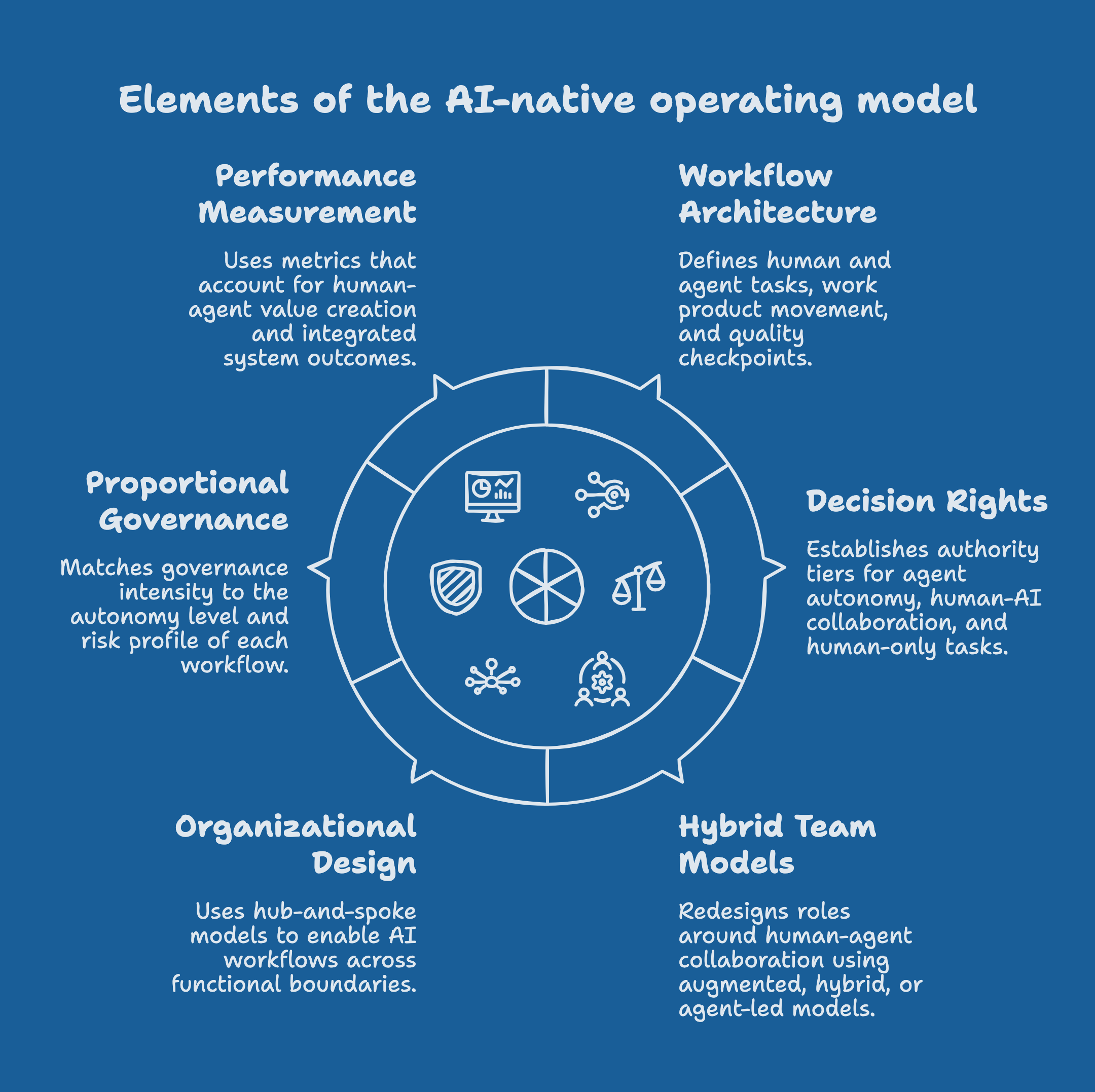
AI-Native Operating Model
These six elements are interdependent. Workflow architecture without decision rights is ungovernable. Decision rights without organizational design are unenforceable across functions. Organizational design without role redesign leaves people doing old work in new structures. Governance without measurement is unaccountable. The weakest element constrains the value of all the others.
IBM's 2026 research provides direct evidence for this interdependence. Organizations that redesigned five core business areas, rather than addressing them in isolation, are four times more likely to have delivered on their AI objectives. The multiplier is not additive. Each additional dimension of change amplifies the value of the others. This is why point solutions, an AI tool here, a workflow redesign there, produce so little enterprise value. The operating model is a system. It works as a system or it does not work at all.
The Dual Maturity Framework, described in a separate Arion Research article, provides the assessment model. Organizations at Level 1 (Ad Hoc) can safely deploy only Level 1 (Assisted) agents. Organizations at Level 3 (Systemic) can deploy Level 3 (Conditional Autonomy) agents across functions. The maturity levels are not arbitrary. They are defined by the presence or absence of the six elements described above: an organization cannot operate at Level 3 without explicit decision rights, proportional governance, and cross-functional data architecture. The maturity assessment tells an organization where it stands, which elements are weakest, and where to invest next.
The CEO Mandate
Operating model transformation is not a CIO initiative. It is not a Chief AI Officer initiative. It is a CEO initiative that requires coordinated change across every function in the organization.
IBM's 2026 study of 2,000 CEOs and senior leaders underscores the shift. Organizations that redesigned five core business areas (technology, finance, HR, operations, and cross-functional collaboration) are four times more likely to have delivered on their AI business objectives. 76% of surveyed organizations now have a Chief AI Officer, up from 26% in 2025. But the presence of a CAIO is not the differentiator. What matters is whether AI accountability extends across the entire C-suite. 85% of respondents say all functional leaders must become technology experts in their domain. AI is no longer something the technology function does for the rest of the organization. It is something every function must own.
BCG's 2026 AI Radar confirms the CEO-level shift. Corporate AI spending as a share of revenue has roughly doubled, and more than 80% of that spend now sits outside the traditional IT budget. The governance of AI has moved from technology leadership to chief executives. Eighty-two percent of CEOs are more optimistic about AI ROI, but the optimism runs ahead of the evidence for most organizations. The 6% generating real value have CEO sponsorship, cross-functional governance, and investment allocation that treats organizational change as equal in importance to technology investment.
The cross-functional dimension is critical. 79% of executives surveyed by IBM say they are decentralizing decision-making, distributing accountability as AI plays a bigger role enterprise-wide. This is not delegation. It is redesign: moving from a model where the CIO owns AI to a model where the CEO sets the strategy, the CAIO provides technical leadership, and every functional leader is accountable for AI adoption and value creation within their domain.
Roland Berger's research supports this from the investment side. Their 2026 study found that enabler-driven operating models, where AI governance, data, and talent are treated as enterprise-wide capabilities rather than function-specific resources, consistently outperform in ROI. The enabler model mirrors what BCG calls the "reshape" approach: transformation that spans the entire organization rather than optimizing within individual functions. Both studies reach the same conclusion. AI value at scale requires CEO-level coordination across every dimension of the operating model.
The Three-Year Window
The competitive implications are clear. The organizations that redesign their operating models now will compound their advantages over the next three years. The organizations that wait will face a gap that widens with every quarter.
The evidence for this window is consistent across sources. McKinsey finds that 72% of leaders say their organizations are not fully ready to face upcoming changes. Only 38% of executives who expect radical operating model changes have begun acting on them. CEOs project that by 2030, 48% of operational decisions where consistency and guardrails can be codified will be made by AI without human intervention, up from 25% today. The trajectory is set. The question is whether your organization will shape it or be shaped by it.
Gartner's projection that more than 40% of agentic AI projects will be canceled by the end of 2027 is a warning about what happens without operating model readiness. The projects that get canceled will not fail because the AI did not work. They will fail because the organization did not change. Escalating costs, unclear business value, and inadequate risk controls: these are operating model failures, not technology failures. OneTrust's 2026 research found that 86 % of organizations have already experienced an AI-related incident, yet only 27% slowed deployment in response. The incidents are a signal. Organizations without embedded governance are absorbing risk they have not priced and cannot sustain.
The human-in-the-lead principle, emphasized throughout this series, is what separates sustainable AI deployment from reckless acceleration. The organizations in the top 6% are not moving slowly. They are moving deliberately: building the decision authority structures, governance mechanisms, and human oversight systems that allow them to increase agent autonomy safely over time. Speed without operating model readiness produces the cancellations Gartner projects. Speed with operating model readiness produces the compounding advantages BCG documents.
The organizations in the top 6% are not there because they bought better technology. They are there because they invested equally in the 70% that most organizations neglect: the people, the processes, the governance, the organizational structures, and the performance systems that turn AI capability into business results.
The operating model gap is the defining strategic challenge of the AI era. Closing it is not a technology project. It is an organizational transformation. And the organizations that treat it as such will own the competitive high ground for the decade ahead.
Strategy Playbook
1. Operating Model Maturity Score. Using the six elements from this article, assess your organization on each dimension (1-4 scale aligned with the Dual Maturity Framework). Calculate the average and identify the weakest dimension. The weakest dimension constrains the value of all the others. An organization with strong workflow architecture but weak governance will hit a ceiling when agent incidents force a pullback. An organization with strong governance but fragmented organizational design will have well-governed agents that cannot cross functional boundaries. Start with the constraint.
2. Competitive Operating Model Benchmark. Compare your operating model maturity against the best available benchmarks for your industry. If your competitors are at Level 2 and you are at Level 1, the competitive gap is already opening. If you are at Level 3 and they are at Level 2, you have a compounding advantage to protect. The BCG data suggests that the top 6% are pulling away. Knowing where you stand relative to that group is the first strategic question.
3. 18-Month Transformation Roadmap. Build a phased plan that sequences operating model changes across the six elements. Start with workflow architecture (Article 2) and decision rights (Article 3), which produce visible results fastest and build organizational confidence. Follow with role redesign (Article 4) and organizational structure (Article 5), which require more change management and political capital. Embed governance throughout, not as a final phase. Governance retrofitted after incidents is expensive and destroys organizational trust in AI. Performance measurement (Element 6) runs in parallel, evolving as the other elements mature.
4. CEO-Level Operating Model Review. Establish a quarterly CEO-level review of operating model transformation progress. This is not an IT governance meeting. It is a business strategy review that tracks: workflows redesigned, decision rights redefined, roles transformed, cross-functional barriers removed, governance embedded, and business outcomes achieved. The review should carry the same strategic weight as a quarterly business review. The organizations in the top 6% treat operating model transformation as a CEO-level priority. The organizations in the bottom 60% treat it as a technology initiative. The difference in outcomes is the difference between +9.3% and -1.7% in total shareholder returns.
Arion Research advises enterprise leaders on AI strategy and the shift to a digital workforce.