
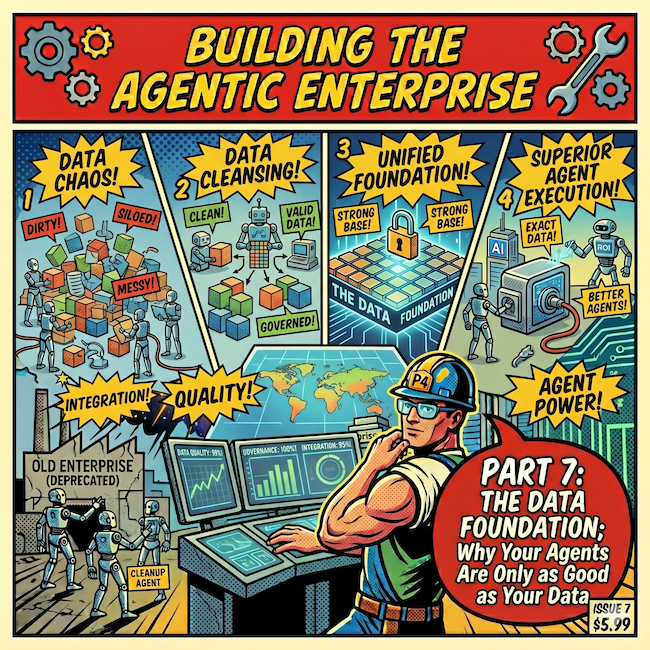
Building the Agentic Enterprise, Part 7: The Data Foundation; Why Your Agents Are Only as Good as Your Data
Agents are only as good as the data they can access and reason over, and for most organizations, the data is not ready. In Part 7 of the Building the Agentic Enterprise series, we confront the most common and most underestimated barrier to agentic AI deployment: data readiness. Only seven percent of enterprises consider their data completely ready for AI, and data quality as a reported barrier nearly doubled over the course of 2025 as organizations moved from simple experiments to multi-agent workflows. We break data readiness into five interconnected dimensions -- quality, accessibility, architecture, knowledge management, and context management -- and explore why agents amplify data problems that human-mediated processes have long papered over. The article also covers data governance for agentic access, the real-time versus batch data freshness decision, and practical guidance for assessing where your data foundation stands today.

The Impact of Bad Data on Modern AI Projects (and How to Fix It)
The enterprise AI conversation has been dominated by models. Which LLM should we license? Should we fine-tune or use RAG? What about open-source versus proprietary? These are the wrong questions to start with.
The AI boom is exposing a truth that data teams have known for years: most organizations are building on a foundation of poor-quality data. Decades of neglected data strategy are now coming due. The models are powerful, but they're only as reliable as what they're trained on and what they retrieve.

The Pillars of Data Quality: What Every Agentic AI System Needs to Succeed
The enterprise agentic AI revolution is here, but there's a catch. While organizations rush to deploy autonomous agents capable of making complex decisions without human oversight, many are building these sophisticated systems on shaky ground. The critical foundation that determines whether agentic AI succeeds or fails isn't the algorithm sophistication or computational power. It's data quality.
Why Trust in Data Matters: Building Business Confidence with Reliable AI
In boardrooms across industries, executives are grappling with a modern paradox. AI promises enhanced business insights and competitive advantages, yet its power hinges entirely on something most leaders rarely see: the quality of data flowing through their systems. As artificial intelligence becomes the backbone of strategic decision-making, the old adage "garbage in, garbage out" has never carried higher stakes. This isn't merely a technical concern relegated to IT departments. Trust in data has become a critical business confidence driver, determining whether organizations can harness AI's potential or fall victim to its blind spots.