The "Agent Orchestrator": The New Middle Manager Role of 2026
The Empty Desk and the Humming Server
The dominant narrative around AI in the enterprise has been one of subtraction: fewer headcounts, leaner teams, entire departments rendered obsolete. It makes for compelling headlines, but it misses the point. The real story unfolding in 2026 is far more interesting than simple displacement. It is a story of structural evolution, of org charts being redrawn not because roles are vanishing, but because entirely new ones are emerging to meet demands that didn't exist two years ago.
The catalyst is a shift that has been building for years but is now impossible to ignore. We are moving from "Software as a Service" to "Service as a Software," a world where intelligent agents don't just support workflows but actively execute them. And this shift demands a new leadership layer, one that sits at the intersection of strategy, technology, and operational judgment.
Enter the Agent Orchestrator: the professional who doesn't manage people, but manages the synthetic talent that supports them. This is not an IT role dressed up with a new title. It is a genuine middle-management function, requiring the same blend of oversight, accountability, and decision-making that has always defined effective leadership, only now applied to a workforce that runs on tokens instead of timesheets.
If that sounds like a stretch, consider the trajectory. Five years ago, "prompt engineer" wasn't a job title. Three years ago, most enterprises treated AI as a feature inside existing software. Today, autonomous agents are negotiating vendor contracts, triaging customer support queues, and generating first drafts of regulatory filings. The complexity of coordinating this synthetic workforce has outpaced the ability of any single department to absorb it. Someone has to own it. That someone is the Orchestrator.
Hiring the Synthetic Workforce: The New Onboarding
Think about what it takes to bring a new employee into your organization. There's credentialing, orientation, role definition, access provisioning, and a probationary period where performance is closely monitored. Now consider that deploying an AI agent follows a remarkably similar arc, just compressed and made more technical. The parallel is not a metaphor. It is an operational reality that the best-run organizations are already treating with the seriousness it deserves.
Provisioning over interviewing. "Hiring" an agent is not the same as subscribing to a SaaS platform. It requires deliberate architectural choices: which APIs does this agent connect to? What data can it access? What actions is it authorized to take? The Orchestrator must define these boundaries with the same rigor a hiring manager applies to a job description, because a poorly scoped agent is just as costly as a poorly scoped hire.
The probationary period. Every new agent deployment should begin with a "Human-in-the-Loop" phase. During this window, the Orchestrator monitors outputs, corrects drift, and fine-tunes the agent's behavior. This is not a set-it-and-forget-it exercise. It is active management, requiring pattern recognition, contextual judgment, and a willingness to intervene when the agent's outputs miss the mark.
Guardrails as policy. The best Orchestrators think about agent permissions the way compliance teams think about corporate policy. They establish clear "Rules of Engagement" that govern what an agent can and cannot do autonomously. For example: "You can draft the invoice, but you cannot send it without my approval." These guardrails protect the organization while still allowing the agent to operate at speed. And unlike traditional policy documents that collect dust in a shared drive, these rules are encoded directly into the agent's operating logic. They are living constraints, enforced in real time.
The Performance Review: Managerial Metrics for Bots
Managing synthetic workers requires a new vocabulary for performance. The annual review, the 360-degree feedback cycle, the subjective assessment of "culture fit": none of it translates. Traditional evaluations built around soft skills, collaboration, and interpersonal dynamics don't apply here. In their place, the Agent Orchestrator works with hard data, observable logs, and measurable outcomes. And frankly, this clarity is one of the advantages of managing agents over managing people.
Three KPIs are emerging as essential:
Hallucination rate. Accuracy is non-negotiable, but it often exists in tension with speed. The Orchestrator must calibrate this tradeoff for each use case. A research summarization agent can tolerate more creative latitude than one generating financial disclosures. Knowing where to set that dial is a judgment call, and it is one of the most consequential decisions an Orchestrator makes.
Token efficiency. Compute costs are the new payroll. Every API call, every prompt, every chain-of-thought loop carries a price tag. An effective Orchestrator manages this "salary" with the same discipline a CFO applies to headcount budgeting, finding the balance between capability and cost.
Goal completion rate. Does the agent actually finish the task, or does it loop, stall, or produce partial outputs that require human cleanup? This metric cuts to the heart of whether an agent is delivering value or simply creating a new form of busywork.
The path to “Human-in-the-Lead”. And then there is the question of promotion. When an agent consistently demonstrates reliability, accuracy, and efficiency, it earns expanded autonomy: deeper access to sensitive data, authority to execute more complex workflows, fewer checkpoints. The Orchestrator controls this progression, ensuring that trust is earned incrementally, never assumed. This is the same principle any good manager applies to a high-performing team member: prove yourself in the small things, and you earn the right to handle the big ones. The difference is that with agents, this trust ladder can be precisely quantified, logged, and audited.
Synthetic EQ: Ensuring Agents "Play Nice"
Perhaps the most underestimated dimension of the Orchestrator role is what we might call synthetic emotional intelligence: ensuring that AI agents operate in ways that feel natural, respectful, and appropriate within the human systems they inhabit.
The core responsibility here is serving as a human-centric filter. An Orchestrator's job is to make sure that AI doesn't create "digital noise," the kind of unnecessary interruptions, tone-deaf communications, and context-blind actions that erode trust faster than any technical failure.
Contextual awareness is critical. A customer service agent that pings a human representative during a high-stakes board meeting is not just unhelpful; it is actively disruptive. Training agents on when to act, when to wait, and when to escalate requires the Orchestrator to encode situational logic that goes well beyond simple rule sets.
Tone management matters more than most technologists realize. An agent's communication style must match the specific culture of the organization it serves. A legal firm's internal communication agent should not sound like a startup's Slack bot. The Orchestrator ensures that every interaction an agent has, whether with employees, customers, or partners, reflects the company's values and norms.
This dimension of the role may be the hardest to get right, because it requires something machines still lack: genuine social intuition. The Orchestrator bridges that gap, translating the unwritten rules of organizational culture into behavioral parameters that agents can follow. It is part management, part anthropology, and entirely essential.
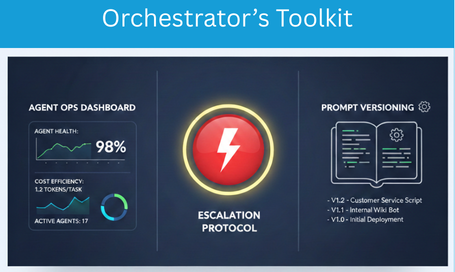
Created with Google Nano Bana Pro and Canva
Why This Matters
The rise of the Agent Orchestrator is not an abstract prediction. It is already happening in organizations that are serious about deploying AI at scale. And it carries a message that should resonate with every executive planning their workforce strategy: the competitive advantage of the next few years will not come from having the most agents. It will come from having the best orchestrators.
This is the idea at the center of what we've been calling "Building the Digital Workforce." The phrase is intentional. A workforce, whether human, synthetic, or hybrid, requires structure, leadership, and governance. The technology alone is not enough. Without the human layer of orchestration, even the most sophisticated agents will underperform, misfire, or quietly erode the trust your organization has spent years building.
This is the lens through which we approach the digital workforce. Just deploying intelligent agents is only part of the transformation. Successful companies build the frameworks, the governance structures, and the leadership capabilities required to manage those agents effectively. Because the technology is only as good as the human judgment directing it.
The companies that will thrive in this new landscape are the ones that recognize a simple truth: AI agents are powerful tools, but they are not self-managing. They need oversight, calibration, and strategic direction. They need, in a word, orchestration.
The most successful organizations of 2026 won't be defined by the size of their agent fleet. They will be defined by the quality of the people directing it. The Agent Orchestrator is not a future role waiting to be invented. It is a present-tense necessity for any enterprise serious about turning AI potential into business results.