Enterprise AI Is a System, Not a Model
The Chatbot Fallacy
Many enterprise leaders are making a costly category error. They're confusing access to intelligence with operational AI.
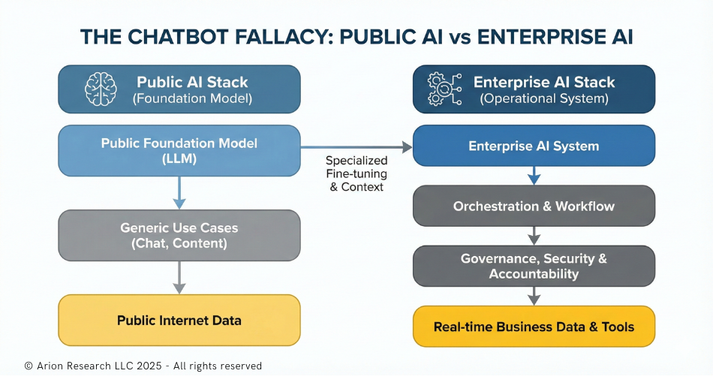
The distinction matters because public chatbots and foundation models are optimized for one set of outcomes while enterprise AI requires something entirely different. ChatGPT, Claude, and Gemini excel at general reasoning, conversational fluency, and handling broad, non-contextual tasks. They're designed to answer questions, generate content, and provide insights across virtually any domain.
Enterprise AI operates in a different universe. It must execute inside real workflows, maintain accountability and governance at every step, and deliver repeatable business outcomes. The goal isn't to answer questions. It's to orchestrate work.
This isn't a matter of degree. It's a difference in kind. And until enterprise leaders recognize this distinction, they'll continue investing in AI capabilities that deliver impressive demos but fail to transform operations.
Public AI vs. Enterprise AI: A Category Difference
This isn't a "better model" story. It's a system design story.
Consider how these two categories differ across critical dimensions. Public chatbots and foundation models present a chat UI as the primary interface. Enterprise AI embeds itself in workflows, applications, and processes. Public AI operates on prompt-based, ephemeral context. Enterprise AI maintains persistent awareness of roles, policies, and organizational state.
The data access patterns tell the same story. Public AI relies on user-provided information or generic training data. Enterprise AI connects to governed systems with carefully controlled permissions. Accountability sits with individual users in the public model. In enterprise deployments, the organization takes responsibility for AI actions.
Most importantly, the outcomes diverge completely. Public AI delivers insight. Enterprise AI drives action, automation, and execution.
Embedded AI: Where Enterprise Value Actually Emerges
The real value in enterprise AI doesn't come from "AI in a tab." It emerges from AI inside the app.
Embedded AI operates where work actually happens: in CRM, ERP, HCM, ITSM, customer experience platforms, finance systems, and supply chain management. It functions at the point of decision and action, not in a separate interface that requires context-switching and manual translation.
This positioning creates distinct advantages. Embedded AI has native access to domain semantics. It understands what "opportunity stage" means in Salesforce, what "requisition approval" means in Workday, and what "incident severity" means in ServiceNow. It maintains real-time awareness of process state, knowing where each workflow stands and what actions are permissible at each step. Perhaps most critically, it collapses the distance between insight and action, eliminating the friction that kills most AI initiatives.
Enterprise software vendors understand this shift. They're repositioning their applications as AI execution environments, not just systems with AI features bolted on.
AI Platforms, Not Just AI Features
The next wave of enterprise AI isn't about features. It's about platforms that enable business users to become AI operators.
Enterprise AI platforms provide workflow-aware orchestration, agent builders and templates, and comprehensive connectors to tools, APIs, and enterprise systems. This architecture allows business users to design and deploy AI capabilities without writing code, while IT retains the guardrails and governance necessary for enterprise operations.
The contrast with public AI clarifies the value. Public AI requires prompt engineering, producing one-off outputs that must be manually integrated into business processes. Enterprise platforms enable process design, creating reusable capabilities that execute automatically within existing workflows.
When a sales operations manager can build an AI agent that qualifies leads, updates CRM records, and triggers follow-up sequences without involving IT, that's not an incremental improvement. It's a shift in who can operationalize intelligence.
Governance by Design
Here's the differentiator most buyers underestimate: governance isn't something you add to enterprise AI after the fact. It's an architectural feature.
Enterprise AI must be auditable, explainable, and policy-aware from the ground up. This requirement isn't about compliance theater. It's about operational trust. Governance gets embedded at the data access layer, in action permissions, and through decision thresholds that determine when AI can execute autonomously versus when it must escalate to human judgment.
Public AI takes a different approach. It relies on user discretion, terms of service agreements, and post-hoc monitoring. Users decide what data to share, what outputs to trust, and what actions to take based on AI recommendations. The platform provider monitors for abuse but can't enforce organizational policies it doesn't know about.
Enterprise AI inverts this model. Policies are encoded into the system. Access controls are enforced at runtime. Audit trails are generated automatically. The AI can't violate rules it doesn't have permission to break.
This isn't bureaucracy. It's the foundation that makes autonomous AI possible in regulated, high-stakes environments.
Agentic AI: From Assistants to Coordinated Digital Workers
Organizations are moving beyond single-agent chat experiences because business processes require coordination, not just conversation.
Enterprise agents differ from public AI agents in three critical ways. They're task-specialized rather than generalist, optimized for specific business functions like accounts payable processing or incident triage. They operate in teams and hierarchies, with clear roles and handoff protocols. And they're constrained by policies, KPIs, and escalation rules that govern their decision-making authority.
Embedded orchestration enables multi-agent workflows where different agents handle different process steps, conflict resolution when agents make competing recommendations, and escalation to humans when situations exceed defined parameters. A procurement workflow might involve one agent validating vendor credentials, another negotiating terms within approved parameters, and a third routing exceptions to category managers.
Public agents can't support this pattern. They lack persistent identity across sessions, operate without accountability chains, and have no shared operational memory. They're designed for individual users, not organizational workflows.
The Hybrid Workforce: Digital and Human Workers Operating Together
The shift to agentic AI introduces a profound organizational change: organizations no longer manage just human workers. They're managing a hybrid workforce where digital workers and human workers collaborate on shared outcomes.
This isn't a distant future scenario. It's happening now in accounts payable departments where AI agents process standard invoices while humans handle exceptions. It's visible in customer service operations where digital workers resolve routine inquiries while human agents manage complex cases and relationship issues. It's emerging in software development teams where AI agents handle code reviews, testing, and deployment while human developers focus on architecture and product decisions.
The hybrid workforce requires new management paradigms. HR systems need to track both human headcount and digital worker capacity. Workforce planning must account for work that can be redistributed to AI agents, work that requires human judgment, and work that benefits from human-AI collaboration. Performance management shifts from measuring individual productivity to measuring team outcomes where teams include both types of workers.
Most critically, the hybrid workforce changes how organizations think about talent strategy. The question isn't "Should we hire more people or deploy more AI?" It's "What's the optimal mix of human expertise and digital execution for each business function?" A finance organization might maintain specialized human talent for complex financial modeling while deploying digital workers to handle month-end close processes. A legal department might keep senior attorneys for strategic counsel while using AI agents for contract review and compliance monitoring.
This model challenges the replacement narrative that dominates public discourse about AI. Enterprises aren't choosing between humans or AI. They're designing operations that leverage the strengths of both. Humans bring creativity, contextual judgment, relationship skills, and the ability to handle novel situations. Digital workers bring tireless execution, perfect recall, instant scalability, and consistent application of learned patterns.
The organizations that master hybrid workforce management won't be the ones that deploy the most AI. They'll be the ones that most effectively orchestrate collaboration between digital and human workers.
The Collaboration Layer as Enterprise AI Operating System
Something unexpected is happening in enterprise AI architecture. The collaboration layer is becoming the operating system for digital work.
Platforms like Slack, Microsoft Teams, and other collaboration tools weren't designed as AI orchestration environments. They were built for human communication. But they possess three attributes that make them ideal control planes for enterprise AI: they already contain the organizational graph showing who works with whom, they maintain permission structures that govern access to information and systems, and they sit at the center of workflows where humans coordinate work across applications.
This positioning is creating a new pattern. Instead of accessing AI through separate interfaces or embedded features in disconnected applications, enterprises are deploying AI agents directly into collaboration environments. A finance team's Slack channel becomes the interface for interacting with procurement agents, approval workflows, and budget tracking systems. A customer success team's Teams workspace becomes the coordination point for AI agents that monitor customer health scores, identify expansion opportunities, and draft renewal proposals.
The advantages extend beyond convenience. Collaboration platforms provide persistent context that spans multiple workflows and applications. When an AI agent operates in a Slack channel, it can see the full conversation history, understand the relationships between team members, and access the same shared files and integrations that humans use. This eliminates the context loss that happens when humans must brief AI tools on background information before each interaction.
More importantly, collaboration platforms create a unified surface for hybrid workforce coordination. Humans and digital workers participate in the same channels, respond to the same threads, and contribute to the same projects. A supply chain channel might include human logistics managers, a digital worker that monitors shipment status, another that predicts delivery delays, and a third that automatically rebooks affected shipments. The humans see all digital worker actions, can override decisions, and can step in when situations require judgment.
This pattern is transforming how enterprises think about AI deployment. Instead of asking "Which applications should have AI features?" they're asking "Which workflows benefit from having digital workers as team members?" The collaboration layer provides the answer because it already maps to how work actually flows through the organization.
Vendors are responding to this shift. Enterprise collaboration platforms are evolving from passive communication tools into active orchestration environments. They're adding agent development frameworks, workflow builders, and integration hubs that position them as the coordination layer for both human and digital work.
The strategic implication: the collaboration layer isn't just one channel for accessing enterprise AI. For many workflows, it's becoming the primary interface where humans design, deploy, monitor, and collaborate with digital workers.
MCP, APIs, and Enterprise Integration Gravity
Interoperability defines real enterprise AI maturity.
Enterprise AI exists within an integration mesh that includes Model Context Protocol and agent-to-agent communication standards, APIs for data exchange and action execution, event streams that trigger AI responses, and identity, security, and access control layers that span all connected systems.
Public AI treats integrations as optional add-ons that users can configure if needed. These connections are often fragile, one-directional, and vulnerable to breaking when either the AI service or the connected app changes its interface.
Enterprise AI is event-driven by design. It responds to business events in real time. It's system-aware, understanding dependencies and state across multiple applications. And it's architected for change, with abstractions that allow swapping underlying models or adding new capabilities without breaking existing workflows.
The strength of enterprise AI isn't in having more integrations. It's in having deeper, more resilient integration patterns that can support mission-critical operations. When a digital worker in the collaboration layer needs to update a CRM record, approve a purchase order, and notify a customer, those actions must execute reliably across multiple systems with proper error handling, rollback capabilities, and audit logging.
Foundation Models Are Necessary but Not Sufficient
Models are commodities. Systems are differentiators.
Enterprises rarely interact with foundation models directly. They consume model capabilities through platforms that provide guardrails, domain abstractions, and operational controls. A procurement agent doesn't call GPT-4 or Claude. It invokes a platform capability that happens to use those models under the hood, along with semantic layers, business rules, and integration logic.
This creates a strategic shift in how buyers should evaluate AI. The question isn't "Which model?" It's "Which AI operating environment gives us the governance, integration depth, and operational control we need?"
Foundation models will continue improving. They'll get faster, cheaper, and more capable. But those improvements matter less than the quality of the system that wraps them. A mediocre model deployed through a well-designed enterprise AI platform will outperform a cutting-edge model accessed through a chat interface when it comes to actual business value.
The Enterprise AI Stack
A useful mental model for understanding how these pieces fit together:
At the foundation sit the models themselves, which are increasingly interchangeable. Above that, the enterprise AI platform provides durable value through agent orchestration, workflow context, and operational controls. The collaboration layer often serves as the coordination interface, providing a unified surface for human-AI interaction and cross-application workflow orchestration. The governance, security, and observability layer cuts across everything, ensuring that AI operations remain visible, auditable, and compliant. Finally, embedded execution inside business applications is where users actually experience AI value.
This stack clarifies why "we have ChatGPT licenses" doesn't constitute an enterprise AI strategy. The bottom layer matters, but it's the upper layers that determine whether AI actually transforms operations or just generates insights that require manual follow-through.
Strategic Takeaways for Enterprise Leaders
What does this mean for how you evaluate and deploy AI?
First, stop benchmarking AI on chat quality. The ability to have a fluent conversation with an AI model tells you almost nothing about its operational value inside your business processes.
Second, evaluate AI where work actually happens. Look at how it performs embedded in workflows, with access to real enterprise data, operating under your governance policies, and executing actions that drive business outcomes.
Third, recognize that you're building a hybrid workforce, not just deploying tools. This requires new approaches to workforce planning, management systems that track both human and digital workers, and organizational designs that optimize for human-AI collaboration rather than human replacement.
Fourth, pay attention to where your collaboration layer sits in the architecture. For many workflows, it's becoming the control plane for digital work. Enterprises that treat collaboration platforms as mere communication tools will miss the opportunity to use them as orchestration environments.
Finally, prioritize embedded execution over standalone tools, governance by design over compliance add-ons, and integration depth over feature breadth. The AI that wins in the enterprise won't be the one with the most impressive demos. It will be the one that earns operational trust at scale.
The winners in enterprise AI won't be determined by who has the smartest models. They'll be determined by who builds the most trusted, most deeply integrated, most operationally resilient systems for coordinating work across hybrid workforces.
That's not a technology race. It's a systems engineering challenge. And it's one that requires thinking about AI as infrastructure for a new kind of organization, not as a chatbot with enterprise features tacked on.