
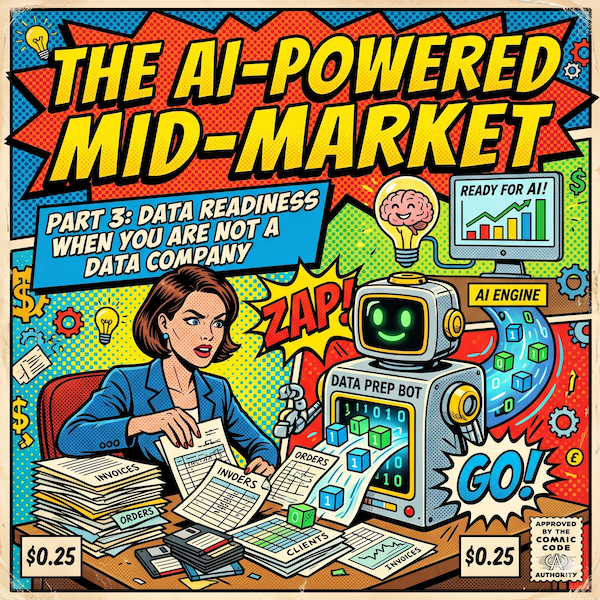
The AI-Powered Mid-Market, Part 3: Data Readiness When You Are Not a Data Company
Data readiness is the most common reason AI initiatives fail at any scale, with 85 percent of failed projects citing poor data quality as a root cause. But mid-market organizations often have a data advantage they do not recognize. This third article in "The AI-Powered Mid-Market" series makes the counterintuitive case that SaaS-first environments are frequently cleaner and more accessible than the sprawling data landscapes enterprises spend years trying to untangle. The article introduces the "good enough" threshold, arguing that different AI use cases have different data requirements and that quick-win applications often need surprisingly modest data. It covers how your existing SaaS stack is your data layer (with embedded AI features from Salesforce, HubSpot, and Microsoft already using the data in place), how iPaaS tools make mid-market integration more manageable than it appears, and why institutional knowledge captured from experienced employees may be the most valuable and most at-risk data your organization possesses. It closes with three common data traps that catch mid-market organizations: the perfection trap, the boil-the-ocean trap, and the shadow data trap.
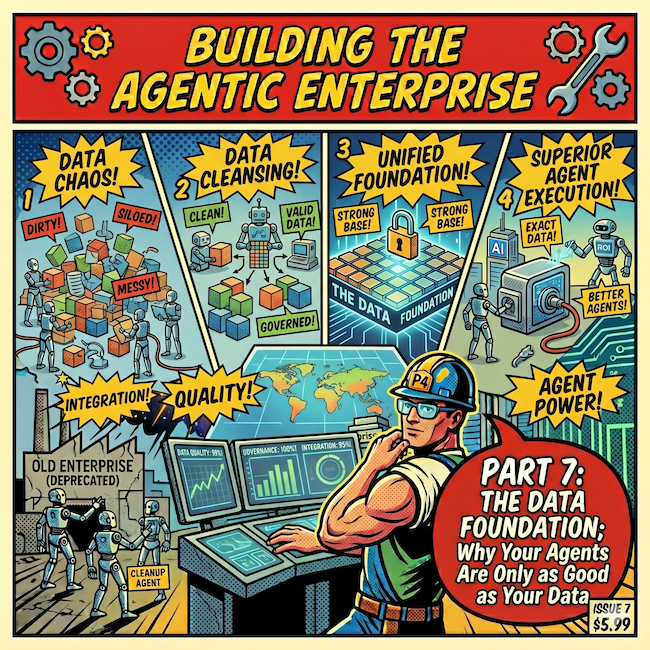
Building the Agentic Enterprise, Part 7: The Data Foundation; Why Your Agents Are Only as Good as Your Data
Agents are only as good as the data they can access and reason over, and for most organizations, the data is not ready. In Part 7 of the Building the Agentic Enterprise series, we confront the most common and most underestimated barrier to agentic AI deployment: data readiness. Only seven percent of enterprises consider their data completely ready for AI, and data quality as a reported barrier nearly doubled over the course of 2025 as organizations moved from simple experiments to multi-agent workflows. We break data readiness into five interconnected dimensions -- quality, accessibility, architecture, knowledge management, and context management -- and explore why agents amplify data problems that human-mediated processes have long papered over. The article also covers data governance for agentic access, the real-time versus batch data freshness decision, and practical guidance for assessing where your data foundation stands today.
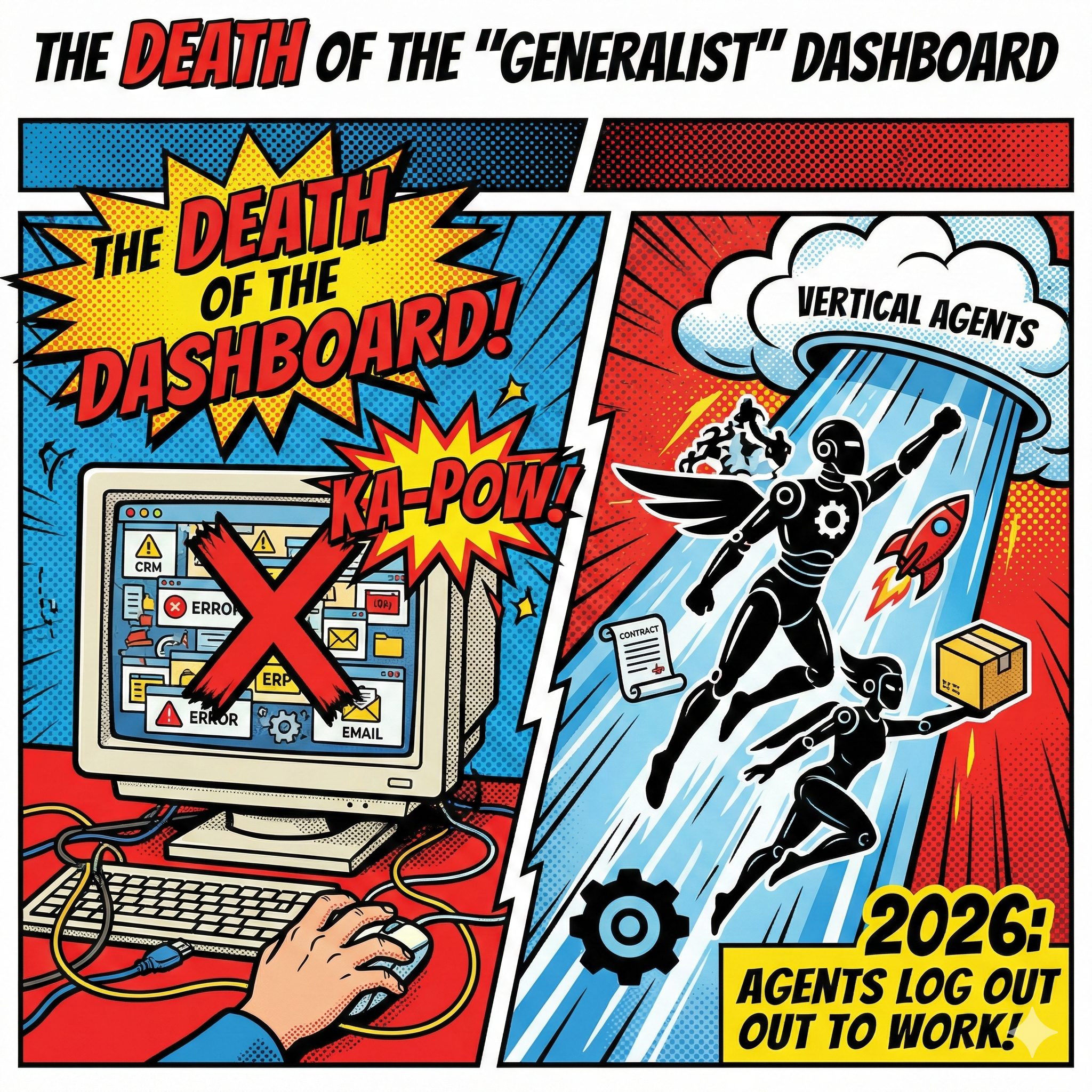
The Death of the "Generalist" Dashboard: Why 2026 Belongs to Vertical Agentic Workflows
We are witnessing a pivot in enterprise computing that will reshape how organizations operate. The application layer, as we've known it, is evaporating. We are moving from a world where humans log in to work, to a world where agents log out to execute. The dashboard is no longer a destination. It is a legacy artifact.

Measuring Success: KPIs for Agentic AI in Data Quality Management
Agentic AI systems now monitor, correct, and negotiate data integrity across enterprise systems. They operate semi-autonomously, making decisions that once required human judgment. But here's the challenge: how do we know they're actually performing well? Success in this new paradigm isn't just about accuracy. It's about trust, speed, resilience, and measurable business impact.

The Impact of Bad Data on Modern AI Projects (and How to Fix It)
The enterprise AI conversation has been dominated by models. Which LLM should we license? Should we fine-tune or use RAG? What about open-source versus proprietary? These are the wrong questions to start with.
The AI boom is exposing a truth that data teams have known for years: most organizations are building on a foundation of poor-quality data. Decades of neglected data strategy are now coming due. The models are powerful, but they're only as reliable as what they're trained on and what they retrieve.

Synthetic Sensors and Surrogate Data: How Agentic AI Fills Gaps and Fights Fraudulent IoT Streams
What happens when your sensors lie, or simply go silent?
In our hyper-connected world, IoT systems power our most critical infrastructure. Smart factories run around the clock. Energy grids balance supply and demand in real time. Logistics networks track millions of shipments across continents. All of this depends on one thing: continuous, trustworthy data streams flowing from thousands of sensors.
The traditional answer has been redundancy and maintenance. Add more sensors. Check them more often. But there's another way, one that doesn't just patch the problem but reimagines how we think about sensing itself. Agentic AI offers a path beyond physical sensors, using intelligence and inference to synthesize and validate the data we need.

The Pillars of Data Quality: What Every Agentic AI System Needs to Succeed
The enterprise agentic AI revolution is here, but there's a catch. While organizations rush to deploy autonomous agents capable of making complex decisions without human oversight, many are building these sophisticated systems on shaky ground. The critical foundation that determines whether agentic AI succeeds or fails isn't the algorithm sophistication or computational power. It's data quality.
Why Trust in Data Matters: Building Business Confidence with Reliable AI
In boardrooms across industries, executives are grappling with a modern paradox. AI promises enhanced business insights and competitive advantages, yet its power hinges entirely on something most leaders rarely see: the quality of data flowing through their systems. As artificial intelligence becomes the backbone of strategic decision-making, the old adage "garbage in, garbage out" has never carried higher stakes. This isn't merely a technical concern relegated to IT departments. Trust in data has become a critical business confidence driver, determining whether organizations can harness AI's potential or fall victim to its blind spots.
How Agentic AI Agents Automate and Elevate Data Cleansing
Every business sits on a goldmine of data, but too often, that gold is buried under layers of inaccuracies, duplicates, and incomplete records. Data quality issues plague organizations across industries: customer records with missing email addresses, financial transactions with inconsistent formats, inventory systems showing phantom stock levels, and analytics dashboards built on unreliable information. But what if data cleansing could shift from a manual, reactive scramble to an automated, proactive discipline? Agentic AI agents can facilitate this transformation, turning data quality from a persistent headache into a strategic advantage.