
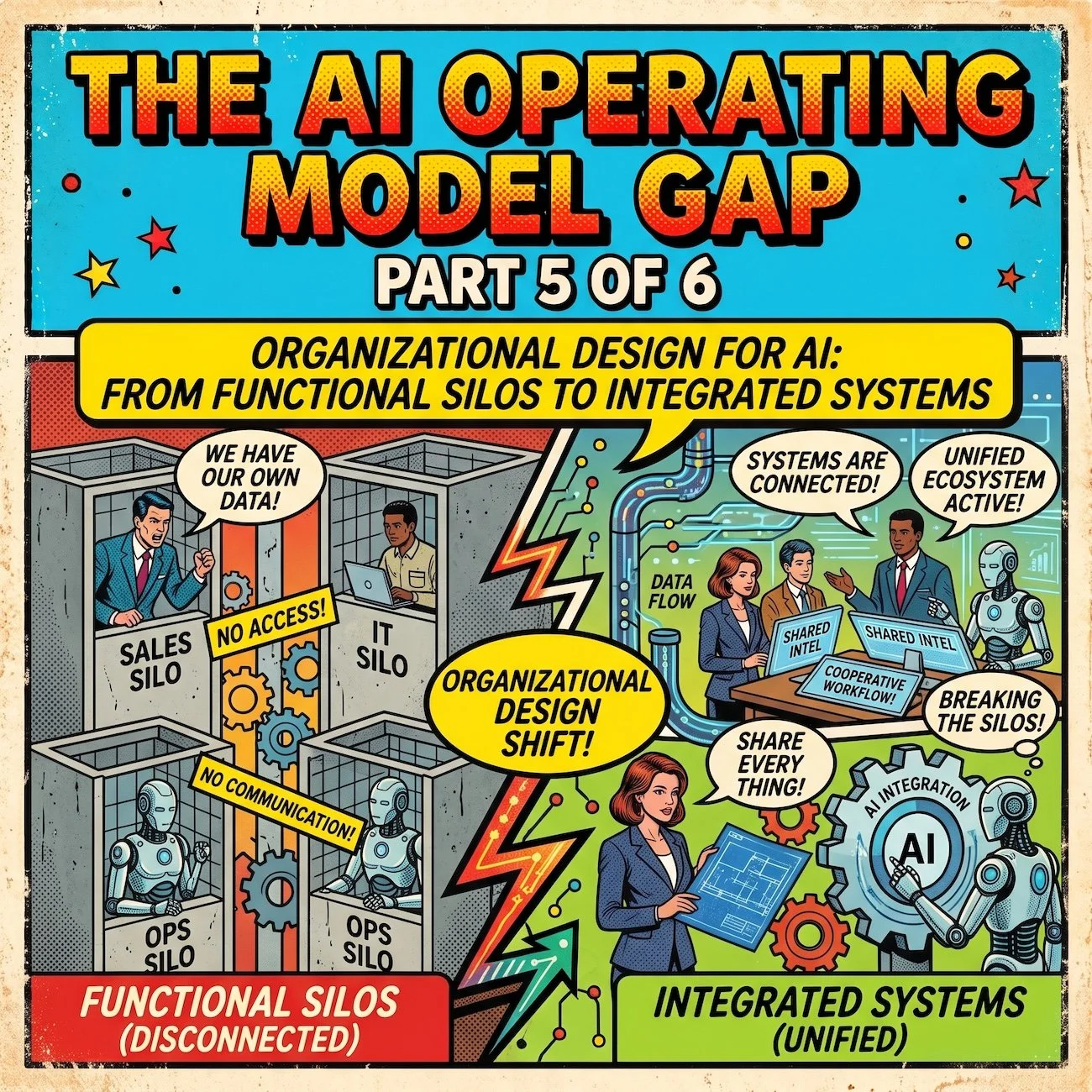
Organizational Design for AI: From Functional Silos to Integrated Systems
The traditional functional organization is structurally incompatible with how AI creates value. Roughly three-quarters of generative AI's economic potential concentrates in cross-functional areas, yet the average enterprise runs 12 or more agents with half operating in isolated silos. This article, the fifth in a six-part series on the AI operating model gap, examines why functional boundaries block AI value, how the AI Center of Excellence must evolve from a centralized team to a hub-and-spoke enablement function, the three organizational models for scaling AI (centralized, federated, and hub-and-spoke), and why data architecture and governance must be redesigned as organizational infrastructure rather than applied as compliance overlays. Drawing on PwC, Salesforce, Deloitte, Celonis, and HBR research, the article argues that organizational design is the structural dimension of the operating model that determines whether AI investments deliver point solutions or enterprise-wide competitive advantage.