The Industrial AI Platform War Just Got Its Biggest Move
Schneider Electric's $22.6 billion bid for PTC is not just an acquisition. It is a declaration about who will control the data layer for physical industries.
On October 5, 2026, Schneider Electric announced an all-cash offer to acquire PTC for $22.6 billion, at $205 per share, a 42.3% premium over PTC's prior close. Four months earlier, Schneider closed its $3.1 billion acquisition of Cognite, the industrial AI data platform company. Combined with its existing ownership of AVEVA, these three moves add up to more than $35 billion in industrial software over the past several years.
The size of the bet matters. But the strategic logic matters more: Schneider is assembling a full-stack industrial AI platform that spans the entire lifecycle of physical assets, from product design through manufacturing, operations, and maintenance. No other industrial company has this combination under one roof. That is the point.
What Schneider Is Building
To understand the PTC deal, you have to see the three pieces together.
AVEVA provides operations technology and energy management software. It is Schneider's existing strength: process simulation, operational data management, and the supervisory layer that runs plants, grids, and buildings. AVEVA brought Schneider deep into the "operate and maintain" side of industrial assets.
Cognite, acquired in June 2026, provides the industrial AI data foundation. Cognite's platform builds a knowledge graph that contextualizes operational data, connects it across siloed systems, and makes it available for AI applications. This is the middleware layer: it takes the messy reality of industrial data (historian tags, sensor streams, maintenance logs, process data scattered across dozens of systems) and turns it into something AI models can reason over.
PTC brings the "design and build" side. Its Creo CAD platform and Windchill PLM system are standard tools for product engineering across aerospace, automotive, industrial equipment, and medical devices. PTC also brings ThingWorx for IoT and ServiceMax for field service management.
The combined stack creates what Schneider is calling a "digital thread": an unbroken data chain from how a product is designed, through how it is manufactured, to how it operates in the field and how it is maintained over its lifetime. Each piece is valuable alone. Together, they create a data architecture that no single competitor currently matches.
Post-acquisition, software and services will account for roughly 24 percent of Schneider's group revenue, up from the mid-teens. Schneider projects €250 million in cost synergies by Year 3 and approximately €800 million in revenue synergies as cross-selling and platform integration take hold. PTC itself generated roughly €2.4 billion in revenue with margins near 40 percent and is expected to grow at about 10 percent annually through 2029.
The Competitive Landscape
Schneider is not the only industrial conglomerate assembling an AI-enabled software stack. The question is how these stacks compare and where the strategic gaps remain.
Siemens is the closest competitor in ambition. Its Xcelerator platform combines Teamcenter (PLM), Simcenter (simulation), MindSphere (IoT), and a growing portfolio of digital twin capabilities. Siemens has also partnered with NVIDIA to bring GPU-accelerated simulation and the Omniverse platform into its industrial digital twin workflows. Siemens has strong coverage on the design-to-simulate axis, but its operational technology footprint is narrower than Schneider's, particularly in energy and process industries.
Rockwell Automation has deepened its partnership with Microsoft, integrating its FactoryTalk suite with Azure AI and cloud services. Rockwell's strength is discrete manufacturing and factory automation, but it lacks the breadth of PLM, energy management, and process industry coverage that Schneider is assembling.
Honeywell offers Forge, its enterprise performance management and analytics platform, plus a substantial process control business. Honeywell has strong positions in refining, petrochemicals, and building automation, but has not made the kind of large-scale software acquisitions that would create a comparable end-to-end platform.
ABB has Ability, its digital platform, and a strong position in electrification and robotics. ABB's approach has been more organic and partnership-driven than acquisitive, which means a lighter software stack but also fewer integration challenges.
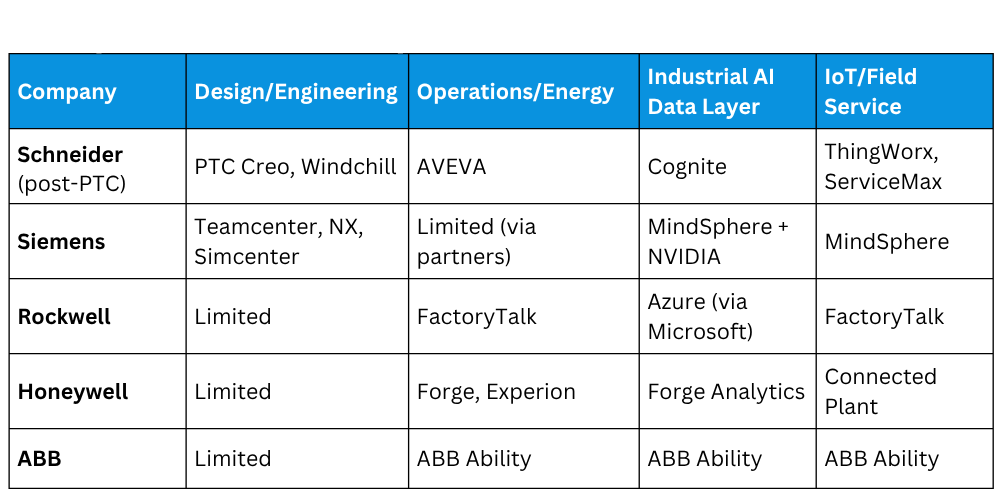
The table tells a clear story. Before the PTC acquisition, each player had strength in one or two columns. After it, Schneider has credible coverage across all four. That is the competitive bet: owning the full data lifecycle, not just a piece of it.
Why This Is a Platform War, Not Just an Acquisition
The deeper significance here is about where value is migrating in industrial markets. For decades, value in industrial companies lived in hardware: turbines, drives, switchgear, PLCs, robots. Software was a supporting function. The concept behind Schneider's $35 billion in software acquisitions is that value is shifting to the data and intelligence layer, and the company that controls the data architecture for physical assets will have durable competitive advantages that hardware alone can’t provide.
This is the same pattern that played out in enterprise IT. The companies that controlled the data layer (the ERP system, the CRM database, the cloud platform) captured disproportionate value relative to the hardware vendors. Schneider is betting that industrial markets are entering the same transition, and that the "industrial AI platform" will be as strategically important to energy and manufacturing companies as the enterprise software stack has been to knowledge-work companies.
The industrial context makes this harder. Industrial data is messier, more heterogeneous, and more physically distributed than enterprise IT data. Operational technology environments have 20-year equipment lifecycles, proprietary protocols, and safety requirements that make integration genuinely difficult. This is precisely why Cognite's industrial data fabric sits at the center of the strategy: it is the translation layer that makes the full-stack offering viable.
What Energy and Industrial Buyers Should Watch
For enterprise buyers in energy, manufacturing, and infrastructure, the consolidation trend raises practical questions.
First, vendor lock-in risk increases as these stacks become more integrated. The value proposition of a unified design-to-operate platform is real, but so is the switching cost once you are inside it. Buyers should be mapping their current dependencies and assessing where interoperability standards (like the OPC-UA standard for industrial data, or emerging digital thread standards) provide portability.
Second, the competitive dynamics will pressure the other players to respond. Expect Siemens to deepen its NVIDIA partnership and potentially make its own acquisitions on the operations side. Expect Rockwell and Honeywell to lean harder into their cloud and AI partnerships. The next 12 to 18 months will be active.
Third, the "digital thread" concept is moving from aspiration to compliance requirement. Regulatory bodies in aerospace, energy, and pharmaceuticals are increasingly requiring traceability from design through operations. The companies that already have this data architecture in place will have a structural advantage in regulated industries.
The Unresolved Question
Schneider now has the pieces. Whether it can integrate them into a coherent, interoperable platform that industrial customers will adopt is the open question. AVEVA's integration has been underway for years and is still in progress. Cognite is months old within the portfolio. PTC, if the deal closes as expected in the second half of 2027, adds another massive integration challenge.
The history of large-scale industrial software consolidation is mixed. The technical pieces fitting together on a strategy slide is necessary but not sufficient. The real test is whether the combined platform delivers value that customers cannot get from best-of-breed alternatives or from the cloud hyperscalers that are increasingly reaching into industrial AI.
Schneider has made the boldest move in the industrial AI platform war. Now it has to execute.
Arion Research advises enterprise leaders on AI strategy and the shift to a digital workforce.