Part 7 of the series "The Agent Coordination Gap"
A Practical Roadmap for Enterprises Moving from Agent Islands to Coordinated Agent Systems
The Plumbing Arrived. The Coordination Did Not.
Measured by announcements, the last twelve months solved the agent coordination problem. A2A shipped its first stable specification, v1.0, in March 2026 and now sits inside the Linux Foundation's Agentic AI Foundation (AAIF), with more than 150 supporting organizations. MCP moved to a stateless request and response model in its July 2026 specification and made enterprise-managed authorization a formal extension. AAIF itself passed 305 members in October, less than a year after it launched. And every major platform vendor now ships an agent registry: Microsoft Agent 365, the AWS Agent Registry, the agent registry in Google's Gemini Enterprise Agent Platform, MuleSoft Agent Fabric, and ServiceNow's AI Control Tower.
Measured by how enterprises operate, very little has changed. Microsoft's own 2026 Work Trend Index found that only 26 percent of respondents say agent workflows, human handoffs, and quality standards are documented and repeatable in their organizations. The same report says the number of active agents in the Microsoft 365 ecosystem grew 15 times year over year. Agent populations are compounding. The discipline to coordinate them is not.
The first six articles in this series traced why. Part 1 described the islands of automation that the first wave of agentic AI produced. Part 2 showed that MCP and A2A are connectivity, and that connectivity is a prerequisite for coordination, not a substitute for it. Part 3 mapped the five functions of the Agent Service Bus and found Conflict Arbitration to be the widest gap. Part 4 argued that arbitration is an organizational design problem. Part 5 showed that governance designed per agent fails when the risk is per chain. Part 6 explained why no platform vendor has a commercial reason to close the gap for you.
Put those findings together and the conclusion is uncomfortable. The coordination gap will not close on its own, and it will not close by purchase. It closes when an enterprise builds a coordination capability: a deliberate, funded program that spans technology, organization, and governance, with an owner, milestones, and a business case. This article lays out that program.
What a Coordination Capability Is
A coordination capability is the enterprise's ability to make agents running on different platforms work toward shared business outcomes under enterprise-owned authority, policy, and audit. Three strands make it up, and the weakest one sets the ceiling for the other two.
Technology. The protocols, gateways, registries, identity services, and observability that let agents find each other, exchange work, and leave a traceable record. This is where the Agent Service Bus functions live: Capability Discovery, Intent Resolution, Contract Negotiation, Conflict Arbitration, and Routing and Orchestration.
Organization. The people who own coordination, the decision authority frameworks that say which agent prevails, and the business process owners who write the priority rules. Part 4 made the case that these rules are business decisions. Someone has to be accountable for making them.
Governance. The multi-agent policies, chain-level controls, audit trails, and escalation paths that Part 5 described as the five-component governance architecture: an enterprise agent registry, coordination-layer policy enforcement, cross-platform audit integration, proportional governance extended to agent relationships, and a cross-functional governance board with real authority.
This maps directly to the six elements of the AI-native operating model from Part 6 of the Operating Model Gap series. Coordination is where Explicit Decision Rights, Cross-Functional Organizational Design, and Embedded Proportional Governance meet a multi-vendor agent estate. The same warning applies: the weakest element constrains the value of all the others. An enterprise with an excellent gateway and no priority rules has built a faster way to propagate conflicts.
A Coordination Maturity Model
The Arion Research Dual Maturity Framework assesses two dimensions: Organizational AI Maturity (Level 0, No Capabilities, through Level 4, Strategic) and Agentic AI Capability (Level 1, Assistive, through Level 5, Full Agency). Its central rule is alignment: do not deploy Level 3 agentic capability until the organization has built Level 3 maturity.
Multi-agent estates expose a gap the two axes do not capture on their own. An organization can run individual agents at Conditional Autonomy and still have no ability to govern what happens when those agents interact across platforms. Coordination maturity is the bridge between the two lenses. It measures whether the organization can sustain autonomous agents not one at a time, but together. The five coordination levels below are aligned to the organizational levels so they can be assessed in the same exercise.
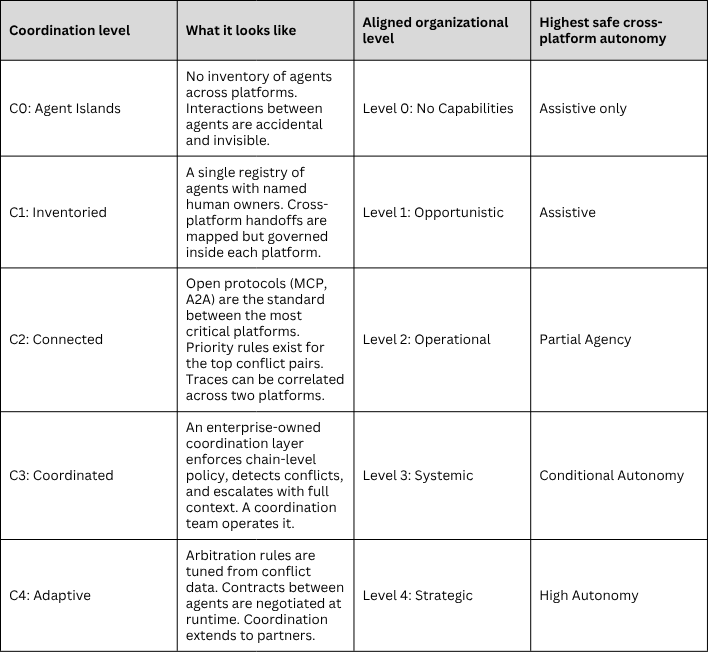
Five Coordination Levels
The alignment rule extends naturally. An agent chain that crosses platforms should not run at an autonomy level above what the coordination level supports, even if each agent in the chain is individually rated higher. A pricing agent rated at Conditional Autonomy inside its own platform drops to Partial Agency when it hands work to an agent on another platform and the enterprise is at C2. The chain is only as autonomous as the coordination underneath it.
Most enterprises that read this series will place themselves at C1 or below. That is the honest starting point, and the roadmap later in this article is built from it.
The Technology Stack: Buy Execution, Assemble the Plumbing, Build the Authority
Build versus buy is the wrong frame for the coordination stack, because the answer differs by layer. The market now offers credible products for most of the plumbing. It offers nothing that an enterprise should trust as the owner of its cross-platform decision authority. The practical answer is a layered one.
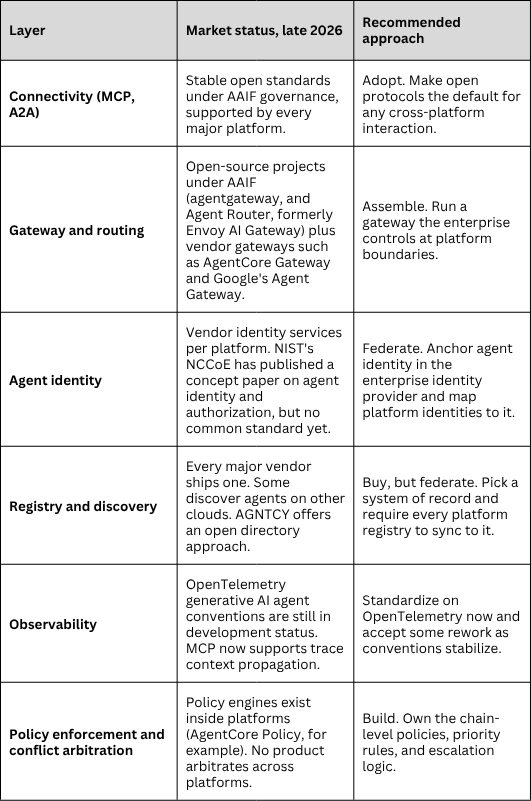
The Tech Stack
The pattern follows from Part 6. Vendors are open at the protocol layer and closed at the governance layer. So the enterprise should take full advantage of the openness and keep ownership of the layer that is closed. In Agent Service Bus terms, Capability Discovery and much of Routing and Orchestration can lean on purchased infrastructure. Intent Resolution and Contract Negotiation can start as static configuration in the gateway and registry. Conflict Arbitration, and the policy enforcement that surrounds it, is the part the enterprise builds.
Building that layer does not mean building a platform. In most organizations it starts as a policy service, a rules repository maintained by business owners, a correlation job across platform traces, and an escalation workflow, often running on infrastructure the enterprise already operates. The build is mostly rules and process. The code is the smaller part.
One more consideration belongs in every build or buy decision: coordination is not free at runtime. Anthropic reported in 2025 that its multi-agent research system used about 15 times more tokens than chat interactions. Coordination designs that route every interaction through multiple model calls will carry that overhead, and the business case has to account for it.
The Organization: Who Owns Coordination
Part 3 cited survey data showing that only 7.2 percent of enterprises have a named person formally accountable for agent behavior. Coordination has even less ownership, because it sits between the platforms each team owns. The first organizational decision is simply to assign it.
The hub-and-spoke model from the Operating Model Gap series is the right home. The hub owns the coordination layer, the registry of record, the protocol standards, and cross-platform policy. The spokes own their agents, their workflows, and the business priority rules for the conflicts their processes create. A coordination function in the hub, call it a Coordination Office, does not need to be large. It needs five capabilities:
Coordination architect. Owns the reference architecture, the build and buy decisions by layer, and the mapping of the agent estate to the Agent Service Bus functions.
Agent registry and operations lead. Runs the registry of record, onboarding and retirement of agents, and the cross-platform traces. This is where AgentOps skills concentrate.
Protocol and integration engineers. Implement MCP and A2A connections, the gateway, and identity federation.
Policy and arbitration analyst. Works with business process owners to turn priority rules into enforceable policy and reviews every escalated conflict for patterns.
Coordination risk partner. A named member of the risk or compliance team who owns chain-level controls and audit evidence.
Arion Research's planning assumption is that a large enterprise with agents on four or more platforms needs six to ten people across these roles in the first year, several of them redeployed from integration, identity, and risk teams rather than newly hired. That is a planning range, not a benchmark, and it should be tested against the size of the agent estate. The skills are adjacent to ones enterprises already have. Integration architects, identity engineers, and process owners are the talent pool. Microsoft's 2025 Work Trend Index reported that 78 percent of leaders were considering hiring for new AI roles, with 30 percent considering an AI agent specialist, which suggests the competition for outside talent will be stiff.
Operating examples are starting to appear. BNY has described nearly 140 digital employees, each with credentials, an employee number, and a human supervisor who assigns tasks and reviews output. Walmart consolidated its agent efforts into four "super agents" after concluding that many individually useful agents could become overwhelming and confusing. Neither is a cross-platform coordination case, but both show organizations treating agent populations as something to be managed, not just deployed.
Decision authority sits above the Coordination Office. The cross-functional governance board from Part 5, with veto power, should formally own the three-tier decision authority model as it applies across platforms: which cross-platform interactions are Tier 1 and automated, which are Tier 2 and escalate to a human with context from both sides, and which are Tier 3 and stay with people. And the CEO mandate from the Operating Model Gap series applies here as well. Coordination cuts across every function's agents. Only an executive with authority across functions can make the priority rules stick.
The Governance Clock
Part 5 covered multi-agent governance architecture in depth, so the roadmap here focuses on timing. Three external dates should shape the program.
The EU AI Act, as amended by the Digital Omnibus regulation that entered into force in July 2026, now applies its rules for stand-alone high-risk systems listed in Annex III from December 2, 2027. Any agent chain that touches a high-risk use, such as employment decisions or creditworthiness, will need the logging and human oversight evidence that only a coordination layer can produce across platforms. For an enterprise starting now, that date lands roughly at month 13 of a 24-month roadmap.
In the United States, NIST's Center for AI Standards and Innovation launched the AI Agent Standards Initiative in February 2026, with agent identity, security, and interoperability as core tracks. It has not produced final guidance, but its direction is clear enough to design toward. And ISO/IEC 42001 gives organizations a certifiable AI management system standard that can anchor coordination policies in an auditable framework.
None of these instruments tells an enterprise how to arbitrate between a sales agent and a supply chain agent. All of them assume the enterprise can show who authorized what, which system acted, and how a human could intervene. In a multi-vendor estate, that evidence only exists if someone builds it.
The Roadmap: 12 and 24 Months
The earlier Building the Agentic Enterprise series laid out a 36-month enterprise program in three phases: Foundation, Expansion, and Transformation. The coordination capability runs inside that program, mostly during Expansion, when the agent estate crosses platform boundaries in earnest. The roadmap below starts from C1 or below and targets C2 at 12 months and C3 at 24 months.
Phase 1: Baseline and Ownership (days 0 to 90). Name the coordination owner and charter the Coordination Office. Inventory every agent across every platform into a single registry with a human owner for each. Assess coordination maturity alongside the two Dual Maturity dimensions. Identify the ten cross-platform agent chains with the highest business impact and the five conflict pairs most likely to cause harm. Have the governance board approve priority rules for those five pairs. The milestone is simple: the enterprise knows what it has, who owns it, and which interactions matter most.
Phase 2: Connect and Govern (months 4 to 12). Make MCP and A2A the required standard for new cross-platform integrations. Designate the registry of record and sync platform registries to it. Federate agent identity to the enterprise identity provider for the two most critical platforms. Deploy an enterprise-controlled gateway at that boundary and standardize traces on OpenTelemetry. Run the bilateral coordination pilot from the Part 6 playbook, with chain-level policies and a Tier 2 escalation path. Begin logging every detected conflict.
The 12-month milestones define C2: every agent registered with an owner; the two most critical platforms coordinated under enterprise policy; cross-platform traces that can reconstruct any agent chain between them; priority rules in force for the top conflict pairs; and a baseline for conflict frequency and resolution time.
Phase 3: Coordinate at Scale (months 13 to 24). Extend the coordination layer to every platform that hosts production agents. Move from pairwise priority rules to chain-level policies, such as the Part 5 example that no chain of agents may collectively commit more than a set amount without human review. Automate Tier 1 arbitration through the policy service and route Tier 2 conflicts to people with context from every platform involved. Produce audit evidence for high-risk chains ahead of the December 2027 EU date. Set coordination service levels and report them to the governance board quarterly.
The 24-month milestones define C3: chain-level policy enforced across all production platforms; conflict detection and escalation operating across platforms; audit evidence available for any cross-platform chain on request; cross-platform autonomy raised to Conditional Autonomy only for chains that meet the coordination standard; and a measured reduction in conflicts and manual reconciliation against the Phase 2 baseline.
Two cautions. First, the timeline assumes Level 2 organizational maturity at the start. Organizations at Level 0 or 1 should spend the first year on Phase 1 and on the organizational foundations, not on gateways. Second, the roadmap deliberately leaves C4 out of the 24-month window. Runtime contract negotiation and coordination with partners depend on standards that do not exist yet.
The Economics: Coordination Versus Continued Fragmentation
No public, primary-source study yet compares the return on a coordination capability with the cost of leaving agent estates fragmented. Enterprises will have to build the business case from their own data. The Arion Research model below is a structure for doing that, not a benchmark.
Start with the cost of fragmentation, the coordination tax from Part 1, expressed in measurable terms:
Conflict cost. The number of cross-platform conflicts per quarter multiplied by the average cost to detect and resolve each one, including customer remediation.
Duplication cost. Spend on agents in different platforms that perform overlapping work.
Reconciliation cost. Staff hours spent manually checking and correcting work that agents hand across platforms.
Governance overhead. The cost of maintaining separate policy, audit, and compliance processes on each platform.
Autonomy ceiling. The value of automation forgone because cross-platform chains have to stay at low autonomy to avoid conflicts.
Then the cost of the capability: the Coordination Office, gateway and registry tooling, integration and identity work, and the runtime overhead of coordinated agent interactions. Net coordination value is the reduction in the first list, minus the second.
Two pieces of research suggest which way the numbers tend to fall. The MAST study of multi-agent system failures (Cemri and colleagues, 2025) found failure rates between 41 and 86.7 percent across seven open-source multi-agent systems, with inter-agent misalignment as one of three main failure categories. And research from Google and collaborators on scaling agent systems found that independent agents amplified errors by 17.2 times, while centralized systems with an orchestrator contained that amplification to 4.4 times. Both are laboratory findings, not enterprise ROI data. Both point the same way: uncoordinated agents fail more and compound their errors, and coordination is what contains them.
The largest item is usually the autonomy ceiling. Part 4 noted that the dominant production pattern is bounded autonomous action, keeping agents narrow enough that conflicts are unlikely. That caps value. The strongest argument for the coordination capability is not cost avoidance. It is that coordination is the precondition for raising autonomy across platforms safely, which is where most of the value of an agent estate sits. Measure cost per business outcome, not cost per token, and the case usually becomes clear within the first two phases.
Adapting the Roadmap for the Mid-Market
The AI-Powered Mid-Market series argued for buying first, distributing AI literacy instead of concentrating expertise, and governance that fits the size of the organization. All three apply to coordination.
A mid-market company with agents on two or three platforms does not need a Coordination Office. It needs a named coordination owner, often the AI coordinator or fractional chief AI officer the mid-market series recommended, with a few hours a week of support from the AI champions in each function. It should lean on the coordination features of its dominant platform for routing and observability, while keeping three things under its own control: the registry of record, the one-page priority rules for its top conflict pairs, and the right to require MCP and A2A support in every new agent contract.
The timeline compresses as well. A realistic mid-market target is C1 in 90 days and C2 in 12 months, with C3 reserved for companies whose agent chains touch customers, money, or regulated decisions across platforms. The mid-market advice on multi-agent workflows still holds: master single agents first, then add handoffs where they occur naturally. Minimum viable coordination is better than none, and far better than an architecture the organization cannot staff.
What Comes Next
The argument across seven parts of this series has been consistent: agents from different vendors will not coordinate themselves, protocols will not coordinate them, and platform vendors will not coordinate them in the enterprise's interest. The enterprise has to build the capability, and it has to own the layer where authority lives. How the vendors' competing control planes settle is a separate question, and the Enterprise AI Vendor Landscape series takes it up in its synthesis article as the build, buy, or partner decision for the coordination layer.
Everything in this roadmap assumes that the enterprise controls both ends of every agent interaction. The next article in this series drops that assumption. When a buyer's procurement agent negotiates with a supplier's sales agent, or a logistics agent books capacity with a carrier's agent, there is no shared registry, no common governance board, and no coordination layer that spans both companies. Part 8 examines inter-enterprise coordination: how agents from different organizations establish trust, make commitments that bind their companies, and resolve disputes when those commitments collide. It is also the question that decides whether any enterprise can reach C4, the top level of the coordination maturity model.
Strategy Playbook
1. Coordination Maturity Assessment. Score your organization on all three lenses in one exercise: Organizational AI Maturity (0 to 4), Agentic AI Capability (1 to 5) for your most autonomous agents, and coordination maturity (C0 to C4). Then list every cross-platform agent chain in production and compare its effective autonomy with the coordination level beneath it. Any chain running above what the coordination level supports is a priority risk. Repeat the assessment every quarter during the roadmap.
2. Stand Up the Coordination Function. Name one accountable owner for cross-platform coordination within 30 days. Charter a Coordination Office in the hub of a hub-and-spoke model, staffed first from integration, identity, and risk teams. Give the cross-functional governance board formal ownership of cross-platform decision authority, and require each business process owner to approve the priority rules for conflicts their processes create.
3. Layer-by-Layer Build, Buy, and Assemble Decision. For each layer of the coordination stack (connectivity, gateway, identity, registry, observability, policy and arbitration), document what you will buy, what you will assemble from open-source projects, and what you will build. Default to adopting open protocols, assembling gateways you control, federating identity, buying registries that sync to a system of record, and building policy enforcement and arbitration. Revisit the decisions every six months, because this market is moving quickly.
4. Coordination Business Case. Establish a 90-day baseline for the coordination tax: cross-platform conflicts and their resolution cost, duplicated agent spend, manual reconciliation hours, and redundant governance effort. Estimate the value of the autonomy ceiling for your highest-impact chains. Set the 12-month and 24-month targets against that baseline, track the cost of the capability including runtime overhead, and report net coordination value to the governance board quarterly.
Arion Research advises enterprise leaders on AI strategy and the shift to a digital workforce.